





Best Herbal Supplements for Hormone Balance: No Cure, 2026

Best overall: no herbal supplement is proven to balance all women's hormones. Best for stress-related concerns: ashwagandha warrants a safety review; best for premenstrual symptoms: chasteberry has symptom-specific research. This 2026 guide from Herbalgoodnessco separates those uses from unsupported hormone-balance promises.
- The best herbal supplements for hormone balance depend on your symptoms; no herb provides a universal hormone reset.
- Herbalgoodnessco offers ashwagandha root liquid extract; research on other preparations does not establish this product's effects.
- Chasteberry has research on premenstrual symptoms, not proof that it corrects every hormonal concern.
- Black cohosh, soy isoflavones, and evening primrose oil are not default recommendations for menopausal hot flashes.
Why this matters
Hormone balance is a marketing phrase, not a single clinical outcome. Premenstrual discomfort, disrupted sleep, hot flashes, and irregular periods require different decisions. A supplement studied for stress does not automatically belong in a guide to menstrual regularity.
Choose a specific concern before choosing a plant. If symptoms are new, persistent, or interfering with daily life, get an assessment rather than combining herbs. Unexplained bleeding, missed periods, and ongoing fatigue deserve more than a wellness label.
What makes the best herbal supplements for hormone balance?
The ranking below uses five criteria rather than treating every women's wellness ingredient as interchangeable:
- Symptom match: Human research must address the concern you actually have.
- Preparation match: Plant part, extraction method, and serving information should be clear.
- Evidence quality: Controlled human studies carry more weight than traditional use or laboratory findings.
- Safety fit: Pregnancy, medicines, liver health, and thyroid conditions change the decision.
- Claim restraint: Stress support is not proof of estrogen, progesterone, or thyroid normalization.
Organic labeling describes production practices. It does not establish effectiveness for a hormonal symptom. Likewise, a concentrated extract is not automatically better than a capsule or tea.
Herbal options at a glance
This 2026 comparison ranks ingredients by distinct decision slots, not by a claim that every option improves hormonal health. The limitations are part of the recommendation.
| Option | Best for | Standout distinction | Key limitation |
|---|---|---|---|
| Ashwagandha root liquid extract | Evaluating stress-focused support | Some human research concerns stress and sleep | Results from studied extracts do not establish this liquid's effects |
| Chasteberry | Discussing recurring premenstrual symptoms | Research addresses PMS rather than general wellness | Study quality and preparations vary; interactions require review |
| Black cohosh | Understanding a traditional menopause ingredient | Long history of use for menopausal symptoms | Evidence is inconsistent, with liver-safety concerns |
| Soy isoflavones | Comparing concentrated supplements with food-based choices | Plant compounds studied for menopausal symptoms | Not recommended as a dependable hot-flash supplement |
| Evening primrose oil | Assessing heavily marketed women's wellness claims | A seed oil rather than an herbal root or leaf extract | Evidence does not support a broad hormone-balance verdict |
1. Ashwagandha: best for evaluating stress-focused support
Ashwagandha, Withania somnifera, is a plant used in Ayurvedic traditions. Some modern human studies examine stress and sleep, not a universal correction of female reproductive hormones. Keep those outcomes separate when reading a label.
Herbalgoodnessco lists an organic ashwagandha root liquid extract with stress, energy, and mood positioning. That makes the preparation relevant to a stress-focused discussion. It does not make the product a proven option for irregular periods, fertility concerns, or menopausal hot flashes.
Ashwagandha pros:
- Human studies exist for stress-related outcomes.
- A clearly identified root preparation gives you a specific plant part to evaluate.
- Its research question is more useful than a vague hormone-reset claim.
Ashwagandha cons:
- Study extracts and liquid products are not automatically equivalent.
- Thyroid effects and medicine interactions require attention.
- Rare liver injury has been reported; pregnancy is a reason to avoid use.
Best for: Adults asking a clinician or pharmacist whether stress-focused herbal support fits their circumstances.
Verdict: Hold until safety and preparation details are reviewed. Ashwagandha is not a substitute for assessing persistent fatigue or menstrual changes.
2. Chasteberry: best for a premenstrual-symptom discussion
Chasteberry, Vitex agnus-castus, usually appears as a fruit extract. Its relevant research concerns premenstrual symptoms, including studies of recurring symptom patterns. That is narrower than correcting an unspecified hormone imbalance.
The National Center for Complementary and Integrative Health, or NCCIH, describes research suggesting possible benefit for some PMS symptoms while emphasizing limitations in the evidence. Traditional use and promising studies do not justify promises about conception, cycle regulation, or progesterone levels.
Chasteberry pros:
- Research addresses a recognizable menstrual symptom category.
- A fruit extract is a specific preparation you can compare with study descriptions.
- It offers a more focused research question than multi-herb hormone blends.
Chasteberry cons:
- Study quality and product consistency limit confidence.
- Use alongside hormonal medicines or dopamine-related medicines needs professional review.
- It is not appropriate for self-directed use during pregnancy or breastfeeding.
Best for: A clinician-guided conversation about recurring premenstrual symptoms after other explanations have been considered.
Verdict: Hold for a symptom-specific review. Do not use chasteberry as a general fertility or hormonal-normalization supplement.
3. Black cohosh: best for understanding menopause-label claims
Black cohosh, Actaea racemosa, is a traditional ingredient in products marketed for menopausal symptoms. Supplements commonly use the root and rhizome. Research findings are inconsistent, and different preparations complicate comparisons.
The North American Menopause Society's 2023 nonhormone therapy position statement does not recommend supplements or herbal remedies for vasomotor symptoms, including hot flashes. That published assessment is relevant to a 2026 buying decision; a familiar ingredient name is not enough to override it.
Black cohosh pros:
- It has been studied in humans rather than only in laboratory models.
- Its traditional use and research focus are clearly associated with menopausal symptoms.
- Identifying the exact preparation helps distinguish research from broad advertising.
Black cohosh cons:
- Findings do not support a dependable hot-flash recommendation.
- Liver injury reports require caution, although causation is not always clear.
- Product identity and preparation differences make generalization difficult.
Best for: Readers evaluating whether a menopause supplement's claims match the evidence.
Verdict: Skip as your default hot-flash purchase. Discuss established symptom-management options with a qualified clinician instead.
4. Soy isoflavones: best for separating food from extract claims
Soy isoflavones are plant compounds concentrated in some supplements. They interact with estrogen receptors, but that mechanism does not mean a supplement restores estrogen to an ideal level. A biological mechanism is not a clinical verdict.
Soy foods and concentrated isoflavone supplements also represent different choices. The 2023 menopause position statement does not recommend soy foods, soy extracts, or equol specifically for managing hot flashes. That recommendation concerns symptom management, not whether soy foods can belong in an ordinary diet.
Soy isoflavone pros:
- Human research exists on menopausal symptoms.
- A named compound group gives you something specific to examine on a label.
- Comparing food with extracts discourages treating every soy product as equivalent.
Soy isoflavone cons:
- Effects across studies are not consistent enough for a default recommendation.
- Concentrated supplement use requires review when relevant medicines or medical histories are involved.
- Soy allergy rules out soy-derived choices.
Best for: Readers distinguishing dietary choices from concentrated menopause supplements.
Verdict: Skip as a dependable hot-flash supplement. Do not interpret plant estrogen activity as proof of whole-body hormone balance.
5. Evening primrose oil: best for checking unsupported wellness claims
Evening primrose oil comes from the seeds of Oenothera biennis and contains gamma-linolenic acid, a fatty acid. It appears frequently in women's wellness discussions. Familiarity does not establish effectiveness.
NCCIH reports insufficient evidence to support evening primrose oil for any health condition. Its presence in PMS or menopause marketing therefore does not support a strong hormone-balance recommendation.
Evening primrose oil pros:
- Its plant source and oil preparation are straightforward to identify.
- The fatty-acid content gives you a specific ingredient to evaluate.
- Its evidence limits can be checked against public health guidance.
Evening primrose oil cons:
- Evidence does not justify broad hormone-balance claims.
- Gastrointestinal side effects can occur.
- Medicines and pregnancy-related questions require a safety review.
Best for: Shoppers auditing a familiar ingredient before accepting its marketing claims.
Verdict: Skip for an unspecified hormone-balance goal. A recognizable bottle is not a reason to add another supplement.
What the research actually measures
A useful study names the preparation, participants, duration, and outcome. Without those details, a claim such as supports cortisol tells you little about whether the research fits your situation.
For example, Chandrasekhar and colleagues' 2012 study in the Indian Journal of Psychological Medicine enrolled 64 adults with a history of chronic stress. It evaluated a specific ashwagandha root extract over 60 days, using 300 mg twice daily in the intervention group. These are study details, not dosing instructions for a different product.
That trial cannot establish an effect on women's menstrual regularity or prove that Herbalgoodnessco ashwagandha liquid delivers the same outcome. Different extraction methods, concentrations, and formulations need their own supporting evidence. A stress result also does not prove a hot-flash or fertility result.
The same distinction matters when comparing supplements for perimenopause: evidence about stress or sleep does not establish an effect on hot flashes. Define the symptom before deciding which research applies.
For 2026 decisions, use named public sources rather than testimonials: NCCIH's ingredient summaries, the NIH Office of Dietary Supplements' ashwagandha fact sheet, and the menopause society's published position statement address different parts of the evidence and safety question.
Read the label before choosing a format
A capsule, liquid extract, tea, and seed oil are not interchangeable. Even products made from the same plant can use different plant parts or extraction processes. Read the preparation details before borrowing results from a study.
Use this sequence when reviewing a product:
- Plant identity: Look for the common and botanical names.
- Plant part: Distinguish root, fruit, leaf, and seed oil.
- Preparation: Identify powder, extract, tea, or oil.
- Serving details: Read the actual amount and all additional ingredients.
- Safety review: Check your medicines, pregnancy status, and relevant conditions.
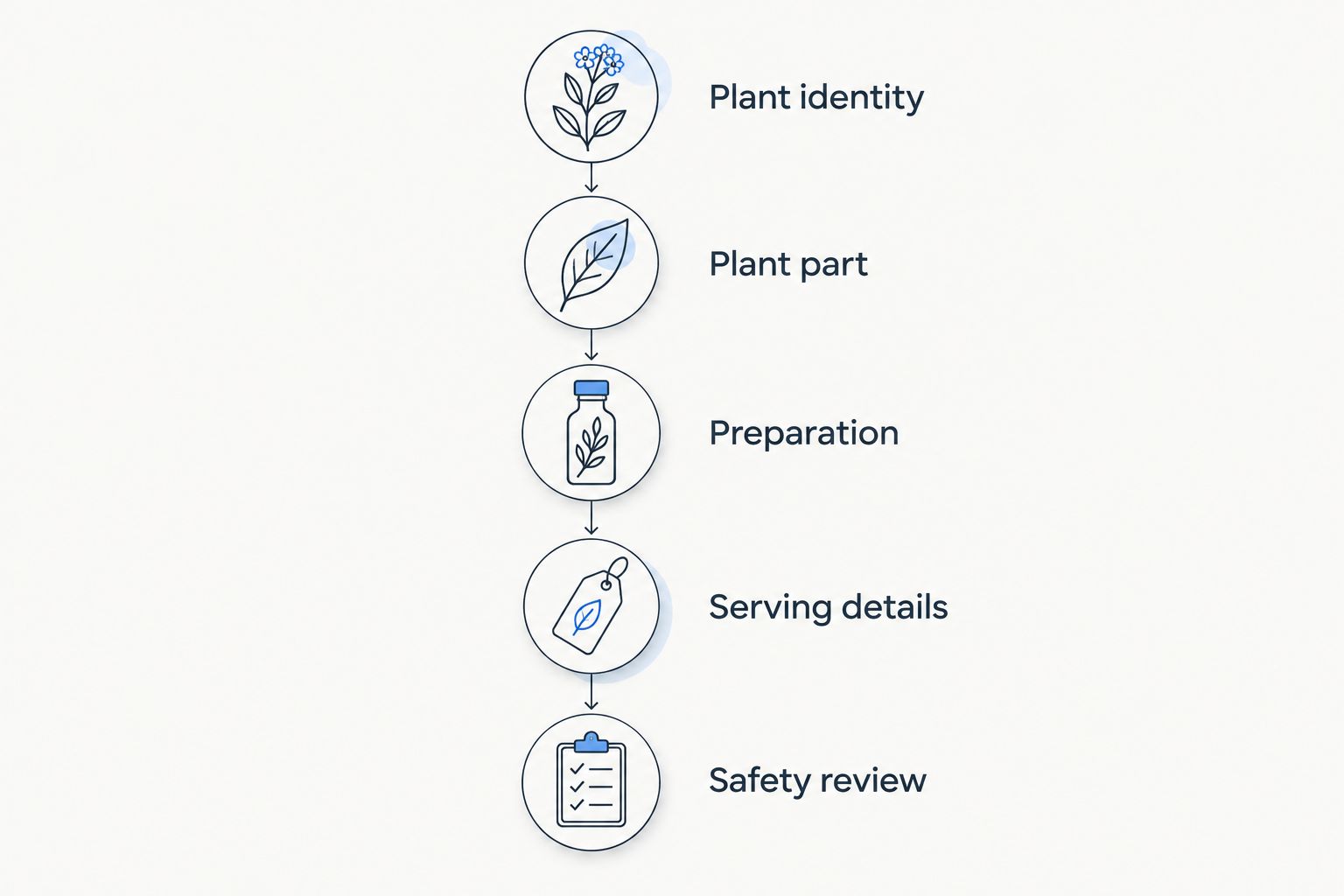
For Herbalgoodnessco herbal supplements, apply the same standard you would use elsewhere: read the actual label, then check whether relevant research used a comparable preparation. An organic claim does not answer the safety or effectiveness question.
Safety comes before a supplement stack
More herbs do not create a more complete hormone plan. Combining ingredients makes it harder to identify which product caused an unwanted effect. It also increases the number of medicine interactions you need to assess.
Ask a clinician or pharmacist before starting these supplements if you are pregnant, breastfeeding, trying to conceive, using hormonal medicines, or managing thyroid or liver concerns. Give them the full ingredient list, not just the front-label name.
For ashwagandha specifically, NIH and NCCIH guidance identifies pregnancy concerns, thyroid considerations, medicine interactions, and reports of liver injury. Stop using a supplement and seek medical advice for concerning symptoms such as jaundice or dark urine.
New bleeding after menopause, very heavy bleeding, or persistent menstrual changes need medical assessment. Do not interpret those symptoms as a signal to increase an herbal serving.
Retailers and health practitioners should maintain this distinction in customer education: describe the plant and preparation, separate traditional use from human evidence, and avoid promising hormonal normalization. Trade-interest readers can ask about the brand's wholesale application without converting a retail wellness claim into clinical advice.
How these options were ranked
The order reflects symptom relevance, preparation clarity, human evidence, and safety—not popularity or concentration claims. Ashwagandha comes first for a stress-focused discussion, while chasteberry occupies the distinct premenstrual-symptom slot.
Black cohosh, soy isoflavones, and evening primrose oil remain in the comparison because readers encounter them in women's wellness marketing. Their inclusion is not an endorsement. The limitations determine the verdict.
Which herbal supplement should you choose?
For an undefined hormone-balance concern, choose an assessment before a supplement. If stress is your specific concern, discuss ashwagandha's evidence and safety. If symptoms recur before menstruation, ask whether the chasteberry research fits your situation.
Herbalgoodnessco herbal supplements belong in a plant-specific conversation, not a promise to reset reproductive hormones. In 2026, the strongest buying decision is still the one tied to a clear symptom, an appropriate preparation, and a personal safety review.
FAQ
What's the best herbal supplement for women's hormone balance?
No herbal supplement is proven to balance all women's hormones. Ashwagandha has research on stress-related outcomes, and chasteberry has research on premenstrual symptoms; neither supports a universal hormone-reset claim.
Is ashwagandha better than chasteberry for women?
Neither is better for every concern. Ashwagandha research focuses on areas such as stress and sleep, while chasteberry research addresses premenstrual symptoms. Choose the research question before choosing the herb.
Does an ashwagandha liquid work like a studied capsule?
A liquid extract cannot be assumed to work like a studied capsule. Plant part, extraction method, concentration, and serving differ, so findings require a preparation-specific comparison.
Can black cohosh reliably help with hot flashes?
Black cohosh is not a dependable default recommendation for hot flashes. Research is inconsistent, and the North American Menopause Society's 2023 position statement does not recommend herbal remedies for vasomotor symptoms.
Does evening primrose oil balance estrogen?
Evidence does not establish evening primrose oil as an estrogen-balancing supplement. NCCIH reports insufficient evidence to support its use for any health condition.
Can I combine several herbs for hormone support?
Do not start a multi-herb combination without reviewing the ingredients and your medicines with a clinician or pharmacist. Combining products complicates interaction checks and makes unwanted effects harder to attribute.
Are organic herbal supplements automatically safer?
Organic labeling does not establish that a supplement is safe for your circumstances. Pregnancy, medicines, plant identity, preparation, and relevant medical conditions still determine suitability.
Should I use herbs for irregular periods or bleeding after menopause?
Seek medical assessment for persistent menstrual changes or bleeding after menopause rather than self-managing with herbs. A supplement does not establish the cause of the symptom and does not replace medical care.
One last thing
A lower stress score is not the same outcome as a more regular menstrual cycle. Keep that distinction beside every supplement label you read: match the evidence to the symptom, not the marketing category.
Related guides
Share this


FAQs
1. What are the main benefits of drinking bamboo leaf tea?
Drinking bamboo leaf tea supports hydration, relaxation, skin wellness, and antioxidant balance.
2. What is bamboo leaf extract used for?
It’s used for general body wellness, skin elasticity, hair and nail support, and overall vitality.
3. Can bamboo leaf help with skin care and body wellness?
Yes, bamboo leaf is rich in silica and antioxidants, which promote healthy skin, strong nails, and a youthful glow.
4. What forms of bamboo leaf are available?
You can find dried bamboo leaf, powder, extract, drops, oil, and bamboo leaf green tea.
5. Are there any side effects of bamboo leaf?
Bamboo leaf is generally safe when consumed in moderation. Always consult your healthcare provider before starting any new herbal supplement.