





Best Black Seed Oil Capsules in 2026: Ranked Guide

Black seed oil capsules promise the same nigella sativa benefits as the liquid oil without the taste, but not every capsule on the shelf earns that promise. The best black seed oil capsules in 2026 standardize thymoquinone content, use cold-pressed oil (not solvent-extracted), and state that on the label — and if capsules aren't your format, Herbal Goodness's cold-pressed liquid Black Seed Oil covers the same ground without the swallowing.
- Best black seed oil capsules in 2026 name their thymoquinone percentage on the label — most don't.
- Cold-pressed, single-ingredient softgels beat blended immune capsules for anyone tracking dose.
- Herbal Goodness Black Seed Oil 8oz is the pick for people who skip capsules and measure by the spoonful instead.
- Vegan capsule shells matter if you avoid gelatin; check the label, don't assume.
- Pairing black seed oil with oil of oregano is a common immune-season stack, not a capsule swap.
Why this matters
Black seed oil (Nigella sativa) has shown up in traditional remedies for more than 2,000 years, including references tied to artifacts from Tutankhamun's tomb, and it's one of the more studied botanical oils on the market today. Thymoquinone is the compound doing most of the work, and it's fat-soluble — meaning how the oil is pressed and stored changes how much of it actually survives into the capsule.
The problem: most black seed oil capsules on store shelves don't list a thymoquinone percentage at all. They list "Nigella sativa seed oil, 500mg" and stop there, which tells you nothing about potency. A capsule without a stated thymoquinone content is a guess, not a supplement decision.
What makes the best black seed oil capsules
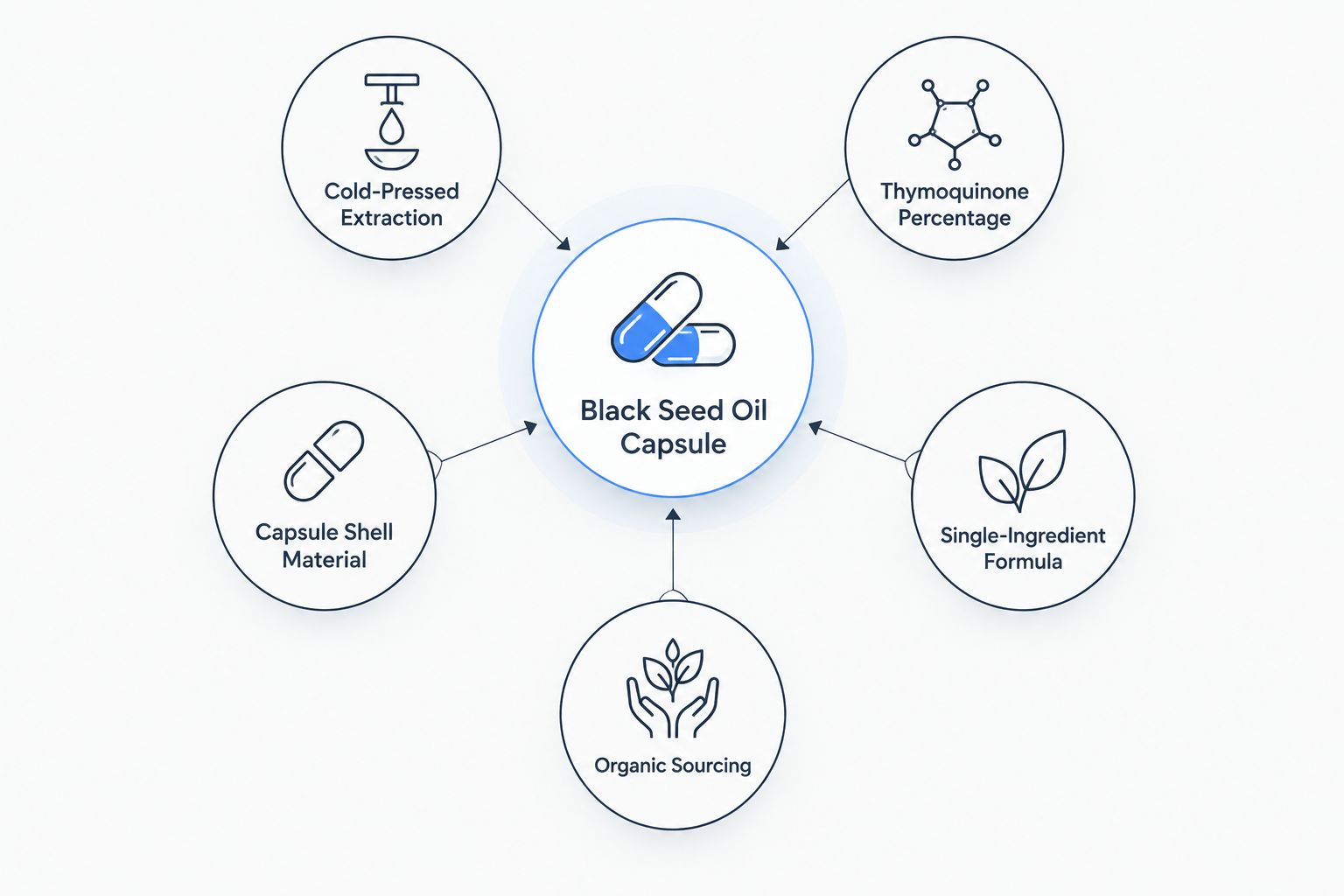
- Cold-pressed extraction — heat-processed or solvent-extracted oil loses thymoquinone; cold-pressing preserves it.
- Stated thymoquinone percentage — the single biggest quality signal on any black seed oil label, capsule or liquid.
- Capsule shell material — gelatin vs. vegan (plant-based) shells matter if you avoid animal-derived ingredients.
- Single-ingredient vs. blended formulas — blends (turmeric, black pepper, etc.) add other actives but dilute the black seed oil dose per serving.
- Organic and non-GMO sourcing — Nigella sativa is a field crop, and pesticide residue is a real concern with unverified sourcing.
- Third-party testing or a traceable source — brands that name their sourcing region or testing process are more accountable than ones that don't.
At a glance
| Format | Best for | Standout feature | Key limitation |
|---|---|---|---|
| Cold-pressed single-ingredient softgel | Purity-first buyers | No fillers, one active ingredient | Harder to find with stated thymoquinone % |
| Thymoquinone-standardized capsule | Potency trackers | Label states actual active compound level | Fewer brands offer this transparency |
| Black seed oil + turmeric capsule | Joint and inflammation support | Two anti-inflammatory actives in one dose | Lower black seed oil dose per capsule |
| Vegan black seed oil capsule | Gelatin-free diets | Plant-based shell | Shell type varies batch to batch — check label every time |
| Herbal Goodness Black Seed Oil 8oz (liquid) | Anyone who skips capsules | Cold-pressed, measurable spoon dose | Requires a spoon and a moment, not a swallow-and-go format |
1. Cold-pressed single-ingredient softgels: best for purity-first buyers
A single-ingredient softgel with nothing but cold-pressed Nigella sativa oil inside is the cleanest option on the shelf, and it's what most people picture when they search for black seed oil capsules. The tradeoff is availability — most mass-market softgels blend in a carrier oil or skip the thymoquinone disclosure entirely.
Single-ingredient softgel pros:
- No added fillers or blended actives diluting the dose
- Easiest format to compare apples-to-apples across brands
- Straightforward for anyone new to black seed oil
Single-ingredient softgel cons:
- Thymoquinone percentage is often missing from the label
- Gelatin shell isn't vegan unless stated otherwise
Verdict: Buy if the label states a thymoquinone percentage. Skip if it only lists total oil weight with no potency marker.
2. Thymoquinone-standardized capsules: best for potency trackers
This is a narrower category than plain black seed oil softgels — these are formulas that explicitly state thymoquinone content per capsule, not just total oil weight. For anyone tracking dose the way they'd track a vitamin D or omega-3 intake, this is the format that actually gives you a number to work with.
Thymoquinone-standardized pros:
- Actual potency data instead of a guess
- Easier to compare against published research doses
- Signals a more accountable manufacturing process
Thymoquinone-standardized cons:
- Fewer brands do this, so selection is limited
- Standardized formulas can cost more per capsule than generic ones
Verdict: Buy if potency tracking matters to your routine. Hold if you're just trying black seed oil for the first time and don't need that level of precision yet.
3. Black seed oil + turmeric combo capsules: best for joint and inflammation support
Pairing black seed oil with turmeric (curcumin) is a common combination aimed at inflammation support, since both have overlapping traditional uses. The combo format makes sense if you're already taking two separate supplements and want to consolidate.
Combo capsule pros:
- Two traditionally anti-inflammatory botanicals in one capsule
- Fewer bottles to manage if you already take both separately
- Convenient for a joint- or inflammation-focused routine
Combo capsule cons:
- Lower black seed oil dose per capsule than a single-ingredient formula
- Harder to isolate which ingredient is doing what if you're sensitive to either
Verdict: Buy if you already take both ingredients separately. Skip if you specifically want a measurable black seed oil dose on its own.
4. Vegan black seed oil capsules: best for gelatin-free diets
Standard softgels use a gelatin shell, which rules them out for anyone avoiding animal-derived ingredients. Vegan capsule versions use a plant-based shell (typically cellulose-derived) to hold the same oil.
Vegan capsule pros:
- Suitable for plant-based and gelatin-free diets
- Same oil inside, different shell only
- Growing category as more brands add vegan lines
Vegan capsule cons:
- Shell material isn't always clearly labeled — confirm before buying
- Fewer options than traditional gelatin softgels
Verdict: Buy if gelatin-free is a hard requirement. Hold if shell material isn't stated anywhere on the packaging — email the brand before you order.
5. Herbal Goodness Black Seed Oil 8oz: best for people who skip capsules entirely
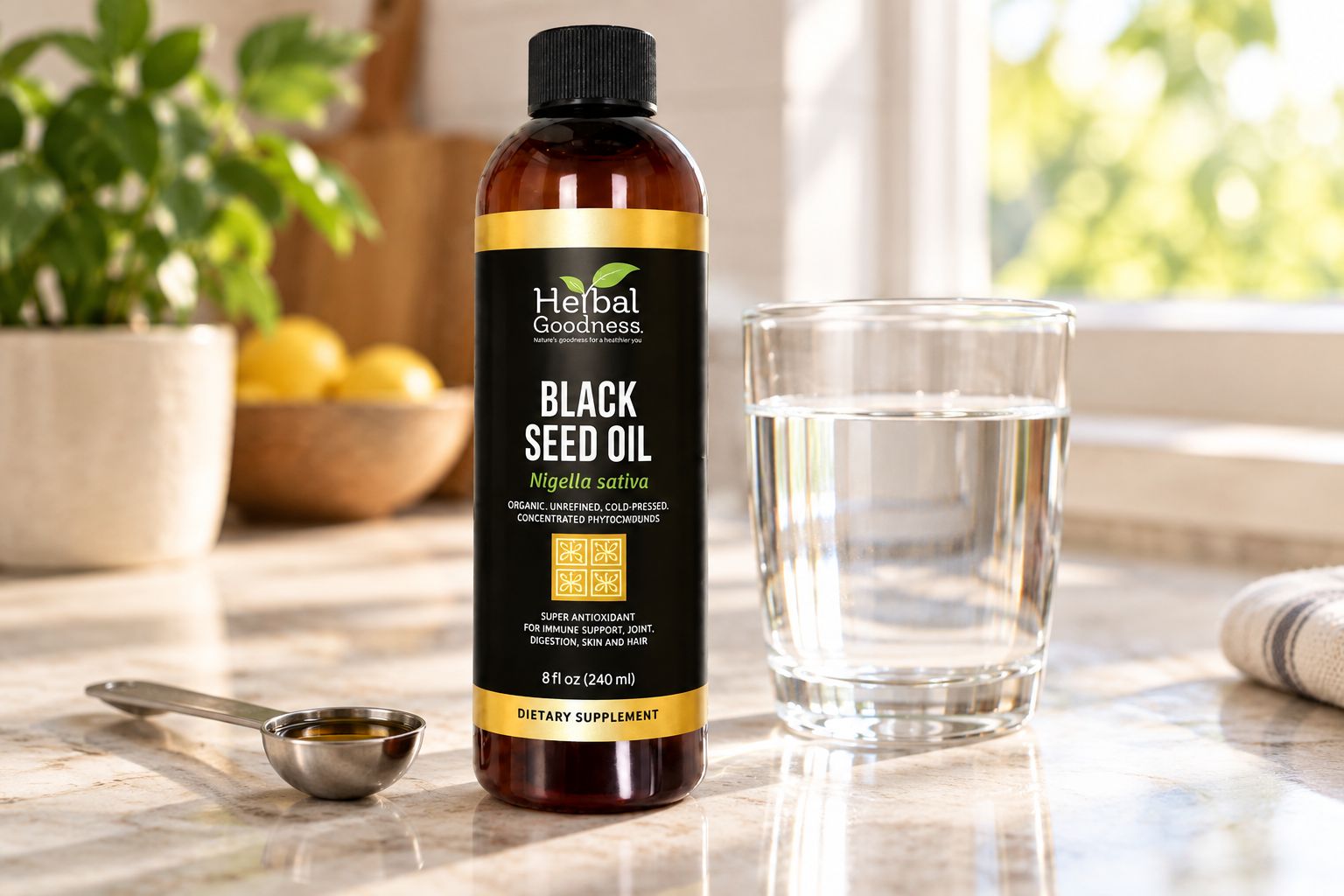
If swallowing capsules isn't the point — getting cold-pressed Nigella sativa oil into your routine is — Herbal Goodness Black Seed Oil 8oz is a cold-pressed liquid format you measure by the spoon instead of counting capsules. It's built for daily wellness use, the same use case most capsule buyers are chasing, just without the shell.
Herbal Goodness Black Seed Oil pros:
- Cold-pressed, not solvent-extracted
- Liquid dosing gives you control over how much you take, spoonful by spoonful
- No capsule shell material to worry about, vegan or otherwise
Herbal Goodness Black Seed Oil cons:
- Not a capsule — if convenience means swallow-and-go, this isn't that
- Stronger flavor than a flavorless softgel, which some people won't love
Verdict: Buy if you're comfortable with a liquid dose and want a cold-pressed option without capsule fillers.
Stacking for immune season
Black seed oil is often paired with oil of oregano during cold and flu season rather than used as a standalone capsule swap. The Oregano Oil & Black Seed Oil Bundle pairs both, and the Immune Defense Stack adds soursop tea on top for a broader routine. If you're taking Oil of Oregano 75% Carvacrol already, black seed oil is a natural addition rather than a replacement.
“If a black seed oil capsule doesn't list a thymoquinone percentage, the batch quality is unknown, and no capsule count fixes that.”
How we ranked
Each format above was weighed against the six criteria listed earlier: extraction method, thymoquinone disclosure, shell material, ingredient purity, sourcing transparency, and testing accountability. Formats that name their potency and extraction process outrank ones that only list total oil weight, and that holds whether the format is a capsule or a liquid.
Which black seed oil capsule should you choose?
If you want the cleanest capsule format available in 2026, buy a single-ingredient cold-pressed softgel that states thymoquinone percentage on the label. If you can't find one that discloses potency, a thymoquinone-standardized capsule is the next best signal of quality. And if capsules were never really the requirement — just consistent, cold-pressed Nigella sativa oil — Herbal Goodness Black Seed Oil 8oz gets you there without a capsule count to track.


FAQ
What are the best black seed oil capsules in 2026?
The best black seed oil capsules in 2026 are cold-pressed, single-ingredient softgels that state a thymoquinone percentage on the label. Most drugstore capsules skip that disclosure entirely, so read labels before buying.
Is black seed oil liquid better than capsules?
Neither is inherently better — liquid gives you flexible spoon-measured dosing, while capsules are swallow-and-go with a fixed amount per serving. Herbal Goodness Black Seed Oil 8oz is a cold-pressed liquid option for people who prefer measuring over counting capsules.
What is thymoquinone and why does it matter in black seed oil?
Thymoquinone is the primary active compound in Nigella sativa oil and the reason black seed oil is studied for immune and inflammatory support. A capsule that states its thymoquinone percentage gives you a real potency reference; one that doesn't is essentially unverified.
Can you take black seed oil and oil of oregano together?
Yes, pairing the two is a common immune-season combination rather than a substitution for one another. Bundles like the Oregano Oil & Black Seed Oil Bundle package both together for that purpose.
Are black seed oil capsules vegan?
Not by default — most softgels use a gelatin shell, so check the label for a plant-based or cellulose-derived capsule if you need a vegan option. The oil itself is plant-derived regardless of shell material.
How is black seed oil traditionally used?
Nigella sativa has appeared in traditional remedies for more than 2,000 years, with historical references tied to ancient Egyptian use. Modern use is centered on daily immune and general wellness support rather than any single condition.
What's the difference between cold-pressed and refined black seed oil?
Cold-pressing extracts the oil without added heat, which preserves more thymoquinone content than heat- or solvent-based refining. That's why cold-pressed is the extraction method to look for on any 2026 black seed oil label, capsule or liquid.
One last thing
Thymoquinone is fat-soluble, so black seed oil, capsule or liquid, absorbs better taken with a meal that has some fat in it than on an empty stomach. That single detail matters more than capsule count or milligram claims printed on the front of the bottle.
Related guides
Share this

Popular posts


FAQs
1. What are the main benefits of drinking bamboo leaf tea?
Drinking bamboo leaf tea supports hydration, relaxation, skin wellness, and antioxidant balance.
2. What is bamboo leaf extract used for?
It’s used for general body wellness, skin elasticity, hair and nail support, and overall vitality.
3. Can bamboo leaf help with skin care and body wellness?
Yes, bamboo leaf is rich in silica and antioxidants, which promote healthy skin, strong nails, and a youthful glow.
4. What forms of bamboo leaf are available?
You can find dried bamboo leaf, powder, extract, drops, oil, and bamboo leaf green tea.
5. Are there any side effects of bamboo leaf?
Bamboo leaf is generally safe when consumed in moderation. Always consult your healthcare provider before starting any new herbal supplement.