





Mullein tea for singers and voice pros: complete 2026 guide

Mullein tea for singers is a mullein-leaf infusion used as an optional warm-drink ritual with the aim of supporting comfort around demanding voice work, not improving vocal performance. This 2026 guide separates traditional herbal use from clinical evidence and explains how to choose, prepare, and assess tea without overlooking persistent voice changes.
- Mullein tea for singers is an optional beverage, not a proven way to improve range, stamina, or vocal recovery.
- Herbal Goodness mullein tea suits shoppers seeking organic tea bags; its liquid extract is a different preparation.
- Voice care starts with hydration, sensible vocal workload, and breaks—not an herbal supplement.
- Persistent hoarseness needs evaluation; tea should never become a reason to postpone care.
Why mullein tea matters for singers and voice professionals
Singers, actors, teachers, and presenters need a voice that works reliably. A comforting drink can fit your routine, but its usefulness as a beverage is different from evidence that it changes how your vocal folds function.
Herbal Goodness mullein tea is best for singers who want an organic, bagged herbal drink—not a proven vocal-performance aid. Herbal Goodness sells herbal teas and extracts; choose the preparation that fits your routine rather than assuming a concentrated format delivers better voice results.
For a working vocalist, the practical question is not whether mullein has a history of use. It is whether adding it helps you maintain a sensible routine without masking symptoms, adding preparation problems, or encouraging you to sing through discomfort.
Separate traditional use from evidence
Mullein has a history of traditional respiratory use. That history does not establish that mullein-leaf tea improves pitch accuracy, extends range, reduces vocal fatigue, or speeds recovery after a performance.
The European Medicines Agency's mullein-flower monograph describes traditional use for sore throat associated with dry cough and a cold. Its traditional-use classification does not establish clinical effectiveness, and the monograph concerns flowers, not every leaf tea or extract sold under the mullein name.
For your 2026 evidence check, keep the plant part, preparation, and outcome together. A laboratory finding, a traditional-use monograph, and a clinical trial in singers answer different questions; none should be presented as interchangeable proof.
The National Institute on Deafness and Other Communication Disorders, in Taking Care of Your Voice, emphasizes hydration, vocal rest, and avoiding voice use when the voice is hoarse or tired. Those recommendations address voice habits directly; mullein tea remains an optional addition.
How to build a sensible mullein-tea routine
1. Define your goal before choosing an herb
Start with the free approach: identify what you want from the drink. A pleasant warm beverage between teaching sessions is a different goal from resolving recurring hoarseness after rehearsals.
If the problem is vocal fatigue, review your workload, amplification, breaks, and technique first. An herbal drink does not make an excessive rehearsal schedule reasonable, and comfort after drinking does not prove that your voice has recovered.
Write your goal in plain language so you can judge the routine fairly. Avoid targets such as gaining higher notes or preventing vocal injury; mullein tea has no established role in delivering those outcomes.
- Name the occasion: rehearsal break, recording session, or teaching day.
- Separate beverage preference from a voice symptom.
- Review when you speak or sing without adequate breaks.
- Use amplification where appropriate instead of competing with background noise.
2. Check whether voice changes need professional attention
Use a simple symptom note before adding a product. Record when a change started, whether it followed unusual voice use, and whether it affects your normal speaking voice as well as singing.
The American Academy of Otolaryngology–Head and Neck Surgery Foundation's 2018 clinical practice guideline on hoarseness recommends laryngoscopy, or referral for it, when dysphonia fails to resolve or improve within 4 weeks. Evaluation should happen sooner when a serious cause is suspected; professional voice use is also a factor supporting expedited assessment.
This is not a recommendation to wait four weeks before asking for help. A singer whose livelihood depends on the voice has a good reason to discuss new or recurring changes promptly with a qualified clinician.
- Note persistent roughness, effort, or reduced ability to use your usual voice.
- Stop treating repeated voice loss as a normal part of performing.
- Seek urgent medical attention for breathing difficulty.
- Tell your clinician that singing or professional speaking is part of your work.
3. Choose the plant part and preparation deliberately
The manual approach is to read the ingredient panel and preparation instructions. Look for mullein leaf versus mullein flower, a single herb versus a blend, and tea versus liquid extract.
Bagged tea simplifies measuring and handling loose material. Herbal Goodness offers mullein-leaf tea in a 24-bag format and a separately labeled 15X liquid extract. Those are product-format details, not evidence of better singing outcomes or a basis for converting an extract serving into cups of tea.
For your 2026 selection, prioritize a clear label over a respiratory-benefit headline. Organic describes an agricultural standard; it does not establish vocal effectiveness, eliminate every risk, or make a product appropriate for every singer.
- Confirm that the label identifies the plant part.
- Read all ingredients, including additions in blends or extracts.
- Follow the directions for the exact preparation you purchase.
- Ask a pharmacist about suitability if you use medicines or other supplements.
4. Prepare and filter the tea carefully
Begin with the package directions rather than an internet recipe. The amount of herb, water volume, and steeping instructions belong to the actual product; there is no established mullein-tea dose for improving a singer's voice.
Mullein leaves have fine hairs. Careful filtration is a practical preparation consideration for loose-leaf tea: use an appropriate fine filter and do not drink visible plant particles. If a bag tears or the drink contains sediment, filter it again rather than assuming the particles add benefit.
Let the tea reach a comfortable drinking temperature. A hotter cup is not a stronger voice-care intervention, and concentrated brewing does not establish greater effectiveness.
- Use the label's preparation instructions.
- Check tea bags for damage before brewing.
- Filter loose-leaf preparations carefully.
- Let the drink cool enough to sip comfortably.
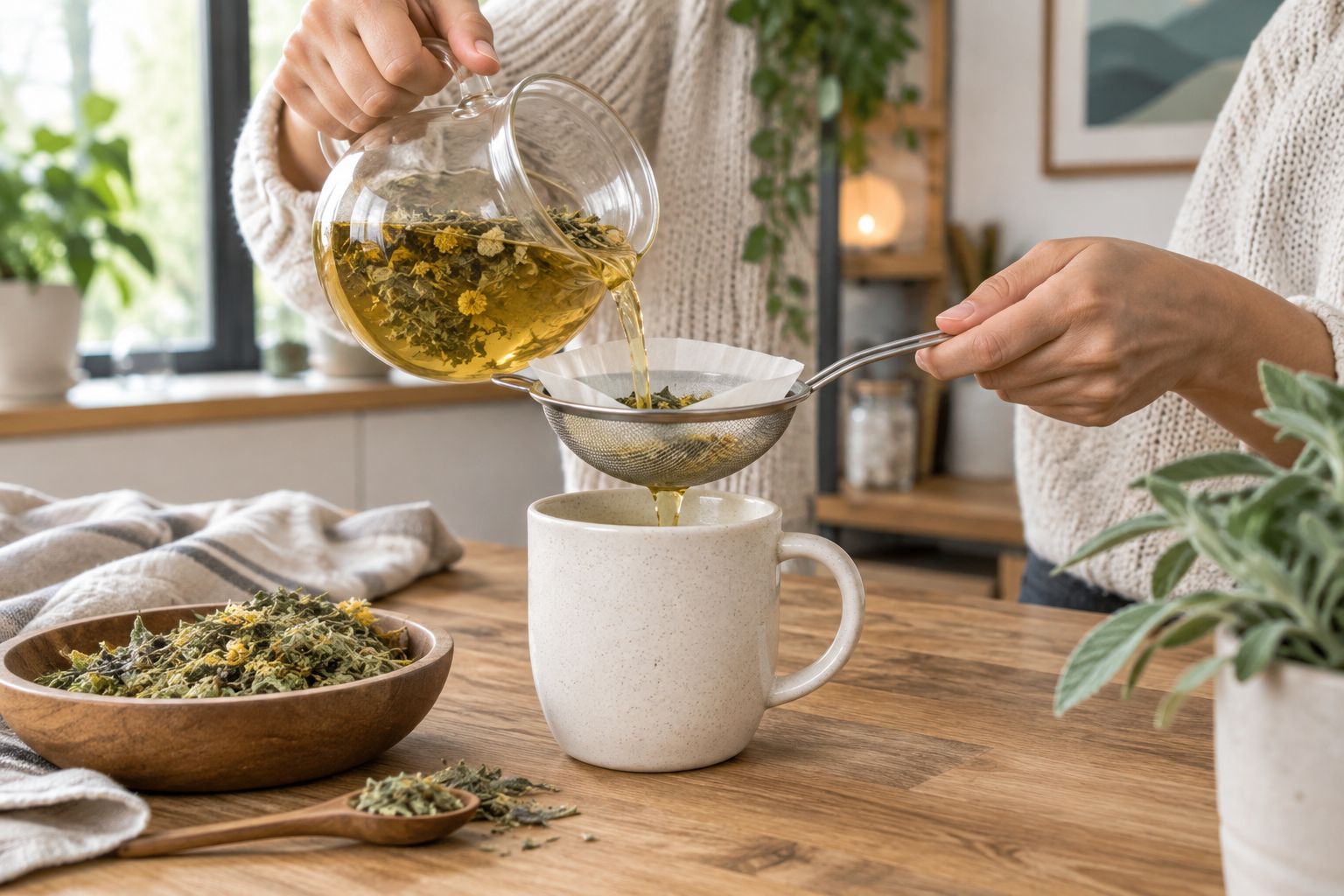
5. Test the routine away from a performance
Try a new beverage on an ordinary day, not immediately before an audition, recording, or paid engagement. That gives you room to assess taste, preparation, and personal tolerability without making the drink part of a high-pressure experiment.
Keep the test simple. Do not introduce mullein tea, a liquid extract, and several other supplements together; you will struggle to identify which change affected your experience.
Your 2026 rehearsal log can track the drink alongside vocal workload, sleep, and breaks. A personal log helps you notice patterns, but it cannot prove that tea caused a change in voice quality.
- Keep your usual warm-up and hydration habits consistent.
- Introduce one new preparation at a time.
- Record the preparation used and any unwanted effects.
- Stop use and seek appropriate advice if you develop concerning symptoms.
6. Measure usefulness without turning comfort into a claim
Judge mullein tea against the goal you named: a drink you enjoy, a manageable preparation routine, or a useful reminder to take a break. Those are practical outcomes you can observe without claiming a medical benefit.
Keep a short record with 3 entries: the preparation, the voice workload, and your experience. That structure helps separate the beverage from a demanding rehearsal or unusually quiet day; it is a tracking method, not a clinical measurement.
For professional voice care, pair symptom reporting with advice from a qualified voice clinician or speech-language pathologist when appropriate. A comforting cup cannot tell you whether the vocal folds are healthy.
- Record the preparation rather than writing only “mullein.”
- Record rehearsal, teaching, or recording demands.
- Note taste, convenience, and unwanted effects separately from voice changes.
- Keep persistent or recurring symptoms on your clinician's agenda.
Compare options for a singer's routine
Choose the format for convenience, not an assumed performance advantage. Tea bags suit a simple beverage ritual; loose leaf requires more handling; an extract is a separate supplement preparation. None of these options has an established advantage for vocal range or stamina.
The comparison below separates practical strengths from evidence limitations. For a 2026 purchase decision, check the current ingredient panel and directions rather than treating a product name as a complete instruction sheet.
| Option | Best for | Practical advantage | Key limitation |
|---|---|---|---|
| Plain water | Singers who want a simple hydration routine | No herbal preparation or filtration | Does not replace assessment of voice symptoms |
| Mullein Leaf Tea Organic 24 Bags | Singers who prefer an organic, bagged herbal drink | Convenient tea-bag format | Not proven to improve singing performance or recovery |
| Loose mullein-leaf tea | Readers comfortable measuring and filtering dried herbs | Control over preparation within label directions | Requires careful handling and filtration |
| Mullein Leaf Organic 15X Liquid Extract | Adults who prefer an extract preparation rather than brewing tea | No tea-brewing step | Not interchangeable with tea; concentration does not prove better voice outcomes |
Choose between tea and extract
Herbal Goodness mullein tea and liquid extract provide different ways to use the same named plant part. If your goal is a warm beverage during a break, tea fits that goal directly; an extract does not reproduce the beverage ritual.
Read the exact product directions before choosing either format. Do not take both to create an improvised “stronger” singer's routine, and do not infer serving equivalence from the 15X label.


Common mistakes singers and voice professionals make
- Treating a comfortable throat as clearance to perform. Feeling better after a drink does not establish that a strained or persistently altered voice is ready for a demanding set. Adjust the workload and seek assessment when symptoms persist.
- Assuming tea reaches the vocal folds directly. During normal swallowing, the drink travels through the esophagus, not over the vocal folds. NIDCD's voice guidance explains why hydration matters; a beverage is not a topical vocal-fold treatment.
- Borrowing evidence from a different plant part. A traditional-use reference for mullein flowers does not prove that leaf tea improves a singer's voice. Keep the ingredient and the claimed outcome aligned.
- Trying a new extract just before stage time. A performance is the wrong setting to discover whether you tolerate an unfamiliar preparation. Test routine changes away from professional commitments.
- Letting an herbal routine delay a voice evaluation. Repeated hoarseness, loss of normal function, or painful voice use deserves attention. Supplements do not replace medical care, voice assessment, or appropriate technique guidance.
FAQ
Is mullein tea good for singers?
Mullein tea is an optional herbal drink for singers, not a proven way to improve vocal performance. Use it for beverage preference and a sensible break routine, while keeping hydration, workload management, and appropriate voice care first.
Can mullein tea improve my vocal range?
Mullein tea has no established clinical benefit for increasing vocal range. Range changes should not be attributed to tea without evidence, and new difficulty reaching your usual notes warrants attention to workload, technique, and voice health.
Should I drink mullein tea before singing?
There is no established pre-performance timing protocol for mullein tea. Try a new preparation away from a performance, follow its label, and avoid making an unfamiliar drink essential to your warm-up.
Is mullein-leaf tea the same as mullein-flower tea?
Mullein-leaf tea and mullein-flower tea use different plant parts and should not be treated as interchangeable evidence sources. The European Medicines Agency's traditional-use monograph concerns mullein flowers, not proof that leaf tea improves singing.
Is mullein extract better than tea for my voice?
Mullein extract has no established advantage over tea for vocal performance. Herbal Goodness offers both preparations, but the extract's concentration label does not prove better results or provide a conversion to cups of tea.
How long can I wait before getting hoarseness checked?
The 2018 AAO-HNSF guideline recommends laryngeal evaluation when hoarseness fails to resolve or improve within 4 weeks, with earlier assessment when indicated. Professional voice use supports expedited attention, so singers should not treat that threshold as a required waiting period.
Can I use mullein tea if I take medication?
Ask your pharmacist or clinician about the exact mullein preparation before combining it with medication. Bring the ingredient panel, including any blend ingredients or extract additives, rather than relying on the plant name alone.
One last thing
Make the break the non-negotiable part of the ritual; make the tea optional. A singer who pauses, reduces unnecessary speaking, and notices a changing voice has a more useful routine than one who keeps performing because a warm drink feels reassuring.
Before your next rehearsal, decide what would make you shorten the session or ask for advice. That decision belongs in your voice-care plan whether your mug contains mullein tea or plain water.