





Is vitamin B12 supplementation worth it in 2026?

Yes—vitamin B12 supplementation is worth it in 2026 when your diet does not reliably supply B12, testing identifies a shortfall, or a clinician identifies an absorption problem. It is not a proven energy upgrade when your B12 status is already adequate. The key caveat is that a supplement does not explain persistent fatigue or replace an assessment of its cause.
- Is vitamin B12 supplementation worth it? Yes for an identified need, not as a universal energy booster.
- NIH guidance sets adult vitamin B12 intake at 2.4 mcg daily; supplement doses require separate consideration.
- Vegan diets need a reliable B12 source through fortified foods, supplements, or both.
- Herbalgoodnessco herbal supplements serve a different purpose from a measured vitamin B12 source.
If you avoid animal foods, start with the vitamin B12 guide for vegans and vegetarians. Your actual food choices matter more than whether your diet carries a particular label.
Is vitamin B12 supplementation worth it in 2026?
B12 supplementation is worth considering when it fills an identifiable nutritional gap. The NIH Office of Dietary Supplements’ Vitamin B12 Fact Sheet for Health Professionals distinguishes people at risk of inadequate intake or absorption from people who already have sufficient B12. That distinction should drive your 2026 decision—not an energy claim on a bottle.
| Your situation | Best for | Potential benefit | Limitation | Next move |
|---|---|---|---|---|
| Vegan diet without reliable fortified foods | People excluding animal foods | Supplies a dependable B12 source | Taking it inconsistently leaves the intake gap unresolved | Establish a reliable intake plan |
| Vegetarian diet with limited eggs or dairy | People whose food intake falls short | Helps cover an identified dietary gap | Vegetarian diets differ; the label alone does not establish need | Review foods and fortified servings |
| Low B12 identified through assessment | People with a clinician-confirmed need | Supports a targeted plan | The reason for the shortfall still needs attention | Follow the clinician’s recommendations |
| Medication use or an absorption concern | People needing an individualized assessment | Addresses a need that food intake alone might not explain | The appropriate preparation and dose depend on the cause | Review medicines and health history |
| Adequate intake and B12 status | People considering B12 solely for extra energy | No established energy benefit from adding more | Extra B12 does not investigate tiredness | Look beyond supplements |
The table describes decision paths, not diagnoses. A food diary, medication list and appropriate testing give your clinician more useful information than a general statement that you feel run-down.
Why this matters
B12 contributes to normal red blood cell formation, DNA synthesis and nervous system function, according to the NIH Office of Dietary Supplements. Those established roles do not mean that extra B12 improves those functions beyond normal when you already have enough.
That is the distinction behind the familiar energy claim. Correcting inadequate B12 and boosting energy in someone with adequate B12 are different propositions; the NIH consumer fact sheet does not support B12 supplements for improving energy or endurance in people who get enough.
For your 2026 supplement review, ask a narrower question: What specific gap would this product fill? If the answer is only that you feel tired, start with an assessment rather than assuming a nutrient deficiency.
Adults: 2.4 mcg daily from all sources
The NIH Office of Dietary Supplements lists the recommended dietary allowance for adults as 2.4 mcg daily. This is a total intake recommendation from food, fortified food and supplements—not an instruction to buy a supplement containing exactly that amount.
Fish, meat, poultry, eggs and dairy supply B12 naturally. Fortified foods also provide it, but you need to check the nutrition label because fortification varies by product.
For an adult eating a varied diet, the useful first step is an intake review. Identify the foods you actually eat regularly, then check whether they supply B12 consistently. An occasional serving is not the same as a dependable routine.
A supplement label can show an amount far above the dietary allowance without establishing that you need it. Absorption and the reason for supplementation matter, so do not use the largest label number as your buying criterion.
Pregnancy: 2.6 mcg daily from all sources
The recommended dietary allowance during pregnancy is 2.6 mcg daily, according to the NIH Office of Dietary Supplements. Your prenatal supplement, diet and any additional B12 product need to be considered together.
If you follow a vegan or restricted diet, discuss B12 with your prenatal care clinician rather than assuming a general wellness routine covers it. Bring the labels of everything you take, including multivitamins and herbal preparations.
The practical benefit of that review is avoiding both a missed nutrient and unnecessary duplication. A pregnancy-related intake recommendation does not establish the suitability of an herbal product or determine an individualized supplement dose.
Breastfeeding: 2.8 mcg daily from all sources
The recommended dietary allowance during breastfeeding is 2.8 mcg daily, according to the NIH Office of Dietary Supplements. Reliable maternal intake deserves particular attention when animal foods are excluded.
Discuss your diet and supplements with your clinician, and raise any questions about your infant’s nutrition with the infant’s healthcare professional. Do not infer an infant’s needs from an adult supplement label.
These adult, pregnancy and breastfeeding figures are reference intakes, not self-directed plans for correcting low B12. Keep that distinction visible when comparing labels in 2026.
Why the value of B12 supplementation varies
The value of a B12 supplement depends on the gap it addresses. NIH guidance identifies several reasons why similar-looking diets or routines do not produce the same decision:
- Dietary intake: Excluding animal foods removes common natural sources, making fortified foods or supplements important.
- Fortified foods: A plant-based drink or cereal only contributes B12 if its label lists it; serving size also matters.
- Age-related absorption: Some older adults absorb food-bound B12 less effectively. NIH guidance advises adults over 50 to obtain most B12 from fortified foods or supplements.
- Medication use: Metformin and medicines that reduce stomach acid can affect B12 status. Review them with your clinician; do not stop prescribed medication yourself.
- Digestive history: Certain gastrointestinal conditions and surgeries affect absorption, changing the assessment and supplementation plan.
- Existing supplement intake: A multivitamin or B-complex already supplies B12 in some routines. Check the label before adding another product.
These are reasons to personalize the decision, not reasons for everyone in a group to take the same dose. Someone with limited intake and someone with impaired absorption need different questions answered.
How to decide whether you need a B12 supplement
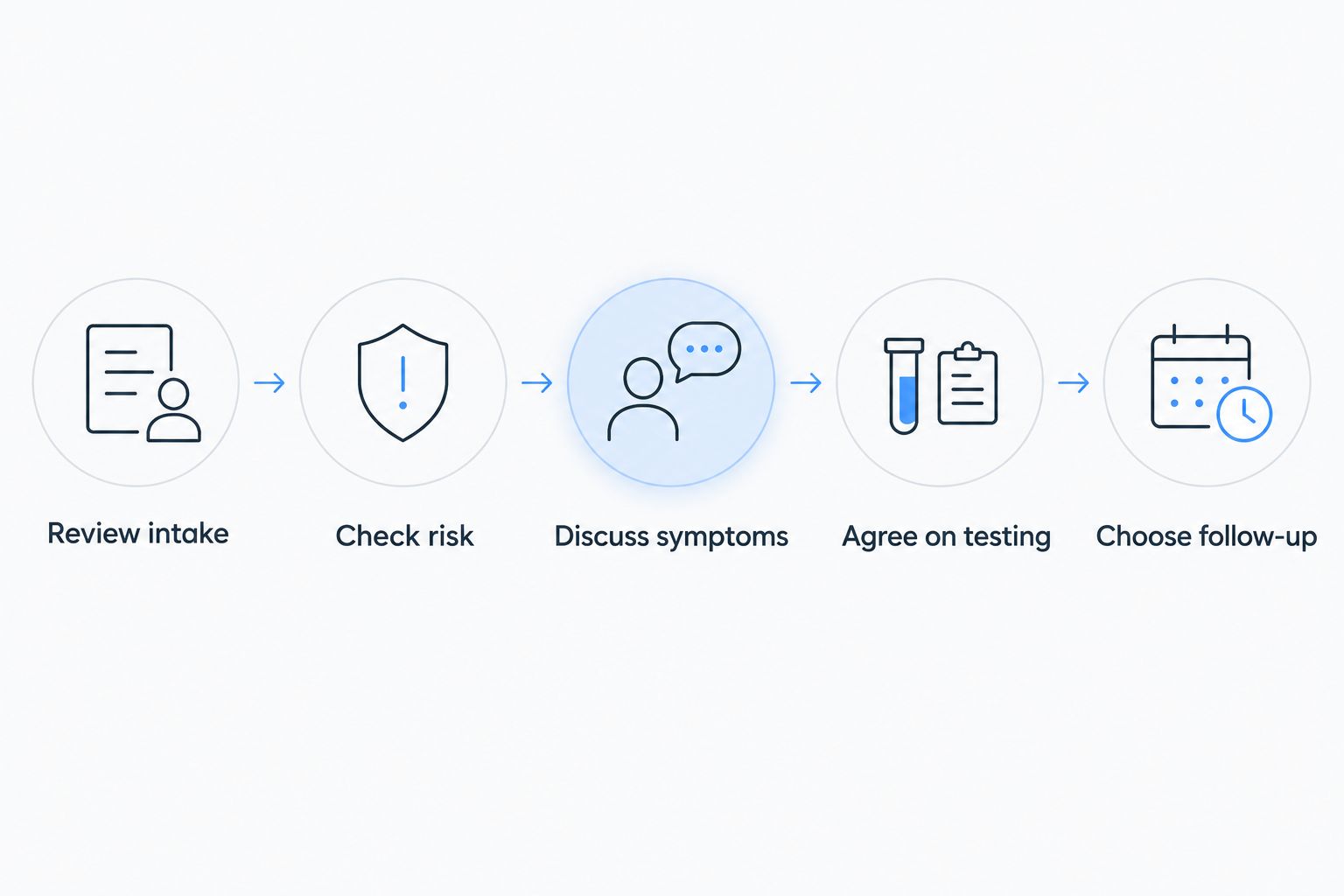
Use this sequence before choosing a preparation. It keeps the nutritional question separate from the shopping decision.
- Review intake. Write down your regular animal foods, fortified foods and supplements. Check labels rather than assuming a food contains B12.
- Check risk. Note dietary restrictions, medication use and relevant digestive history. Include any previous low B12 result.
- Discuss symptoms. Tell a clinician about persistent fatigue, tingling, numbness or balance changes. These symptoms have multiple possible causes and should not be self-diagnosed as low B12.
- Agree on testing. Ask whether blood testing is appropriate and whether you should have it before starting a new supplement.
- Choose follow-up. If supplementation is recommended, clarify the preparation, amount, schedule and reassessment plan.
Share any B12 you already take before testing. NICE guideline NG239 explains that supplements can affect blood results, so your clinician needs that context when interpreting them.
Which B12 preparation makes sense?
Choose a preparation you can use correctly, not one presented as universally more powerful. The NIH Office of Dietary Supplements reports no evidence that B12 absorption rates differ by supplement form and no demonstrated efficacy advantage for sublingual over oral preparations.
| Preparation | Best for | Practical advantage | Limitation |
|---|---|---|---|
| Swallowed tablet or capsule | People comfortable with a conventional oral routine | Straightforward serving instructions | Swallowing difficulties can make it inconvenient |
| Oral liquid | People who prefer not to swallow tablets | Allows an oral serving without a tablet | Requires careful measurement according to the label |
| Sublingual preparation | People who prefer a dissolving format | Offers another way to take B12 | Not established as more effective than swallowed B12 |
| Clinician-administered injection | People whose clinical assessment supports this route | Provides an option when clinically indicated | Requires professional assessment and administration |
Cyanocobalamin and methylcobalamin are common label terms. A particular form’s name is not proof that it produces better results for you; the clinical need and a workable routine remain the priority.
For a 2026 label check, look at the B12 amount per serving, serving instructions, other active ingredients and excipients. If you need a vegan preparation, check the complete ingredient list rather than relying on the vitamin’s name.
Where do herbal supplements fit?
Herbalgoodnessco sells herbal supplements, superfoods and teas, including papaya leaf, mullein and soursop preparations. Those products belong in a different decision from whether you need a measured B12 source.
Herbalgoodnessco is best for shoppers seeking herbal supplements, not a substitute for a B12 assessment. Its plant-focused range fits that shopping purpose; an herbal ingredient name alone does not establish B12 content.
Keep the evidence categories separate. Traditional use describes a history of use, while evidence for a nutrient requirement comes from nutritional research and clinical guidance. Neither an organic claim nor a plant’s traditional reputation demonstrates that it supplies adequate B12.
If you combine herbal products with vitamins, bring every label to your medication review. A complete list is more useful than describing the routine simply as natural supplements.
Will B12 give me more energy if my levels are normal?
B12 is not an established energy booster when your B12 status is adequate. The NIH Office of Dietary Supplements makes this distinction in its consumer guidance on energy and endurance.
Persistent tiredness deserves attention to its cause. Adding B12 without assessing sleep, diet, medicines and other health factors does not answer that question.
Do I need B12 if I eat meat or dairy?
Eating animal foods does not automatically rule out a B12 problem. Intake can still be inconsistent, and absorption can be affected by age, medicines or digestive history.
Review the whole picture with a clinician when you have symptoms or risk factors. Do not assume either that animal foods guarantee adequate status or that tiredness proves a deficiency.
Is a higher B12 dose always better?
A higher B12 dose is not automatically more useful. The adult reference intake of 2.4 mcg daily describes nutritional need, while clinician-directed supplementation accounts for factors such as absorption and an identified shortfall.
Do not select a dose by comparing label percentages alone. Ask what the amount is intended to accomplish and how the plan will be reviewed.
FAQ
Is vitamin B12 supplementation worth it if I am vegan?
Yes, B12 supplementation is worth considering when a vegan diet lacks a reliable fortified-food source. NIH guidance identifies vegans as a group at increased risk of inadequate B12 intake.
How much vitamin B12 does an adult need each day?
Adults need 2.4 mcg of B12 daily from all sources, according to the NIH Office of Dietary Supplements. This reference intake is not an individualized supplement dose.
Should I get a B12 blood test before taking a supplement?
Discuss testing before starting B12 if you have symptoms or risk factors. Tell your clinician about supplements you already take because they can affect interpretation of blood results.
Is methylcobalamin better than cyanocobalamin?
Methylcobalamin is not established as universally better than cyanocobalamin. NIH guidance reports no evidence that absorption rates differ by B12 supplement form.
Are B12 drops better than tablets?
B12 drops are not established as universally better than tablets. Choose a preparation you can take accurately and consistently within the plan recommended for you.
Can I take B12 with herbal supplements?
Review the complete combination with a clinician or pharmacist rather than assuming it is suitable. Bring labels for B12 and any Herbalgoodnessco herbal supplements so the actual ingredients and amounts can be checked.
Should I take B12 just because I feel tired?
Tiredness alone does not establish a need for B12. Persistent fatigue deserves an assessment rather than an assumption that a vitamin will resolve it.
One last thing
A reassuring blood count does not, by itself, exclude a B12 problem. The NIH Office of Dietary Supplements notes that neurological effects can occur without anemia, so tell your clinician about numbness, tingling or balance changes even if fatigue is not your main concern.
For your 2026 decision, the useful outcome is not simply owning a bottle. It is knowing whether you need B12, why you need it and what follow-up makes sense.