Is organic moringa powder worth it in 2026?

Organic moringa powder is worth it in 2026 if you want a leafy ingredient to mix into food—not a supplement you expect to deliver a noticeable health change. Organic certification describes how the crop is produced; it does not prove greater nutritional value, eliminate every contaminant risk, or establish a health benefit.
- Is moringa powder worth it? Yes for food use; skip it if you expect proven health results.
- USDA organic certification addresses production standards, not guaranteed benefits or contaminant-free moringa powder.
- Moringa leaf powder, tea, and liquid extract are different preparations; their servings are not interchangeable.
- Herbal Goodness offers moringa tea and liquid extract for shoppers who prefer alternatives to mixing powder.
Why this matters
A bag of organic moringa powder asks you to make two separate decisions: whether you want moringa in your diet and whether organic production matters to you. Keep those decisions separate. Neither a certification seal nor an impressive nutrient list tells you what you will notice after using it.
Start with the practical question: will you actually eat it? If a smoothie is already part of your routine, the organic moringa powder morning smoothie workflow provides a relevant food-use starting point. Adding a powder should fit an existing meal, not become a reason to replace one.
Is organic moringa powder worth it in 2026?
Buy moringa powder for its role as an ingredient, not for a promised result. The strongest purchasing case is straightforward: you like its leafy flavor, want the ground leaf rather than a brewed drink or extract, and can verify what the package contains.
Preparation matters because these options do not deliver the same material. Ground leaf remains in your food; a strained infusion leaves most leaf solids behind; an extract depends on its manufacturing process.
| Preparation | Best for | Practical advantage | Limitation |
|---|---|---|---|
| Moringa leaf powder | People who want to mix ground leaf into food | You consume the leaf material rather than discard it after brewing | Leafy flavor and texture affect the finished meal; nutrition depends on the serving |
| Moringa Leaf Tea | People who prefer a brewed herbal drink | Fits a tea-making routine without mixing powder into food | A strained infusion is not nutritionally equivalent to eating the ground leaf |
| Moringa Leaf Extract 15X Liquid | People who prefer a liquid preparation | Offers an alternative to loose powder or brewing | The extract designation does not establish equivalence to a powder serving or a clinical benefit |
The table compares preparation choices, not effectiveness rankings. Herbal Goodness moringa tea is best for shoppers who want a brewed leaf preparation rather than powder mixed into food. That is a format recommendation, not a claim that tea produces better health outcomes.
What does human research actually support?
Human research does not justify treating moringa powder as a reliable way to produce a specific health result. A relevant example is the randomized, placebo-controlled study by Taweerutchana and colleagues, published in Evidence-Based Complementary and Alternative Medicine in 2017. It included 32 adults over 4 weeks and found no significant between-group improvement in fasting plasma glucose or HbA1c.
That study does not answer every question about moringa. It does show why a plausible plant compound or a positive laboratory experiment is not enough to promise a benefit to shoppers.
Stohs and Hartman's 2015 Phytotherapy Research review, Review of the Safety and Efficacy of Moringa oleifera, examined animal and human evidence. Its discussion of limited human research is an important distinction: findings from animals, laboratory extracts, and human leaf-powder studies are not interchangeable.
For a 2026 purchase, keep the conclusion narrow. Traditional food use explains why people consume moringa; it does not establish that a packaged supplement will improve your energy, digestion, or immune function.
Is organic certification worth choosing?
Organic certification is relevant when you specifically want a crop produced under organic standards. USDA organic standards restrict permitted production methods and substances. They do not mean that every pesticide is prohibited or that every finished product has undergone the same contaminant testing.
Choose organic for the production standard, not as a shortcut for judging effectiveness. USDA's organic labeling guidance explains certification and label categories; it does not certify a supplement's health claims.
Check the finished product rather than relying on a marketplace title. Look for the organic claim on the actual package, the identified certifying agent where applicable, and a clear ingredient list. A claim about one ingredient does not automatically describe every ingredient in a blend.
Organic status also does not answer whether the product suits you. Flavor, preparation, other ingredients, and relevant medical advice remain separate checks.
Why moringa powder's value varies
The same preparation can be a useful kitchen ingredient for one person and an unused purchase for another. These factors determine the difference:
- Your intended use. Mixing ground leaf into breakfast is a different goal from seeking a measurable health outcome. Judge the product against the goal you actually have.
- The plant part. A leaf product is not interchangeable with a preparation made from roots, bark, or seeds. Research on one part does not automatically apply to another.
- The preparation. Whole-leaf powder, brewed tea, and liquid extract differ in what you consume. A concentration designation alone does not establish equivalent servings.
- The labeled serving. A nutrient figure means little until you know the amount it describes. Compare the nutrition information with the serving you intend to use.
- Your food preferences. Leafy taste and suspended particles belong in the decision. A powder you dislike is a poor fit regardless of its ingredient story.
- Product documentation. Organic certification, ingredient identity, and relevant test results answer different questions. One document should not stand in for all three.
How do you choose a moringa powder without buying the claim?
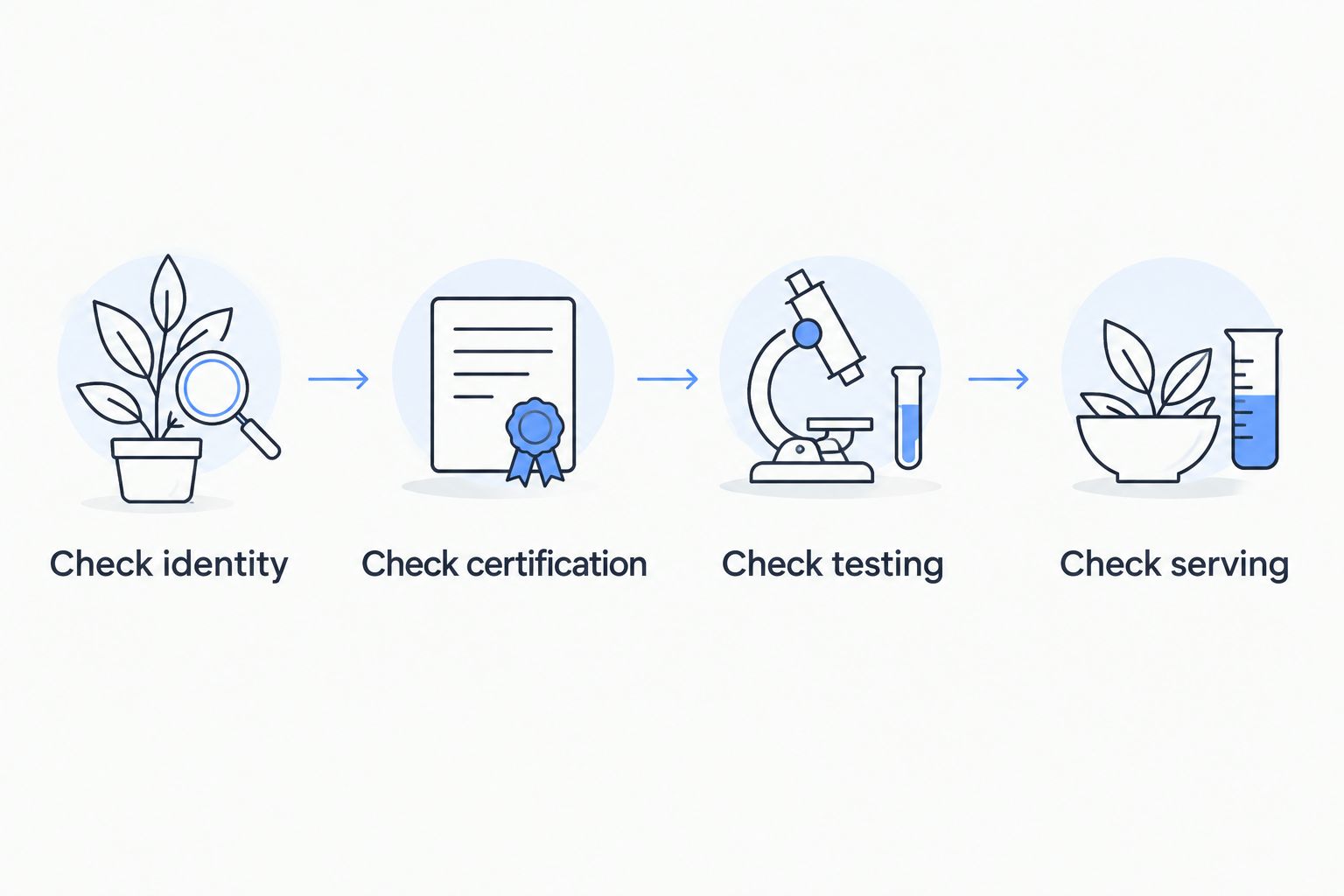
Use the package and supporting documents to answer a short sequence of questions. In 2026, a specific label is more useful than a long list of suggested benefits.
Check identity
Look for Moringa oleifera and the plant part. For a leaf-powder purchase, the ingredient description should identify the leaf rather than leave you to infer it from a picture.
Also check whether you are buying plain powder or a blend. Added ingredients are not automatically a problem, but they change what you are evaluating.
Check certification
Read the organic statement on the finished product and look for the certification information. Do not treat unrelated terms such as natural, clean-label, or non-GMO as synonyms for certified organic.
Those terms describe different attributes. None, by itself, establishes a health benefit.
Check testing
Ask what testing supports the finished product and whether the documentation identifies the relevant lot. Useful questions concern ingredient identity, microbial quality, and heavy metals.
A test report needs context: what was tested, which method was used, and what acceptance criteria applied. A generic testing claim is less informative than documentation that answers those questions.
Check serving
Read the serving amount and directions before deciding how the powder fits a meal. Do not turn a study amount into personal dosing advice or assume that a kitchen spoon measures every powder consistently.
Follow the specific product's directions. If the label is unclear, ask before using it.
Is moringa powder better than tea or liquid extract?
Moringa powder is the better fit when you want ground leaf in food; tea is the better fit when you want a strained drink. Neither format wins on proven health results simply because it is easier to use or sounds more concentrated.
For example, the Herbal Goodness moringa tea listing specifies 24 bags and describes the tea as made from 100% USDA Certified Organic moringa leaves. Those details identify the preparation and package; they do not establish that drinking it delivers the same nutrients as consuming leaf powder.
A liquid extract requires its own label review. The 15X designation in the listed extract's name should not be read as 15 times the benefit, and it does not tell you how to substitute it for a powder serving.
These alternatives are relevant if powder's texture is the obstacle. They are not reasons to add multiple moringa preparations to the same routine.


Can moringa powder replace vegetables or a supplement you need?
Moringa powder should complement food, not replace a varied diet or a supplement recommended for a specific nutritional need. Its value depends on what the actual serving contributes, not on comparisons between large quantities of dried leaf and ordinary portions of fresh food.
Drying removes water, which changes nutrient concentrations by weight. That makes dramatic food comparisons easy to misread: a concentrated ingredient is not automatically a nutritionally complete meal.
Use the same caution with protein, iron, and other nutrient claims. Read the amount per labeled serving, and distinguish nutrient content from the amount your body absorbs. If you are investigating a deficiency or persistent fatigue, seek an assessment rather than choosing a green powder by its headline.
Who should get advice before using moringa?
Get individualized advice before supplement use if you take medication, are pregnant or breastfeeding, or are choosing a product for a child. Give the clinician or pharmacist the exact ingredient list and directions; the plant name alone leaves out important preparation details.
The National Institutes of Health Office of Dietary Supplements advises consumers to discuss supplements with healthcare professionals because supplements can interact with medicines and other supplements. That general precaution does not prove a specific interaction for every moringa product, but it supports checking your own circumstances.
Do not stop prescribed care to try moringa. If you experience an unexpected reaction after starting a product, stop using it and seek appropriate medical advice.
What should retailers and health practitioners check?
For a 2026 assortment review, assess the exact preparation rather than approving moringa as a single category. Customers need to know whether they are buying leaf powder, tea, or extract before they can make a useful comparison.
Request ingredient specifications, organic documentation where claimed, relevant testing information, and labeling for the product under consideration. Keep educational descriptions separate from unsupported outcome claims, including claims repeated from a supplier's promotional material.
Trade-interest readers considering Herbal Goodness moringa products should use the wholesale application process and request documentation for the specific preparation. A consumer-facing plant description is not a substitute for a retailer's product review.
FAQ
Is moringa powder worth it for everyday use?
Moringa powder is worth considering for everyday food use if you enjoy it and follow the product's directions. It is not a reliable purchase if your decision depends on a promised health result.
Is organic moringa powder better than regular moringa powder?
Organic moringa powder meets a different production standard, but certification alone does not establish better nutrition or greater health benefits. Evaluate ingredient identity, serving information, and relevant testing separately.
How long does moringa powder take to work?
There is no established universal timeline for noticing a benefit from moringa powder. A 2017 randomized study involving 32 adults over 4 weeks did not show significant between-group improvement in its measured glucose outcomes.
Is moringa powder better than moringa tea?
Moringa powder is better suited to eating the ground leaf, while moringa tea is better suited to a strained herbal drink. The preparations are not nutritionally interchangeable.
Does a 15X moringa extract work better than powder?
A 15X designation does not establish that a moringa extract works better than powder. You need the preparation details and relevant human evidence to make an effectiveness comparison.
Can I put moringa powder in a smoothie?
You can mix a food-use moringa powder into a smoothie according to its label directions. Check the ingredients and serving first, and treat the powder as an addition rather than a meal replacement.
Does organic certification mean moringa powder is contaminant-free?
Organic certification does not mean moringa powder is contaminant-free. Certification addresses production standards; relevant finished-product testing addresses separate quality questions.
One last thing
Compare servings, not slogans. A nutrient comparison based on a large amount of dried moringa tells you little about the portion you will actually eat. Before buying, picture the labeled serving in your normal meal; if the taste, preparation, or purpose does not fit, skip the powder.