





Is oil of oregano safe during pregnancy?

Avoid oil of oregano during pregnancy unless your obstetric clinician specifically approves the exact preparation. Concentrated oregano supplements do not have established pregnancy safety, and oregano used to season food is a different exposure. If you already took oregano oil, stop further use and contact your prenatal care team with the label, amount taken, and timing; an exposure does not by itself establish that harm occurred.
- Oil of oregano during pregnancy lacks established safety; avoid self-prescribing concentrated drops or capsules.
- Oregano seasoning in food is not equivalent to an oregano oil supplement or essential oil.
- Herbal Goodness oregano oil belongs in a prenatal label review, not an automatic pregnancy wellness routine.
- If you already used oregano oil, contact your prenatal clinician with the product label and exposure details.
Why this matters
Pregnancy changes the question you need answered. Instead of asking whether oregano has traditional wellness uses, ask whether the specific preparation, route, and amount have adequate pregnancy safety evidence. A plant's history of use does not answer that question.
Herbal Goodness sells herbal supplements, teas, and plant oils. Those categories include very different preparations, and a general wellness description is not a pregnancy recommendation. The distinction matters when a familiar kitchen herb appears in a concentrated supplement.
For your 2026 pregnancy supplement review, keep food ingredients and medicinal preparations on separate lists. Bring both lists to your prenatal clinician, but do not treat seasoning a meal as equivalent to swallowing an extract.
Is oil of oregano safe during pregnancy?
Oil of oregano is not established as safe for use during pregnancy. The practical recommendation is to avoid starting or continuing it on your own, whether you want digestion support, immune support, or another wellness benefit.
The comparison below separates preparation types. It is a safety framework, not a list of recommended prenatal products.
| Preparation | Best suited to | Relevant distinction | Pregnancy limitation |
|---|---|---|---|
| Fresh or dried oregano in ordinary food amounts | Seasoning meals | Culinary use differs from concentrated supplementation | Food use does not establish supplement safety |
| Concentrated oregano drops or capsules | Individual clinical review before use | Formulation, ingredients, and serving instructions vary | No established pregnancy-safe dose |
| Oregano essential oil | Route-specific professional safety review | A highly concentrated preparation is not interchangeable with food | Do not assume oral, skin, or inhaled use is safe |
| Oregano-containing herbal blends | Review of every ingredient | The blend introduces additional exposures | Reviewing oregano alone does not clear the whole formula |
The National Library of Medicine's LiverTox: Oregano entry advises against oregano supplementation during pregnancy. MotherToBaby's Herbal Products fact sheet explains the broader problem: many herbal products have not been adequately studied during pregnancy. These sources support caution; they do not provide a pregnancy dosing schedule.
Oregano in food: keep seasoning separate from supplementation
Oregano sprinkled into a sauce, soup, or cooked meal is a culinary ingredient. Concentrated drops, extracts, and essential oils are different preparations. Do not transfer reassurance about food seasoning to an oregano oil bottle.
MotherToBaby distinguishes herbs used in food preparation from herbal products taken for health purposes. That distinction concerns the exposure, not whether the ingredient sounds natural. A recipe containing dried oregano is not evidence that concentrated oregano oil is appropriate during pregnancy.
The useful boundary is ordinary food use versus deliberate supplementation. Drinking a strong herbal preparation repeatedly for a wellness goal belongs in your supplement discussion, even if you prepare it in your kitchen.
In 2026, use the actual preparation to frame your question: dried leaves in dinner, concentrated drops swallowed, or essential oil applied to skin. Naming only the plant leaves out the information your clinician needs. If an unfamiliar recipe uses concentrated oil rather than leaves, clarify the ingredient before using it.
Oregano drops and capsules: no established pregnancy-safe dose
There is no established pregnancy-safe dosing schedule for concentrated oregano supplements. A serving suggestion on a bottle is a manufacturer's usage instruction, not evidence that the serving is suitable during pregnancy.
Reducing the amount does not solve that evidence gap. Neither does taking a capsule instead of liquid drops. A capsule changes how you take a preparation; it does not independently establish safety for you or the pregnancy.
Look beyond the front label. Your clinician needs the full ingredient list, the stated concentration, serving instructions, and any other supplements or medicines you take. Carrier ingredients and additional botanicals belong in that review too.
Do not use the absence of a pregnancy warning as permission to take the product. A label cannot answer every individual safety question. If you are choosing an oregano supplement for a symptom, discuss the symptom itself so your prenatal care team can recommend an appropriate next step.
Topical oregano oil: dilution is not pregnancy clearance
Applying oregano oil to skin is a different exposure from swallowing it, but different does not mean established as safe. Concentrated essential oils can irritate skin, and pregnancy safety requires more than checking whether a product is diluted.
Poison Control's guidance on essential oils addresses exposure hazards, including irritation and risks from swallowing these preparations. It is not a pregnancy approval list. Use that guidance to recognize exposure concerns, not to create your own prenatal protocol.
Do not apply undiluted oregano essential oil to skin or mucous membranes. For a rash, vaginal discomfort, or another new symptom, contact your clinician rather than experimenting with an herbal oil.
Likewise, do not assume that aromatherapy clears the same product for skin or oral use. Route matters. If you want to use an oregano-containing topical preparation in 2026, show your prenatal clinician the exact label and explain where and how you plan to apply it.
What the evidence can—and cannot—tell you
The strongest useful distinction is between research about a plant's biological activity and research establishing safety in pregnant humans. They answer different questions. A laboratory result is not a prenatal recommendation.
Oregano and its constituent carvacrol have been studied for biological activity, including antimicrobial activity in laboratory settings. Such findings do not establish that an oregano supplement prevents illness, treats an infection, or is safe during pregnancy. They also do not identify a pregnancy-safe serving.
Traditional use has a similar limit. It can explain why people use a plant, but it does not replace research on a defined preparation in pregnant people. Testimonials cannot resolve that gap either.
For a 2026 decision, these named sources provide the relevant scope:
- MotherToBaby, Herbal Products: pregnancy-focused information explaining limited research, ingredient concerns, and the difference between food use and herbal supplementation.
- National Library of Medicine, LiverTox: Oregano: oregano-specific clinical safety information that advises against supplementation during pregnancy.
- National Center for Complementary and Integrative Health, Using Dietary Supplements Wisely: general supplement safety guidance, including the need for professional advice during pregnancy and breastfeeding.
- Poison Control, essential-oil exposure guidance: practical information about exposure hazards and when to obtain individualized advice.
These sources serve different purposes. None should be read as permission to replace prenatal care with oregano oil. If a claim cites only test-tube findings, ask for pregnancy-specific human safety evidence before treating it as relevant to your decision.
Why advice about oregano oil varies
Advice often changes because people are discussing different products without naming the differences. Before comparing recommendations, identify the exposure precisely.
- Preparation: dried leaves, an extract, and an essential oil are not interchangeable.
- Route: swallowing, applying to skin, and inhaling create different exposure questions.
- Amount and frequency: a single exposure and repeated use require different histories.
- Additional ingredients: a blend needs a review of every component, not just oregano.
- Your medical context: medicines, allergies, symptoms, and pregnancy circumstances belong in the assessment.
Different advice is not proof that one preparation is safe. It is a reason to make your question more specific. The next useful step is a label review, not choosing whichever online answer sounds most reassuring.
What should you do if you already took oregano oil?
Stop further use and contact your prenatal care team. Taking oregano oil before realizing you were pregnant, or before checking the label, does not establish that harm occurred. Your clinician needs the exposure details to advise you appropriately.
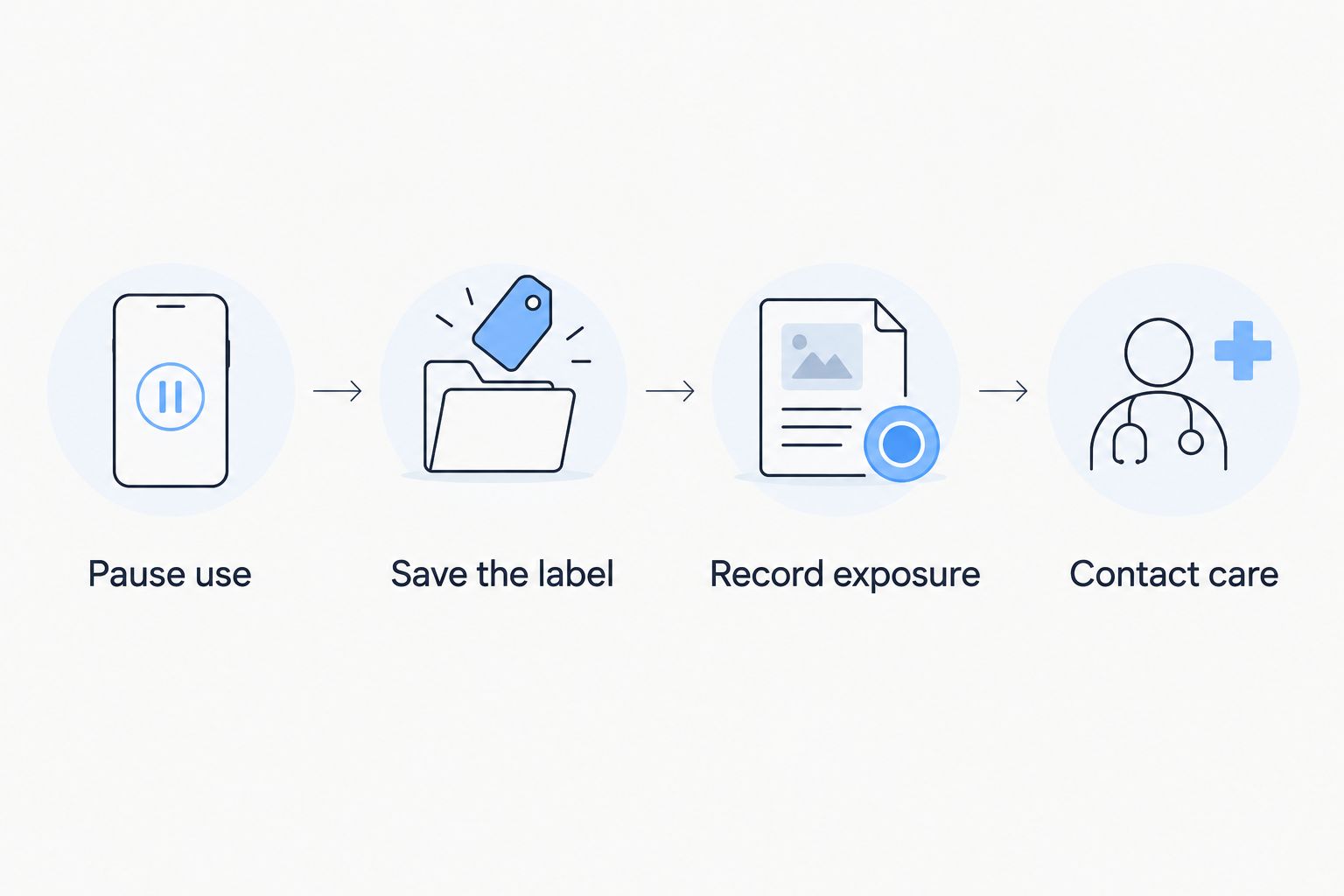
Use this sequence:
- Pause use. Do not take another serving while waiting for guidance.
- Save the label. Keep the bottle or photograph the ingredients and directions.
- Record exposure. Note when you used it, how much, the route, and any symptoms.
- Contact care. Share those details with your obstetric clinician, midwife, or pharmacist.
If you swallowed an essential oil, used an uncertain amount, or have concerning symptoms after exposure, contact Poison Control for case-specific advice. In the United States, 1-800-222-1222 provides 24-hour poison advice. Do not induce vomiting unless a medical professional directs you to do so.
Trouble breathing, collapse, seizures, or inability to wake someone require emergency help. Vaginal bleeding, severe abdominal pain, or other urgent pregnancy symptoms also need prompt medical assessment rather than an online supplement discussion.
Is oregano oil safer after the first trimester?
There is no established pregnancy-safe dose of oregano oil for a later trimester. Completing the first trimester does not turn an inadequately studied supplement into a proven safe option.
If someone recommends starting it later in pregnancy, ask what pregnancy-specific evidence supports that recommendation. Your clinician should assess the exact product and reason for use, not rely on a general trimester rule.
Does organic oregano oil make a difference during pregnancy?
Organic labeling does not establish pregnancy safety. It concerns how a product's agricultural ingredients are produced under the applicable standard, not whether a concentrated preparation has been adequately studied in pregnancy.
The same distinction applies to terms such as non-GMO, natural, or clean-label. Those descriptions do not identify a safe dose or demonstrate a prenatal benefit.
A product label is useful for review—not for prenatal approval
The Oil of Oregano 75% Carvacrol product is listed as a 2 oz bottle. The stated 75% carvacrol is a composition detail; neither that percentage nor the bottle size establishes an appropriate pregnancy serving.
For pregnant shoppers, Herbal Goodness oil of oregano is a product to review with an obstetric clinician, not a prenatal recommendation. A named botanical and stated concentration help identify what you are discussing. The limitation is that product detail does not supply pregnancy safety evidence.
Retailers and health practitioners should preserve this distinction when discussing Herbal Goodness herbal supplements. General immune or digestion positioning should not become a recommendation for pregnant customers. Direct pregnancy-specific questions to the customer's prenatal clinician, and discuss trade enquiries separately from clinical suitability.
Do not substitute black seed oil, another herb, or a multi-herb bundle simply because oregano oil is unsuitable for self-directed use. Each preparation needs its own pregnancy assessment.
FAQ
Can I take oil of oregano during pregnancy?
Avoid oil of oregano during pregnancy unless your obstetric clinician specifically approves the exact preparation. Concentrated oregano supplements do not have established pregnancy safety or a pregnancy-safe dosing schedule.
Can I eat oregano on pizza while pregnant?
Oregano used in ordinary food amounts is different from concentrated oregano oil supplementation. Seasoning a meal does not establish that drops, capsules, or essential oils are suitable during pregnancy.
What if I took oregano oil before I knew I was pregnant?
Stop further use and contact your prenatal care team with the product label, amount, route, and timing. An exposure does not by itself establish that harm occurred.
Is diluted oregano oil safe to put on my skin during pregnancy?
Dilution does not establish pregnancy safety for topical oregano oil. Ask your prenatal clinician about the exact preparation and intended application, and do not apply undiluted essential oil to skin or mucous membranes.
Is there a safe number of oregano oil drops to take while pregnant?
There is no established pregnancy-safe number of oregano oil drops. Bottle directions and lower servings do not replace a pregnancy-specific assessment.
Can I use oregano oil for a cold while pregnant?
Do not self-treat a cold during pregnancy with oregano oil. Discuss your symptoms with your prenatal clinician, who can advise on appropriate care and whether further assessment is needed.
Does a 75% carvacrol label mean oregano oil is safe during pregnancy?
A 75% carvacrol label describes composition, not pregnancy safety. It does not demonstrate a safe prenatal dose or a proven benefit for pregnant users.
Is black seed oil a safer pregnancy alternative to oregano oil?
Do not assume black seed oil is a pregnancy-safe substitute for oregano oil. Ask your prenatal clinician to assess each botanical and preparation separately before use.
One last thing
The most useful item to bring to a pregnancy supplement appointment is the full label, not a list of claimed benefits. Photograph the ingredient panel and serving directions, then explain why you want to use the product. That gives your clinician a specific exposure and a specific goal to assess.
For your 2026 review, include teas, drops, capsules, topical oils, and multi-herb blends—not just products you think of as medicine. Keep necessary prescribed care unchanged unless your clinician tells you otherwise. This article provides education, not individualized prenatal advice.
Related guides
These general educational guides are not pregnancy recommendations. Review any supplement discussed in them with your prenatal clinician before use.