





Is bamboo leaf extract safe to take every day?

Bamboo leaf extract should not be treated as automatically safe for daily use: the decision depends on the exact preparation, serving size, other ingredients, medications, and your health history. Before starting a daily routine in 2026, review the label with a healthcare professional, especially if you are pregnant, breastfeeding, taking medication, or managing a medical condition.
- Is bamboo leaf extract safe daily? The exact formula and your health history determine the answer.
- A 15X concentration statement does not establish a safe daily serving or long-term safety.
- Herbalgoodnessco bamboo leaf extract needs the same label and medication review as any herbal supplement.
- Traditional use and silica content do not establish proven hair, skin, nail, or collagen benefits.
Is bamboo leaf extract safe to take every day?
There is no single daily-use recommendation that applies to every bamboo leaf extract. A leaf extract, a different bamboo plant part, and an isolated silicon ingredient are not interchangeable. Safety information needs to match what is actually in the bottle.
Start with the Supplement Facts panel rather than the front-label benefit statement. Identify the botanical name, plant part, amount per serving, suggested use, and other ingredients. If you are comparing labels, the bamboo leaf extract supplements guide provides a related starting point; suitability still requires an individual safety review.
Use this decision table to organize that conversation. It is a screening aid, not medical clearance.
| Decision | Best for | Practical advantage | Limitation |
|---|---|---|---|
| Review before starting | Adults considering a daily routine | Identifies label questions and potential medication concerns | Does not establish long-term safety |
| Defer use | Anyone with an incomplete label or unresolved health question | Avoids starting without essential information | Requires clarification before deciding |
| Seek individualized advice | People who are pregnant, breastfeeding, taking medication, or managing a condition | Connects the decision to personal circumstances | General supplement guidance cannot replace that assessment |
A label direction is not proof that a product is appropriate for everyone. Equally, uncertainty does not prove that bamboo leaf extract is harmful. The useful next step is a product-specific review, not a blanket yes or no.
Why this matters
Daily use turns an occasional supplement choice into repeated exposure. You need to understand both what you are taking and why you are taking it; a familiar plant name does not answer either question completely.
For your 2026 supplement review, distinguish three separate questions: does the preparation have evidence for your intended purpose, is its composition clear, and is it suitable for you? A positive answer to one does not settle the others.
The FDA's consumer guidance, Dietary Supplements: What You Need to Know, explains that dietary supplements are not approved for safety and effectiveness before marketing in the same way as drugs. That regulatory distinction applies to supplements generally; it is not a finding about a particular bamboo product.
What evidence actually answers a daily-safety question?
The most relevant evidence would involve people taking the same bamboo species, plant part, preparation, and serving for a comparable duration. It would also report adverse effects, not simply a desirable laboratory result.
An antioxidant finding in a laboratory cannot establish that a person can take an extract indefinitely. An animal study also cannot, by itself, establish an appropriate human serving. Those distinctions matter when reading research summaries or product descriptions.
Traditional use is context, not a daily-use guarantee
A history of herbal use can explain why a plant attracts interest. It does not establish that every modern concentrated extract has the same composition as a traditional preparation.
Look for a clear separation between traditional use and findings from human research. When a source blends them together, ask which claim comes from which type of evidence before using it to justify daily supplementation.
Silica-related claims need ingredient-specific evidence
Bamboo leaf extract, silica, and silicon are related terms in supplement discussions, but they do not describe an identical finished product. Evidence about an isolated silicon preparation does not automatically establish the benefits or safety of a bamboo leaf extract.
Do not treat a hair, skin, nail, or collagen statement as proof of a measurable result. Ask whether the supporting study actually tested the ingredient and preparation you intend to use, rather than a different compound with a similar description.
Safety reports need a clear scope
A study that reports tolerability during its observation period answers a narrower question than lifelong safety. The participants, exclusions, serving, and duration all define what the findings can support.
For a 2026 purchasing decision, read those details before accepting a general claim such as safe for everyday use. A summary without its study population or preparation leaves essential questions unanswered.
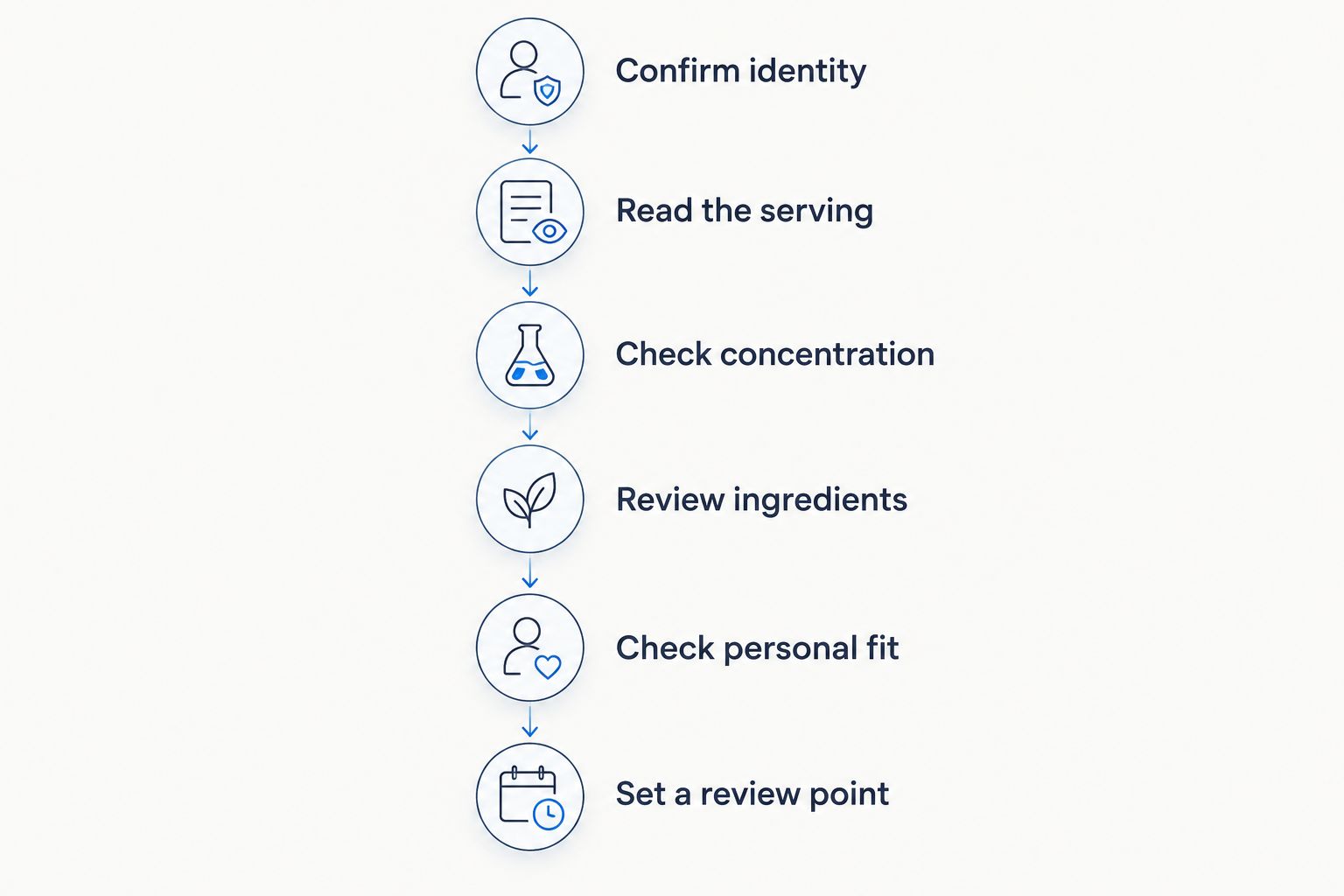
How to review a bamboo leaf extract before daily use
Use the following sequence with the actual bottle or a complete label image. Keep the information together so your pharmacist or clinician can assess the finished formula rather than the plant name alone.
- Confirm identity. Find the botanical name and verify that the listed plant part is leaf. Ask the manufacturer to clarify anything missing or ambiguous.
- Read the serving. Record the labeled amount per serving and suggested frequency. Separate the amount of extract from any separately declared constituent.
- Check concentration. Note an extract ratio or concentration statement, but do not use it alone to calculate a personal serving.
- Review ingredients. Read the full ingredient list, including other botanicals, carriers, flavorings, and preservatives where listed.
- Check personal fit. Share your medications, other supplements, allergies, pregnancy or breastfeeding status, and relevant health history with a healthcare professional.
- Set a review point. Agree on what you are trying to achieve and when to reconsider use. Do not let automatic reordering become the reason you continue.
This process separates label reading from medical assessment. Both matter, and neither is replaced by a concentration number or a benefit statement.
What does a 15X statement tell you?
A 15X statement does not, by itself, tell you the amount of silica, the amount absorbed, or a safe daily serving. Read the manufacturer's explanation alongside the Supplement Facts panel rather than interpreting the concentration statement as a complete specification.
Do not assume that 15X means you should take a fraction of another product's serving. Different labels require their own directions, and serving conversions need more information than a front-label multiplier.
Herbalgoodnessco offers a Bamboo Leaf 15X Liquid Extract. Its liquid format is relevant to shoppers considering an extract, but the 15X designation is not evidence of personal suitability or indefinite daily safety.
Herbalgoodnessco bamboo leaf extract is best considered by adults prepared to review the exact label with a healthcare professional. The decision should rest on the current formula and your circumstances, not on the assumption that a plant-based product is automatically gentle.
Why daily-use suitability varies
These factors explain why another person's experience is not a reliable dosing guide:
- Botanical identity and plant part: information about bamboo shoots or another plant part does not automatically answer a leaf-extract question.
- Preparation: extraction method and finished composition determine what the product contains; the plant name alone is incomplete.
- Serving and duration: the amount taken and the intended length of use belong in the safety discussion.
- Additional ingredients: a blended formula needs a review of the whole ingredient list, not just bamboo leaf.
- Medications and supplements: your pharmacist needs the complete list to assess potential interactions and overlapping ingredients.
- Personal circumstances: pregnancy, breastfeeding, age, allergies, and existing conditions change the information needed before use.
The National Center for Complementary and Integrative Health's Using Dietary Supplements Wisely advises discussing supplement use with healthcare providers and highlights concerns about interactions and use during pregnancy. This is general supplement guidance, not evidence that bamboo has a particular interaction.
For your 2026 safety check, avoid converting a general precaution into an unsupported bamboo-specific claim. Ask about the actual formula instead.
Who should get advice before starting?
Get individualized advice before daily use if you take medication, are pregnant or breastfeeding, or have an existing medical condition. Do not use a general adult label to decide what is appropriate for a child.
Bring the full label to the appointment or pharmacy consultation. A product name alone leaves out serving information and ingredients that can affect the assessment.
Tell your surgical team about all supplements before a planned procedure and follow its instructions. Do not stop prescribed medication or substitute bamboo leaf extract for medical care.
If you develop a new symptom after starting, stop the supplement and contact a healthcare professional for advice. Seek urgent care for trouble breathing, swelling of the lips or tongue, fainting, or another severe reaction; do not take another serving to test whether the reaction happens again.
Can you take bamboo leaf extract with other supplements?
Review the combined ingredient list before combining bamboo leaf extract with other supplements. Separate products can contain overlapping ingredients, especially when several formulas target the same hair, skin, or nail goal.
Taking products at different times does not establish that the combination is safe. Show your pharmacist or clinician the labels together, including vitamins, minerals, herbal blends, and nonprescription medicines.
Avoid starting several new supplements together. Keeping changes separate makes it easier to describe what changed if you develop an unwanted effect, although it does not eliminate risk.
Should you take breaks from bamboo leaf extract?
A break schedule is not a substitute for evidence about the actual product. Do not invent an on-and-off routine to make an uncertain serving seem safer.
Instead, ask your healthcare professional whether use is appropriate, what duration makes sense, and what would prompt reassessment. A product's instructions and your personal circumstances should guide that conversation.
For a daily routine in 2026, continuation should be an active decision. Reconsider use when your medication list changes, a new health issue develops, or the reason for taking the supplement no longer applies.
Does feeling fine mean you can keep taking it?
Feeling fine does not establish long-term safety or prove that a supplement is delivering its intended benefit. Personal experience matters, but it cannot answer every safety question.
Keep the product name, label, and start date available. If you speak with a healthcare professional about a new symptom, mention the supplement even if you do not think it caused the problem.
The same principle applies when you feel no benefit. Do not increase the serving beyond the label or add more products simply because the result is unclear.
FAQ
Is bamboo leaf extract safe to take every day?
Daily bamboo leaf extract use requires a review of the exact formula and your health history; it is not automatically safe for everyone. Check the serving, other ingredients, medications, and intended duration with a healthcare professional.
How much bamboo leaf extract should I take daily?
There is no universal daily serving that applies to every bamboo leaf extract. Follow the current product label and ask a healthcare professional whether that serving is appropriate for you; do not calculate it from an extract ratio alone.
Does 15X bamboo leaf extract mean it contains more silica?
A 15X statement alone does not establish the silica amount in a serving. Look for an explicitly declared amount and ask the manufacturer to explain what the concentration statement describes.
Can I take bamboo leaf extract while pregnant or breastfeeding?
Do not start bamboo leaf extract during pregnancy or breastfeeding without your maternity clinician's approval. A general adult-use label does not establish suitability during these periods.
Can bamboo leaf extract interact with my medication?
Your pharmacist or clinician should review the exact bamboo leaf formula alongside your medication list. General warnings about herb–drug interactions do not establish a specific bamboo interaction, but an unlisted interaction is not proof of compatibility.
Is bamboo leaf extract proven to improve hair and nails?
A bamboo leaf or silica claim alone does not prove a hair or nail benefit. Supporting evidence needs to match the ingredient, preparation, serving, and outcome being claimed.
Should I stop bamboo leaf extract if it makes me feel unwell?
Stop bamboo leaf extract and contact a healthcare professional if you develop a new symptom after starting it. Seek urgent care for severe symptoms such as trouble breathing, lip or tongue swelling, or fainting.
One last thing
An extract ratio is not a safety rating. Before your next purchase, photograph the complete label and keep it with your medication and supplement list. That small step makes the next safety conversation more useful than relying on a product name or remembering a front-label claim.