





How long does mullein tea take to help a cough?

Mullein tea has no clinically established timeline for helping a cough in 2026. A warm drink may temporarily soothe an irritated throat, but that feeling does not prove that mullein shortens a cough or addresses its cause. Do not use a promised number of minutes or days as a reason to delay medical care.
- Mullein tea for cough how long? No reliable clinical evidence establishes a response time.
- European Medicines Agency guidance concerns mullein flower; it does not establish equivalent benefits for mullein leaf.
- Herbalgoodnessco mullein tea suits shoppers seeking a brewed leaf preparation, not a proven cough treatment.
- Seek urgent help for breathing difficulty, chest pain, or coughing up blood.
Why this matters
Throat comfort and cough recovery are different outcomes. You can feel better after drinking something warm while the reason for your cough remains unchanged.
For a 2026 buying decision, the useful questions are which plant part the product contains, what evidence supports that preparation, and whether your symptoms need assessment. A stronger-sounding label does not answer those questions.
How long does mullein tea take to help a cough?
There is no evidence-based countdown for mullein leaf tea. Neither a tea bag nor a concentrated extract has an established clinical response time for cough relief.
| Preparation | Best for | Practical advantage | Evidence limit or drawback |
|---|---|---|---|
| Organic mullein leaf tea | Adults seeking a brewed herbal drink after checking suitability | Combines a leaf preparation with a warm beverage | No established time to cough relief; brewing is required |
| Mullein leaf liquid extract | Adults who prefer a liquid supplement format after checking suitability | Does not require brewing tea | Not interchangeable with tea; concentration does not establish faster relief |
| Warm water | People seeking a simple warm drink without an added herb | Avoids exposure to mullein ingredients | Comfort is not evidence that the cause of a cough has improved |
The European Medicines Agency's herbal monograph on Verbascum flower recognizes traditional use for relief of sore throat associated with dry cough and cold. Its scope is flower preparations, not proof that a leaf tea works within a particular interval.
That distinction matters. Traditional-use recognition is not the same as clinical evidence establishing how much a preparation helps, who responds, or how quickly it works.
What does feeling better after a cup actually mean?
If your throat feels less dry while you sip, record that as temporary comfort. Do not turn it into a claim that mullein has cleared mucus, resolved an infection, or repaired your lungs.
Research by Sanu and Eccles, published in Rhinology in 2008, examined a hot fruit drink and reported subjective relief of some cold symptoms, including cough. It did not study mullein, so its findings cannot establish a mullein-specific effect or response time.
How long does a cough normally last?
NICE guideline NG120 states that an acute cough usually improves within 3–4 weeks without antibiotics. That is a general illness timeline, not the expected time for mullein tea to start working.
NHS cough guidance advises seeking medical assessment for a cough lasting more than 3 weeks. Seek care sooner if symptoms worsen, you feel very unwell, or you have warning signs.
For adults, CHEST cough-classification guidance defines chronic cough as lasting more than 8 weeks. Do not interpret that classification as permission to wait that long before asking for help.
What the research does—and does not—support
The central evidence question in 2026 is not whether mullein has a history of respiratory use. It does. The question is whether human research establishes a reliable benefit and timeline for the specific leaf tea you are considering.
Traditional use supports a history of use, not a guaranteed result. Laboratory findings about plant compounds also cannot tell you when a brewed cup will change a person's cough.
Keep these evidence categories separate:
- Traditional use: Documents how an herb has been used; it does not measure a dependable response time.
- Laboratory research: Examines compounds or biological activity under controlled conditions; it does not establish a household tea's clinical effect.
- Human clinical research: Can assess symptom changes in people, but the plant part, preparation, comparison, and outcome must match the claim.
- Personal experience: Describes what happened to an individual; it cannot separate the herb's effect from warmth, hydration, other care, or natural recovery.
The EMA flower monograph is useful precisely because it identifies its preparation and evidence basis. Applying its conclusions directly to a leaf product would erase an important limitation.
Why leaf and flower are not interchangeable evidence
A shared plant name does not make every preparation equivalent. The plant part, extraction method, ingredients, and amount used all matter when deciding whether research applies.
For mullein leaf products, read the label rather than assuming that research about Verbascum flowers validates the product. Likewise, a study of an extract would not automatically establish the same outcome for tea.
Why your experience with mullein tea varies
A different experience from someone else's does not establish that you need a larger serving. Several factors change how you feel or make the result difficult to interpret:
- Cough cause: Respiratory infections, allergies, reflux, asthma, and some medicines can cause cough. Tea does not identify which explanation applies.
- Throat dryness: A warm beverage can feel comforting even when the underlying cough continues.
- Plant part: Leaf and flower preparations should not inherit each other's evidence without justification.
- Preparation: Tea and liquid extract differ; their labels do not establish equivalent servings or response times.
- Other changes: Rest, fluid intake, prescribed care, and the natural course of an illness complicate any claim that the tea caused improvement.
- Individual suitability: Age, pregnancy, breastfeeding, allergies, and medicine use affect whether trying an herbal preparation is appropriate.
Do not respond to uncertain results by increasing the amount or combining several respiratory supplements. More exposure is not evidence of more benefit, and adding products makes unwanted effects harder to trace.
How should you prepare and assess mullein tea?
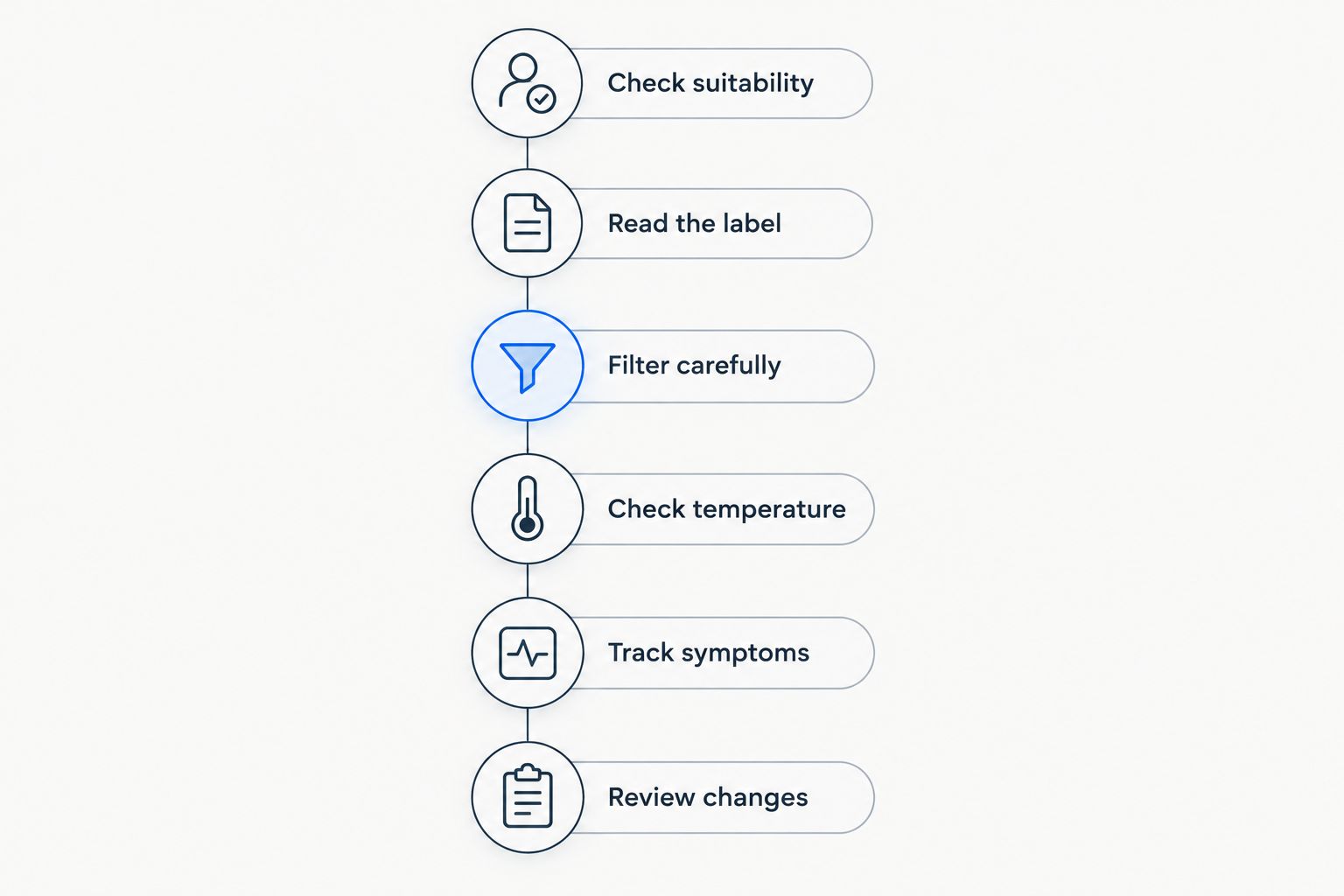
For a 2026 home routine, use the product's directions rather than an online recipe presented as a medical dose. No universal brewing instruction establishes a cough-relief timeline.
- Check suitability. Ask a pharmacist or clinician about your medicines, medical conditions, and whether an herbal product is appropriate.
- Read the label. Confirm that the product contains mullein leaf, note other ingredients, and follow its preparation instructions.
- Filter carefully. Mullein leaves have fine hairs that can irritate; strain loose-leaf preparations thoroughly and avoid drinking visible plant particles.
- Check temperature. Let the tea become comfortably warm before drinking; hotter is not better.
- Track symptoms. Note throat comfort separately from coughing frequency, sleep disruption, and breathing symptoms.
- Review changes. Stop using the product if you develop an unwanted reaction, and seek advice rather than increasing the serving.
Keep your notes simple. Record whether you felt soothed while drinking, whether coughing returned, and whether symptoms are improving overall; you do not need a complicated scoring system.
Avoid changing several supplements at once. If you develop nausea, irritation, or another unwanted symptom after adding multiple products, identifying the cause becomes harder.
Is mullein tea better than liquid extract for a cough?
Neither preparation has an established advantage for speed of cough relief. Tea gives you a brewed drink; liquid extract gives you a different preparation with its own serving instructions.
Herbalgoodnessco offers mullein leaf tea and a mullein leaf liquid extract. Choose between those formats on preparation preference and professional advice—not an assumption that an extract works faster.
A concentration statement describes a product attribute. It does not establish clinical potency, equivalence to a cup of tea, or a shorter wait for symptom relief.
The following products represent those two formats. Their respiratory-wellness names do not establish that they treat cough or replace medical assessment.


Should I keep drinking mullein tea if my cough continues?
A cough lasting more than 3 weeks needs medical assessment under NHS guidance, whether or not tea gives temporary comfort. A persistent cough is a reason to investigate the cause, not automatically extend an herbal routine.
Do not stop prescribed medicines or replace an inhaler with tea. If you already receive care for a breathing condition, follow your clinician's plan and discuss any supplement you want to add.
When should I get help instead of waiting for tea to work?
Seek urgent medical help for difficulty breathing, chest pain, coughing up blood, or a rapidly worsening cough. Severe breathing difficulty is an emergency; do not wait to see what another cup does.
Arrange earlier assessment if you feel very unwell or have a condition that increases your risk of complications. Children, pregnant or breastfeeding people, and people taking regular medicines need individual advice before using mullein products.
A cough becoming more productive is not proof of a beneficial “lung cleanse.” Describe the change to a clinician if it concerns you, particularly when it accompanies worsening symptoms.
What retailers and health practitioners should explain
For 2026 product education, keep the same boundary used for individual shoppers: explain the plant, plant part, format, and label directions without promising a treatment result. Herbalgoodnessco mullein leaf products should not be presented as having a proven onset of cough relief.
Avoid turning customer testimonials into timing claims. Someone reporting that a cup felt soothing does not establish how another person will respond, and flower-based traditional-use guidance should not be presented as leaf-specific clinical proof.
Trade readers can request wholesale information through the wholesale application. Keep purchasing discussions separate from individualized medical advice, especially when a customer describes persistent or worsening symptoms.
Research and guidance behind this answer
These sources address different questions. None establishes a reliable time to cough relief from mullein leaf tea.
- European Medicines Agency, herbal monograph on Verbascum flower: Traditional-use guidance for specified flower preparations; not equivalent evidence for leaf tea.
- Sanu and Eccles, Rhinology, 2008: Human research on a hot fruit drink and subjective cold-symptom relief; not a mullein study.
- NICE guideline NG120, published 2019: Acute-cough guidance, including the usual 3–4 weeks course.
- NHS cough guidance: Advice to seek assessment for cough lasting more than 3 weeks, with earlier help for warning signs.
- CHEST adult cough-classification guideline, published 2018: Defines chronic cough as more than 8 weeks; this is a classification, not a recommended waiting period.
FAQ
How long does mullein tea take to help a cough?
Mullein tea has no clinically established time to cough relief. A warm drink may soothe your throat temporarily, but that does not demonstrate a mullein-specific effect or faster recovery.
Can mullein tea help my cough after the first cup?
You might feel temporary throat comfort after a warm cup, but that is not proof that mullein has changed your cough. Separate how your throat feels while drinking from whether the cough improves overall.
Is mullein liquid extract faster than mullein tea?
There is no established clinical evidence that mullein liquid extract relieves a cough faster than tea. Concentration statements do not establish a response time or equivalence between preparations.
How long should I wait before getting a persistent cough checked?
A cough lasting more than 3 weeks warrants medical assessment under NHS guidance. Seek help sooner for worsening symptoms, breathing difficulty, chest pain, coughing up blood, or feeling very unwell.
Does coughing up more mucus mean mullein is cleaning my lungs?
Coughing up more mucus does not prove that mullein is cleaning your lungs. A change in cough or mucus needs interpretation alongside your other symptoms, not a detox explanation.
Can I give mullein tea to a child with a cough?
Ask a pediatric clinician or pharmacist before giving mullein tea to a child. Adult herbal-product directions and evidence about other preparations do not establish an appropriate pediatric serving.
Can I drink mullein tea while pregnant or taking medicine?
Check with your clinician or pharmacist before using mullein during pregnancy, breastfeeding, or regular medicine use. A natural ingredient is not automatically suitable for your circumstances.
One last thing
Decide what would count as improvement before you brew. Less throat irritation while sipping, fewer coughing episodes, and easier breathing are different observations; do not combine them into a single claim that the herb worked.
The practical rule for 2026 is simple: use symptom changes to guide care, not to justify a stronger herbal routine. Comfort can be welcome without being evidence of treatment.