





How long does ginseng take to boost energy?

Ginseng has no established average time to boost energy; human fatigue studies have assessed changes after 4 weeks and 8 weeks, rather than proving an immediate effect. Those checkpoints are not guaranteed onset times, and results depend on the species, preparation, and people studied. For your 2026 decision, treat ginseng as an uncertain supplement option—not a substitute for investigating persistent tiredness.
- How long does ginseng take to work? Studies assess fatigue over weeks; no reliable average onset is established.
- Panax ginseng and American ginseng are different plants; their energy findings are not interchangeable.
- An 8-week American ginseng trial involved cancer-related fatigue, not ordinary afternoon tiredness.
- Herbalgoodnessco shoppers should compare the named plant and preparation, not rely on a promised energy deadline.
How long does ginseng take to boost energy?
The evidence supports study checkpoints, not a personal countdown. A study that measures fatigue after several weeks cannot tell you precisely when an individual first feels different—or whether that individual will benefit.
Two published trials explain why a single answer is misleading. They investigated different ginseng species, used different preparations, and enrolled different populations.
| Research example | Assessment period | What the results support | Main limitation |
|---|---|---|---|
| Panax ginseng: Kim and colleagues, PLOS ONE, 2013 | 4 weeks | Some fatigue-related outcomes improved in adults with idiopathic chronic fatigue | Findings differed across measures; the trial did not establish a universal onset time |
| American ginseng: Barton and colleagues, Journal of the National Cancer Institute, 2013 | 4 weeks and 8 weeks | A significant between-group fatigue difference appeared at the later checkpoint | Participants had cancer-related fatigue; results do not establish effects in otherwise healthy shoppers |
Before comparing bottles, establish which species and preparation the research actually tested. The ginseng supplements guide provides a separate starting point for product-selection questions; this page focuses on timing and what the evidence can support.
Why this matters
Feeling sleepy, feeling physically exhausted, and struggling to concentrate are not the same outcome. A study measuring fatigue does not automatically prove better alertness, exercise performance, or motivation.
That distinction matters when you read an energy claim in 2026. A product description can group several experiences together, while a clinical trial measures a specific symptom with a particular questionnaire.
Choose the outcome before choosing the supplement. If your concern is persistent exhaustion, evaluating the cause matters more than selecting a stronger extract or waiting for a promised deadline.
Panax ginseng: a 4-week research window
Kim and colleagues’ 2013 randomized, placebo-controlled trial, published in PLOS ONE as Antifatigue Effects of Panax ginseng C. A. Meyer, studied adults with idiopathic chronic fatigue over 4 weeks. The research reported benefits on some fatigue-related measures, but not a uniform improvement across every outcome.
That is evidence of a possible benefit under the study’s conditions. It is not proof that every Panax ginseng capsule, tea, or tincture works within 4 weeks.
The practical advantage of this research is its direct examination of fatigue rather than a vague wellness claim. Its limitation is equally important: a defined study population and preparation cannot represent every shopper or every bottle.
Best for interpreting: claims specifically tied to Panax ginseng research. Do not apply this timeline to a different botanical merely because its common name includes ginseng.
American ginseng: an 8-week research window
Barton and colleagues’ 2013 randomized trial, Wisconsin Ginseng (Panax quinquefolius) to Improve Cancer-Related Fatigue, appeared in the Journal of the National Cancer Institute. The study compared American ginseng with placebo and assessed fatigue at 4 weeks and 8 weeks.
The between-group difference was not statistically significant at 4 weeks but was significant at 8 weeks. That result supports the later assessment in that particular population; it does not prove that effects begin precisely at the later checkpoint.
This trial provides useful human evidence, but its participants had cancer-related fatigue. Anyone receiving cancer care should discuss supplements with their oncology team rather than copy a research regimen independently.
Best for interpreting: American ginseng claims that accurately describe the study population. It is not a general energy timetable for healthy adults.
What those checkpoints mean for you
Neither trial establishes an average onset for everyday low energy. They also do not establish that taking ginseng longer guarantees a better result.
For a 2026 purchasing decision, distinguish three separate questions: Was an improvement measured? Was it greater than placebo? Does the tested preparation match the product you are considering? A convincing answer to only the first question is not enough.
Why ginseng response varies
Differences between products and studies make a universal timeline unreliable. These are reasons to inspect the evidence, not reasons to assume that a disappointing result requires more ginseng.
- Plant identity: Panax ginseng and Panax quinquefolius are different species. A finding for one does not automatically establish an effect for the other.
- Preparation: Root powder, an extract, and brewed tea are not identical preparations. Match the research material to the label before transferring a claim.
- Measured outcome: Fatigue questionnaires, attention tests, and exercise measurements answer different questions. Better performance on one does not prove improvement on all.
- Study population: Findings in adults with a defined fatigue problem do not establish the same response in healthy people seeking an afternoon boost.
- Other ingredients: A blend containing caffeine can produce an alerting effect that cannot be attributed to ginseng alone. Read the complete ingredient list.
- Reason for tiredness: Sleep loss, medication effects, and underlying health problems require different responses. A supplement timeline does not identify the cause.
The National Center for Complementary and Integrative Health’s Asian Ginseng resource distinguishes the plant’s traditional uses from the limits of clinical evidence. Its safety guidance also identifies insomnia and potential medication interactions as considerations—not signs that a product is working.
How should you evaluate a ginseng product before trying it?
Use the label to answer basic identity and safety questions before looking for an energy promise. A clearly described preparation is easier to evaluate than an impressive-sounding claim.
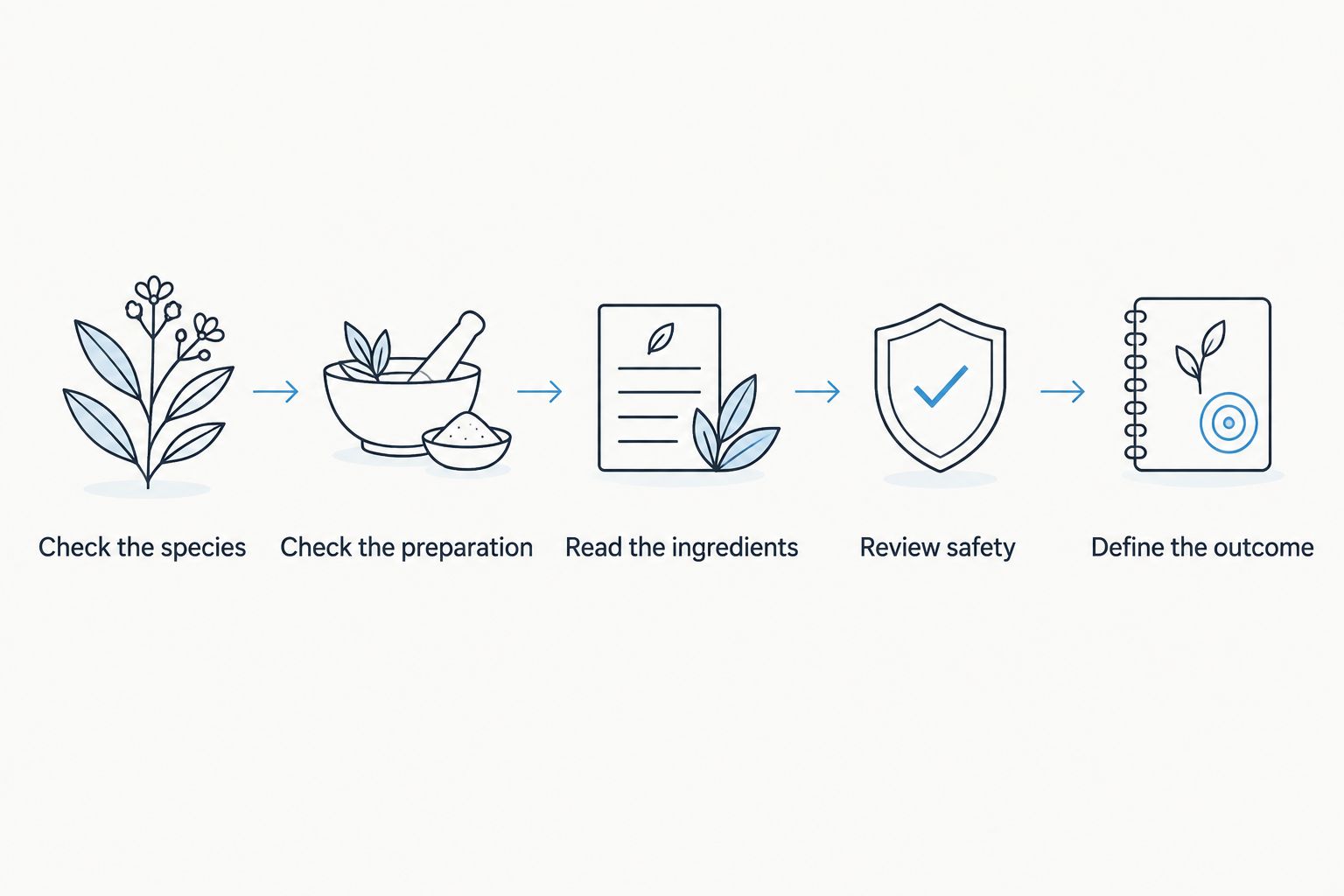
- Check the species. Look for the botanical name, such as Panax ginseng or Panax quinquefolius. The word ginseng alone leaves an important question unanswered.
- Check the preparation. Identify whether the serving contains root powder, an extract, or another form. Do not equate the amount of one preparation with another.
- Read the ingredients. Look for caffeine-containing plants, added stimulants, and other herbs. A multi-ingredient product makes it harder to identify what caused either a benefit or a side effect.
- Review safety. Ask a pharmacist or clinician about your medicines, health conditions, pregnancy status, and planned procedures. Bring the actual label, not just the product name.
- Define the outcome. Decide whether you are tracking afternoon fatigue, concentration, or something else. Set a review point with your clinician rather than borrowing a trial endpoint as a promise.
An extract ratio alone does not establish clinical effectiveness. Neither does an organic claim: sourcing information and evidence of a health benefit answer different questions.
Keep this distinction clear in 2026: a label can describe what is in the bottle without proving how quickly you will feel a change. Ask for evidence that matches the species, preparation, and intended outcome.
Does ginseng work on the first day?
A 4-week fatigue study does not establish a first-day energy benefit. Some ginseng research examines short-term cognitive outcomes, but an attention-test result is not proof of sustained energy or less fatigue in daily life.
If you feel different immediately, check whether the product also contains caffeine. A noticeable sensation cannot identify which ingredient caused it, and a lack of sensation does not establish that you need a larger serving.
Should you wait 8 weeks before deciding ginseng is not helping?
An 8-week study endpoint is not a universal waiting rule. The American ginseng trial’s result applies to its preparation, participants, and measured outcome—not every situation in which someone feels tired.
Agree on an appropriate review point with a clinician if you are considering a trial. Stop and seek advice sooner if you develop unwanted effects; there is no reason to continue a poorly tolerated supplement just to reach a research checkpoint.
Does liquid ginseng work faster than capsules or tea?
Neither a 4-week nor an 8-week fatigue endpoint proves that liquid ginseng works faster. Establishing faster symptom relief requires a direct comparison of the preparations, not an assumption based on their physical form.
| Preparation | Practical advantage | Limitation | Best for |
|---|---|---|---|
| Capsules | A clearly labelled serving can simplify tracking | Capsules can contain different species, powders, or extracts | Readers prioritizing a repeatable labelled serving |
| Liquid extract | Offers a format for people who prefer not to swallow capsules | Concentration and ingredients differ; liquid form does not prove faster fatigue relief | Readers prioritizing a non-capsule preparation |
| Tea | Fits a brewing routine | Brewed tea is not interchangeable with an extract used in a clinical trial | Readers prioritizing the beverage experience rather than a trial-matched regimen |
These are format considerations, not a ranking of effectiveness. Choose a preparation you can evaluate, not the one described as fastest.
How can you tell whether ginseng is helping?
Write down what you want to change before starting. A brief record of fatigue, sleep, caffeine, and unwanted effects is more informative than trying to remember how you felt before opening the bottle.
Keep the outcome specific. For example, note whether you can complete your normal afternoon tasks without the usual exhaustion, rather than recording only a general impression of feeling healthier.
Avoid adding several new supplements at the same time. If your routine changes in several ways, you cannot confidently attribute an improvement—or a problem—to ginseng.
This kind of tracking supports a better conversation with your clinician; it does not turn personal experience into a controlled trial. Expectation, changing workload, and recovery from poor sleep can also affect how you feel.
When should you get medical advice instead of waiting?
Persistent, worsening, or unexplained fatigue deserves medical assessment, especially when it interferes with daily activities. Do not use a supplement review date as a reason to delay care.
Seek urgent medical attention for fatigue accompanied by symptoms such as chest pain, severe shortness of breath, or fainting. Those symptoms require assessment rather than an herbal adjustment.
The NCCIH Asian Ginseng resource identifies insomnia as a common side effect and notes concerns about blood sugar, blood clotting, and medication interactions. Ask for professional guidance if you take medicines, have a health condition, or are pregnant or breastfeeding.
Losing sleep is not a useful energy benefit. If ginseng disrupts your sleep, continuing it can work against the reason you started taking it.
Where Herbalgoodnessco fits
Herbalgoodnessco is best for shoppers comparing named herbs and preparations, not seeking a guaranteed ginseng energy deadline. Its stated range includes herbal supplements, teas, capsules, tinctures, and plant oils; that range does not establish evidence for a particular ginseng product.
Use the same standard when comparing any herbal brand: identify the plant, inspect the preparation, and separate general wellness positioning from a demonstrated outcome. Product variety helps you compare formats, but it cannot tell you whether an herb addresses your reason for feeling tired.
FAQ
How long does ginseng take to work for energy?
Ginseng has no established average onset for an energy benefit. Human fatigue studies have assessed outcomes after 4 weeks and 8 weeks, but those checkpoints do not guarantee that you will benefit.
Will ginseng give me energy immediately?
An immediate energy boost is not established by the fatigue studies discussed here. Check combination products for caffeine, which can affect alertness independently of ginseng.
Is American ginseng better than Asian ginseng for fatigue?
The studies discussed here do not establish that American ginseng is better than Asian ginseng for fatigue. They used different preparations and populations, so their results are not a head-to-head comparison.
Does ginseng tea work faster than capsules?
Ginseng tea is not proven faster than capsules by the fatigue trials discussed here. A brewed preparation and a clinical-trial extract are not interchangeable.
Should I take more ginseng if I do not feel anything?
Do not increase ginseng simply because you do not feel an immediate effect. Follow the product label and discuss lack of benefit or unwanted effects with a clinician or pharmacist.
Can I take ginseng with my prescription medicine?
Ask your pharmacist or prescriber before combining ginseng with prescription medicine. Ginseng can interact with medicines, and your specific product and medication list need review.
Does Herbalgoodnessco guarantee a ginseng energy timeline?
This guide does not establish a guaranteed ginseng energy timeline for Herbalgoodnessco or any other brand. Evaluate claims against research on the same species, preparation, and outcome.
One last thing
A study’s final measurement is not the day an herb starts working. When researchers assess fatigue after several weeks, they establish what was measured at that checkpoint—not an exact onset for everyone who takes the plant.
Make that your 2026 label-reading rule. If a claim turns a study duration into a guaranteed personal deadline, it goes beyond what the study can establish.