





How long does cat's claw take to work?

Cat's claw has no established time to work, so a fixed promise of results within days or weeks is not supported. Small human studies have followed particular extracts over several weeks, but their schedules do not establish when you should notice a benefit from a tea, capsule, or tincture; this 2026 guide explains that distinction and how to assess a product safely.
- How long does cat's claw take to work? No reliable onset time applies across cat's claw supplements.
- Human studies used specific extracts; their results do not establish a timeline for every tea, capsule, or tincture.
- Herbal Goodness sells herbal supplements for health-conscious shoppers; cat's claw still requires a separate evidence and safety check.
- Review medications and pregnancy considerations before starting, rather than waiting for an effect to judge safety.
Why this matters
A study's length is not a countdown to results. Taking an herb for the same period as a research participant does not mean you are taking the same preparation or measuring the same outcome.
Safety also comes before timing. If you are pregnant or trying to conceive, read the guide to cat's claw safety during pregnancy and discuss supplements with your prenatal clinician before starting.
For your 2026 supplement decisions, separate three questions: Is there relevant human evidence? Does your preparation match it? Is taking it appropriate for you? A convincing answer to the first question does not automatically answer the others.
How long does cat's claw take to work?
There is no established average onset time for cat's claw. The National Center for Complementary and Integrative Health, or NCCIH, states that there is not enough high-quality evidence to determine whether cat's claw is useful for any health condition.
The studies below explain why references to weeks appear in discussions of this herb. They describe research schedules, not a recommended waiting period or a promise of benefit.
| Human research | Preparation and scope | Study period | What the timing actually tells you |
|---|---|---|---|
| Piscoya and colleagues, Inflammation Research, 2001 | Freeze-dried Uncaria guianensis extract; 45 participants with knee osteoarthritis | 4 weeks | Researchers assessed a particular extract and specific joint-related outcomes during a short trial. |
| Mur and colleagues, The Journal of Rheumatology, 2002 | A particular Uncaria tomentosa extract; 40 participants with rheumatoid arthritis receiving conventional care | 24-week initial comparison | Researchers assessed that extract alongside existing care, not as a replacement for medical treatment. |
These historical studies involved different species, preparations, populations, and outcomes. They cannot establish a universal timeline for digestion, immune support, or general wellness, and they do not show that every commercially sold cat's claw product behaves alike.
What the research does—and does not—support
The 4-week trial provides a defined observation period for one preparation. It does not establish that you should feel something by the end of week four, or that continuing longer will produce a benefit.
The 24-week comparison also requires context. Participants were receiving conventional care, so the study does not support replacing prescribed treatment with an herb or waiting months before seeking help for persistent symptoms.
A research endpoint is simply a scheduled assessment. Do not turn an assessment date into a personal deadline for results. That distinction is more useful than an unsupported claim that cat's claw “usually works” within a set interval.
Why cat's claw timing claims vary
The following factors explain why two cat's claw claims are not necessarily comparable. They do not provide a formula for predicting your response.
- Plant species: Uncaria tomentosa and Uncaria guianensis both appear in cat's claw research. A shared common name does not make them identical preparations.
- Preparation: Tea, powdered plant material, and extracts are different forms. Evidence for an identified extract does not automatically apply to another form.
- Serving details: A label's serving size describes the product's directions, not a clinically established onset time.
- Outcome measured: A study assessing joint-related symptoms does not establish a timeline for digestion or immune support.
- Other care: Existing medications and treatments matter when interpreting research and deciding whether a supplement is appropriate.
- Evidence quality: Small, condition-specific trials cannot answer every question about effectiveness, safety, or duration of use.
Traditional use belongs in a separate category. A history of use explains why people became interested in cat's claw; it does not establish how quickly a modern supplement works.
Does cat's claw tea, a capsule, or a tincture work faster?
No reliable human comparison establishes that cat's claw tea, capsules, or tinctures produce benefits fastest. Choose a preparation for clear labeling and practical use, not an unsupported speed claim.
| Preparation | Best for | Practical advantage | Limitation |
|---|---|---|---|
| Tea | Adults who prefer a brewed preparation | Fits a familiar tea-making routine | Brewing instructions do not establish equivalence to a studied extract. |
| Capsule | Adults who prefer not to taste an herb | Provides a defined serving according to the label | A capsule can contain powder or extract; the form alone does not identify its contents. |
| Tincture or liquid extract | Adults who prefer a measured liquid | Allows use according to the product's liquid-serving directions | Dropper size and extraction language do not prove faster effects. |
These are format preferences, not recommendations to start taking cat's claw. Each preparation still needs an ingredient and safety review.
Tea: no established onset time
Cat's claw tea is not interchangeable with the freeze-dried extract described in the short human trial. Do not convert a research serving into cups of tea or assume that a stronger brew will reproduce a study.
For a tea, check the botanical name, plant part, ingredients, and preparation instructions. If those details are unclear, choose clarity over a claim about speed.
Capsules: no established onset time
A capsule is a delivery format, not a description of the whole preparation. Read whether the label identifies plant powder, an extract, or a blend, and note the amount per serving.
The convenience of a capsule is a practical benefit. Its limitation is that convenience says nothing about whether the contents match a published study.
Tinctures: no established onset time
A liquid format does not establish faster meaningful effects. Instructions to swallow a liquid or measure it with a dropper are not evidence of a shorter time to benefit.
Check the ingredient list and serving directions rather than treating the word tincture as a speed claim. Do not borrow directions from a different liquid product.
How should you assess cat's claw before starting?
Use this 2026 checklist before deciding whether to add cat's claw to your routine. The goal is not to find the strongest-sounding label; it is to identify what you would take and resolve safety questions first.
- Identify the plant. Look for the botanical name and plant part. A common name alone is not enough to match a product to research.
- Read the preparation. Identify tea, powder, extract, or blend. Record the labeled serving rather than estimating from another product.
- Define your goal. State what you hope to change in plain language. “General wellness” is too broad to judge whether taking something is useful.
- Review medications. Show a pharmacist or clinician the full label and your medication list before starting.
- Plan a review. Agree on what to monitor and when to reassess. Do not substitute a study's duration for individualized advice.
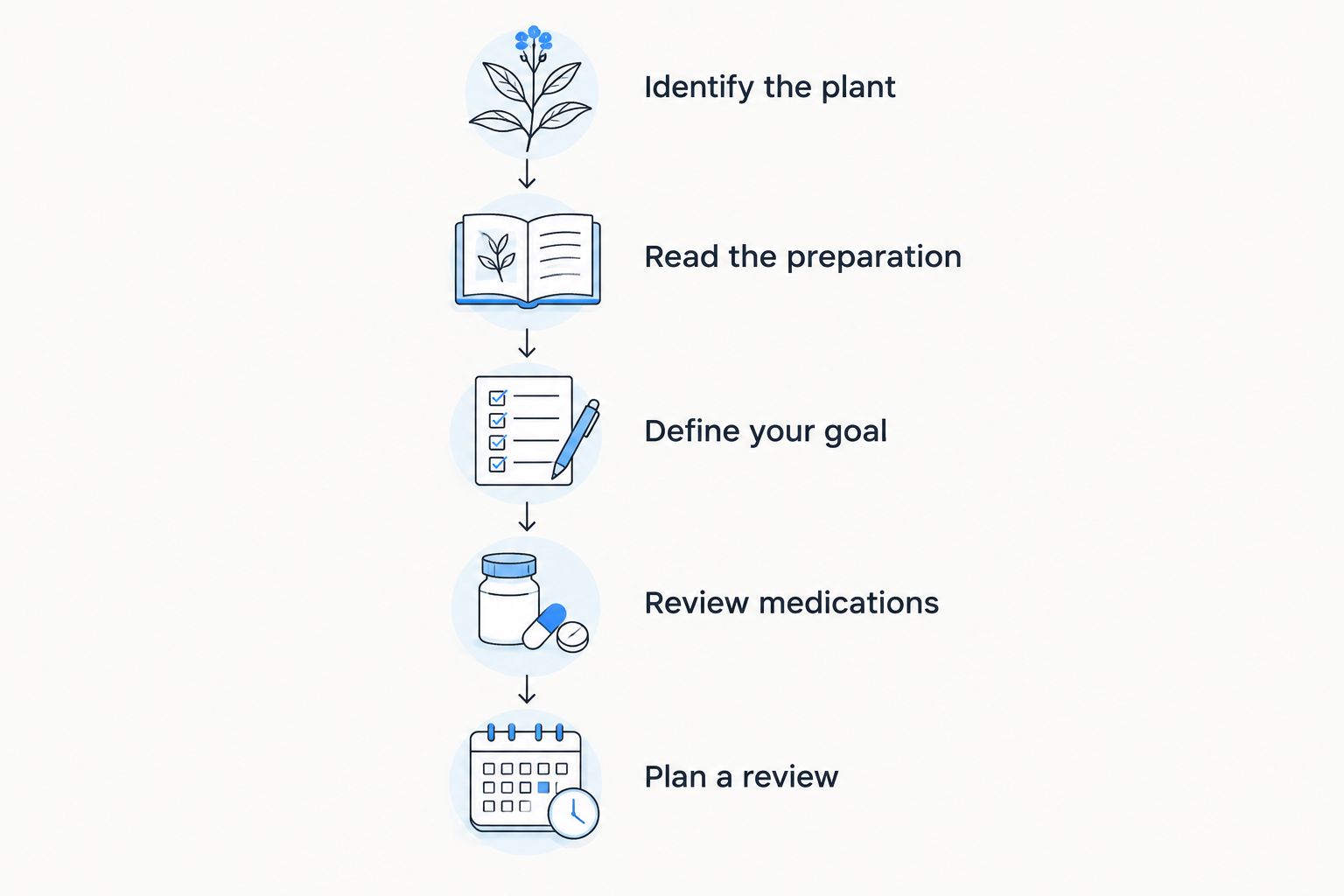
Keep the actual packaging or a clear photograph of its label. That gives your pharmacist something specific to assess and avoids confusion between similarly named herbs or different extracts.
What should you track if a clinician approves use?
Track the same clearly defined observation over time rather than asking whether the supplement “feels like it is working.” Record the product, labeled serving, start date, and any changes to medicines or other supplements.
For example, you can write down the concern that prompted your interest and whether it changes during ordinary activities. Your clinician should help determine which observations matter and whether any testing or medical assessment is needed.
Avoid starting several supplements together. If something changes afterward, simultaneous additions make it harder to identify which product was associated with the change.
Also record unwanted effects. An uncomfortable reaction is not proof that an herb is working, and a “detox” explanation is not a reason to ignore new symptoms.
Is cat's claw appropriate for everyone?
No. NCCIH identifies safety concerns involving pregnancy, autoimmune conditions, and potential interactions with medicines. Its cat's claw fact sheet is a safety reference, not an endorsement of use.
Ask a clinician before taking cat's claw if you use prescription medicines, have a chronic medical condition, are breastfeeding, or have surgery planned. Bring the ingredient label; the supplement's name alone leaves important details unresolved.
Do not use cat's claw as a replacement for medical care. New, persistent, or worsening symptoms need assessment rather than a longer supplement trial. If you develop a suspected reaction, stop taking the product and seek appropriate medical advice; severe symptoms require urgent care.
What should shoppers and retailers ask about cat's claw?
Shoppers should ask for the botanical identity, preparation, full ingredients, and serving directions. Words such as organic, clean-label, and non-GMO address product attributes; they do not establish an onset time or prove a health benefit.
Herbal Goodness sells herbal supplements, superfoods, and teas for health-conscious shoppers. The same evidence standard applies to every category: identify the actual preparation, then assess the claim separately from the format or branding.
Retailers and health practitioners should request product-specific documentation before repeating a timing claim. Trade-interest readers can find the wholesale application on the company's website; a commercial relationship does not replace an independent review of label language and supporting evidence.
How do you know whether cat's claw is working?
No validated home test establishes that cat's claw is working for general wellness. A subjective change alone cannot show that the supplement caused it, particularly when sleep, activity, medicines, or other supplements also change.
Use a clearly defined goal and discuss your observations with a clinician. Feeling nothing does not automatically justify increasing the serving, and feeling better does not establish that continued use is necessary.
Should you take more cat's claw if nothing changes?
No established onset time supports increasing cat's claw simply because you have not noticed a change. Follow the product's directions and seek professional advice rather than copying a research dose or adding another preparation.
More is not a substitute for relevant evidence. Reassess the reason for taking the supplement before changing how you use it.
FAQ
How long does cat's claw take to work in 2026?
Cat's claw has no established time to work. Human studies used particular preparations and outcomes, so their schedules do not establish a reliable personal timeline.
Can cat's claw work the first day?
A first-day benefit is not established by reliable clinical evidence. A sensation after taking a supplement does not demonstrate a meaningful health benefit.
Is cat's claw tincture faster than capsules?
Cat's claw tincture is not established as faster than capsules. The preparation, ingredients, and relevant research matter more than the liquid or capsule format alone.
Should I wait four weeks before deciding cat's claw is not working?
A four-week waiting rule is not established for cat's claw. One historical trial lasted four weeks, but a study period is not a recommended personal trial duration.
Can I take cat's claw with my prescription medicines?
Have a pharmacist or clinician review cat's claw alongside your prescription medicines before taking it. NCCIH identifies potential medicine interactions, and your full ingredient label matters.
Is cat's claw safe to take during pregnancy?
Do not start cat's claw during pregnancy without advice from your prenatal clinician. NCCIH identifies pregnancy-related safety concerns, and traditional use does not establish safety.
Does organic cat's claw work faster?
Organic labeling does not establish that cat's claw works faster. It does not replace evidence about the specific preparation, intended outcome, or safety.
One last thing
A longer study does not mean a slower-working herb, and a shorter study does not mean a faster one. Study length describes how researchers organized an investigation—not a schedule your body must follow.
For your 2026 decision, bring the exact label and a specific question to your pharmacist or clinician: “Does evidence for this preparation apply to my goal, and is it appropriate with my medicines?” That question is more useful than a promised countdown.