





Can you take evening primrose oil with birth control?

Evening primrose oil is not established to reduce birth control effectiveness, but that does not prove every combination is safe. Before combining evening primrose oil and birth control, ask a pharmacist to check your exact contraceptive, the supplement’s full ingredient list, and your other medicines; vomiting or severe diarrhea also needs separate attention if you take a birth control pill.
- Evening primrose oil and birth control have no established effectiveness interaction; limited evidence does not prove safety.
- Check every ingredient, especially in blends; St. John’s wort can reduce some hormonal contraceptives’ effectiveness.
- Keep taking prescribed contraception as directed while a pharmacist reviews your supplement.
- Herbal Goodness herbal supplements are wellness products, not substitutes for contraception or medical care.
Can you take evening primrose oil with birth control?
There is no established clinical evidence that evening primrose oil alone makes hormonal contraception less effective. However, research does not establish the safety of every evening primrose preparation with every contraceptive method. The practical answer in 2026 is to check the combination rather than assume that a plant oil is interaction-free.
The National Center for Complementary and Integrative Health’s Evening Primrose Oil fact sheet describes limited evidence for the supplement’s health benefits and identifies digestive side effects. It does not establish that evening primrose oil improves contraceptive tolerance or prevents hormonal side effects.
Herbal Goodness sells herbal supplements for general wellness. Herbal Goodness herbal supplements are best considered for wellness use, not as replacements for contraception or individualized medication advice.
Use the following comparison to identify what your pharmacist needs to review. It compares medication-review considerations, not which contraceptive you should choose.
| Birth control method | Relevant distinction | Limitation to discuss |
|---|---|---|
| Combined pill | An oral medicine containing estrogen and a progestin | Missed pills and prolonged vomiting or severe diarrhea need pill-specific guidance |
| Progestin-only pill | An oral medicine with instructions that depend on its formulation | Late-pill and digestive-illness advice differs between products |
| Patch or vaginal ring | Hormones do not depend on absorption through the stomach | Certain interacting medicines and herbs still matter |
| Implant | A long-acting hormonal method | Enzyme-inducing medicines and certain herbs can reduce effectiveness |
| Hormonal IUD | A long-acting method with predominantly local contraceptive effects | Supplement safety still depends on your health and other medicines |
| Copper IUD | A nonhormonal contraceptive method | No contraceptive hormone interaction to assess, but supplement side effects still matter |
Why this matters
Two separate questions often get mixed together: will a supplement affect pregnancy prevention, and is the supplement safe for you? A reassuring answer to one does not settle the other.
Evening primrose oil comes from the seeds of Oenothera biennis and supplies gamma-linolenic acid, a fatty acid. That does not make it a contraceptive hormone, and it does not establish a benefit for symptoms caused by birth control.
Your 2026 supplement review should focus on the actual label and your reason for taking it. A capsule marketed for “hormone balance” can contain several ingredients, each requiring its own assessment.
What does the evidence actually support?
No established interaction is not proof of no interaction
A documented interaction requires evidence about a particular substance, preparation, and medicine. The absence of an established interaction between evening primrose oil and birth control does not answer every question about dose, blends, or individual health risks.
Do not interpret “no established interaction” as “clinically proven safe together.” Those statements describe different levels of certainty. A pharmacist can explain whether the available information supports using your particular products together.
For a 2026 evidence check, distinguish authoritative patient guidance from product marketing. NCCIH’s Evening Primrose Oil fact sheet addresses the plant oil’s evidence and safety; the CDC’s U.S. Selected Practice Recommendations for Contraceptive Use addresses contraceptive use and problems such as missed pills and gastrointestinal illness. Neither should be stretched into a guarantee about an unstudied combination.
Traditional use does not establish a benefit for pill side effects
Evening primrose oil has been promoted for premenstrual symptoms, breast discomfort, and other concerns. NCCIH reports insufficient evidence to support its use for health conditions generally, including inadequate support for several commonly promoted uses.
That matters if you are considering the oil because a contraceptive causes symptoms. Evidence about a supplement for a general symptom does not automatically establish that it helps the same symptom during hormonal contraception.
If breast discomfort, mood changes, or bleeding began after starting birth control, discuss the timing with your prescriber. Do not add a supplement simply to avoid reviewing a contraceptive that is causing persistent problems.
Why the answer varies
The ingredient name alone is not enough for a medication review. These factors change what needs checking:
- Contraceptive formulation: Combined pills, different progestin-only pills, implants, and IUDs do not share identical interaction or missed-dose instructions.
- Full ingredient list: Evening primrose oil alone is a different question from a blend containing other botanicals.
- Other medicines: Prescription medicines, over-the-counter products, and other supplements belong in the same review.
- Digestive symptoms: Vomiting and severe diarrhea can affect oral contraceptive use even without a direct supplement–drug interaction.
- Pregnancy possibility: A suspected pregnancy changes the supplement-safety discussion and calls for assessment rather than self-directed experimentation.
- Reason for use: A supplement intended for general wellness requires a different conversation from one being used to manage persistent symptoms.
Bring the container or clear label photographs. The front label rarely contains everything a pharmacist needs.
How should you check the combination before starting?
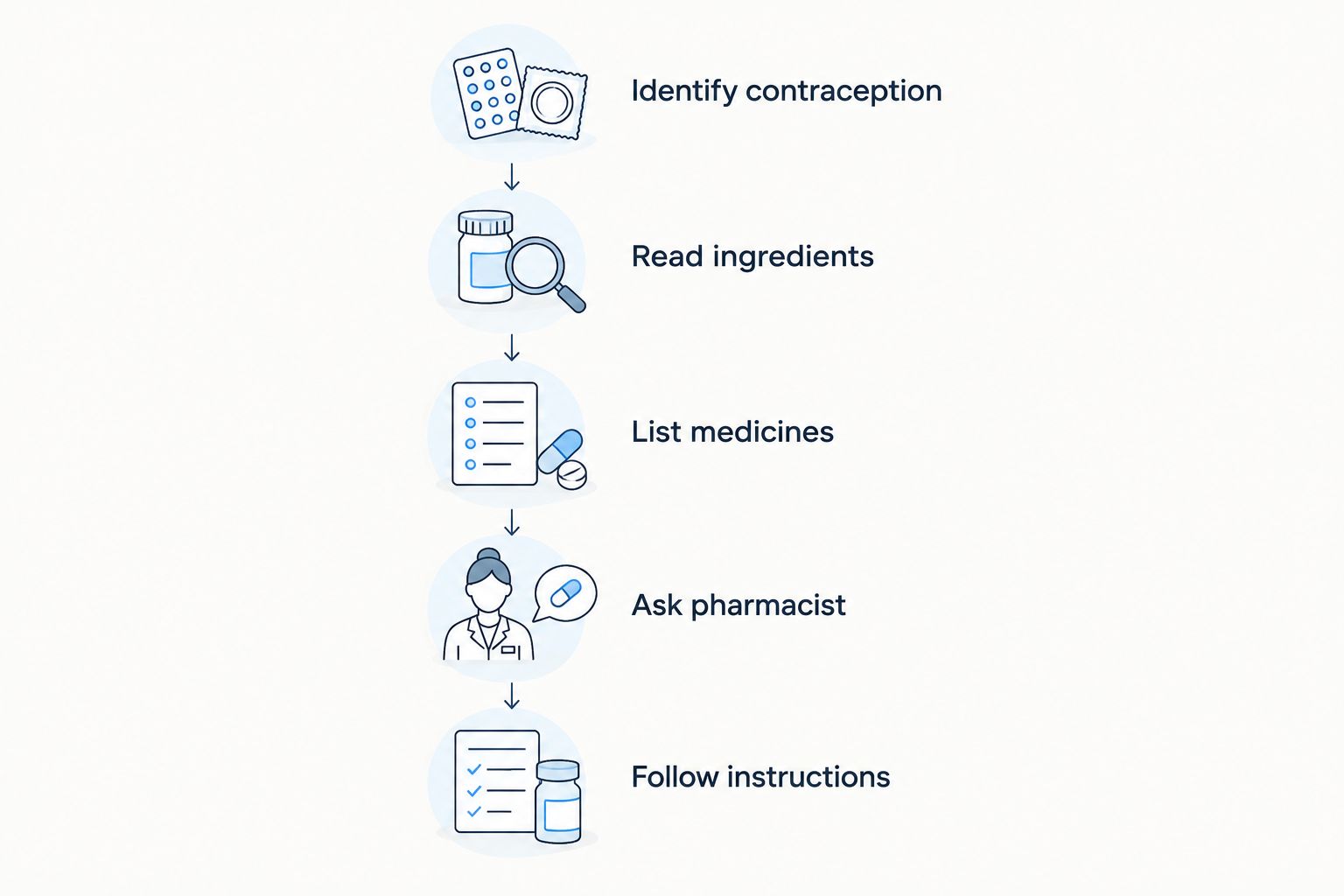
Use this sequence for your 2026 medication review. It keeps the discussion specific and avoids relying on broad claims about “natural” products.
- Identify contraception. Write down the exact medicine or device name, not just “the pill.” Include any recent missed or late doses.
- Read ingredients. Record the plant name, serving instructions, and every additional active ingredient. Photograph the full label.
- List medicines. Include prescriptions, occasional pain relievers, vitamins, teas, tinctures, and other herbal products.
- Ask pharmacist. Ask about contraceptive effectiveness, supplement side effects, and your reason for wanting the oil.
- Follow instructions. Keep using your contraception as directed. Follow the pharmacist’s advice about whether to start the supplement and what symptoms require attention.
A useful question is: “Does this exact supplement affect my contraceptive, and what should I do if it causes vomiting or diarrhea?” That gets a more useful answer than asking whether herbs and birth control generally mix.
What should you do if you already took them together?
Do not stop your prescribed contraception or take extra contraceptive pills just because you took evening primrose oil. Taking the oil does not, by itself, establish that your contraception failed.
Check whether the product contains evening primrose oil alone or additional ingredients. Then consider whether you missed contraception, took it late, vomited, or had severe diarrhea. Those details are more useful than the supplement name alone when deciding whether you need further advice.
Contact a pharmacist promptly if the label contains an unfamiliar botanical or if you also take medicines with interaction warnings. If you have a serious reaction, such as difficulty breathing or swelling of the lips or tongue, seek emergency care.
Can vomiting or diarrhea affect the pill?
Yes. Vomiting or severe diarrhea can interfere with oral contraceptive use, independently of whether evening primrose oil directly interacts with the contraceptive.
For combined oral contraceptives, the CDC’s guidance distinguishes shorter gastrointestinal illness from vomiting or severe diarrhea continuing for 48 hours or longer. The next steps depend on when the illness occurred in the pill pack and other circumstances; progestin-only pills have formulation-specific instructions.
Use your pill’s patient leaflet or contact a pharmacist rather than applying one timing rule to every pill. Do not assume that separating a supplement and contraceptive by a few hours solves prolonged gastrointestinal illness.
Patches, rings, implants, and IUDs do not rely on swallowing and absorbing a daily pill. That distinction does not remove unrelated supplement risks or the need to check other ingredients.
Do you need emergency contraception after taking evening primrose oil?
Taking evening primrose oil alone is not an established reason to use emergency contraception. The decision changes if there was a genuine contraceptive problem, such as missed pills, relevant gastrointestinal illness, or a known interacting ingredient.
If you had sex after a possible contraceptive failure, seek advice promptly. CDC guidance allows emergency contraceptive pills to be used as soon as possible within 5 days of unprotected sex, but the appropriate option depends on timing, other medicines, and your usual contraceptive.
Do not choose an emergency contraceptive solely from a general supplement article. Some options have specific instructions about when to restart hormonal contraception, so get method-specific advice.
When should you take a pregnancy test?
If you do not know when your next period is due, NHS pregnancy-testing guidance recommends testing at least 21 days after the last unprotected sex. Hormonal contraception does not prevent a pregnancy test from working.
A missed withdrawal bleed or new spotting is not enough to diagnose either pregnancy or an evening primrose interaction. Test at the appropriate time and discuss ongoing symptoms with a clinician.
If a test is positive, contact your healthcare professional about your medicines and supplements. NCCIH describes uncertainty about evening primrose oil’s safety during pregnancy; do not treat traditional use as reassurance.
Which label warnings deserve particular attention?
St. John’s wort is not the same as evening primrose oil. NCCIH and contraceptive guidance identify St. John’s wort as an interaction concern with some hormonal contraceptives. A blend containing it requires a different assessment from a single-ingredient evening primrose oil product.
Also tell your pharmacist about medicines affecting bleeding and any relevant medical history. Authoritative evening primrose oil safety references, including Mayo Clinic’s supplement overview, flag potential interactions with anticoagulant or antiplatelet medicines. These concerns are separate from contraceptive effectiveness.
For your 2026 label check, do not use “organic,” “clean-label,” or “non-GMO” as substitutes for an interaction review. Those descriptions do not demonstrate compatibility with a prescription medicine.
FAQ
Does evening primrose oil make birth control less effective?
Evening primrose oil alone is not established to reduce birth control effectiveness. That does not prove every product or combination is safe; ask a pharmacist to review your exact contraceptive and supplement ingredients.
Can I take evening primrose oil at the same time as my pill?
There is no established spacing rule that makes evening primrose oil and the pill safe together. Check the combination first and keep taking your contraceptive according to its prescribed schedule.
Do I need condoms just because I took evening primrose oil?
Evening primrose oil alone is not an established reason to add backup contraception. Missed pills, vomiting, severe diarrhea, or additional interacting ingredients can change the advice; condoms also provide protection against sexually transmitted infections.
Does evening primrose oil balance hormones while I take birth control?
Evening primrose oil is not established to balance hormones or correct birth control side effects. Discuss persistent symptoms with your prescriber rather than using a supplement to avoid a medication review.
Can I take evening primrose oil with an IUD?
An IUD does not depend on daily pill absorption, but that does not establish that evening primrose oil is suitable for you. Your other medicines, medical history, and the supplement’s complete ingredients still need checking.
Should I stop birth control if I already took evening primrose oil?
Do not stop prescribed birth control solely because you took evening primrose oil. Continue as directed and ask a pharmacist about any additional ingredients, missed doses, or digestive symptoms.
When should I test for pregnancy after a possible contraceptive problem?
Test at least 21 days after the last unprotected sex if you do not know when your period is due, following NHS guidance. Seek prompt advice about emergency contraception rather than waiting for a pregnancy test if the possible failure was recent.
One last thing
The most useful item to bring to a pharmacist is the back label, not the product’s marketing description. A familiar plant name on the front can obscure additional ingredients that change the interaction assessment.
Before adding any Herbal Goodness supplement or another botanical to your routine, review it alongside your contraception and other medicines. Keep the contraception decision separate from the wellness purchase: a supplement does not provide pregnancy protection.