





Can you take cat's claw with blood thinners?

Do not take cat's claw with blood thinners unless your prescribing clinician or pharmacist approves the combination. Cat's claw may slow blood clotting and increase bleeding risk; the concern includes anticoagulants and antiplatelet medicines, and separating their doses does not establish safety.
- Cat's claw and blood thinners require a pharmacist or prescriber review before combined use.
- NCCIH warns that cat's claw may slow blood clotting and increase bleeding risk with certain medicines.
- Keep taking prescribed anticoagulants as directed; do not change treatment to accommodate an herbal supplement.
- Tea, capsules, and tinctures do not have an established safe dose for this combination.
Can you take cat's claw with blood thinners?
Avoid starting cat's claw while taking a blood thinner until your medication team reviews the exact product. The National Center for Complementary and Integrative Health, or NCCIH, identifies a potential interaction with medicines that slow blood clotting. This is a safety warning, not proof that every person who combines them will bleed.
The same review principle applies to other herbs. The Herbal Goodness guide to soursop bitters and medication interactions addresses a separate plant; an assessment for one herb does not clear another.
For this 2026 safety guide, the practical distinction is between the medicine you need and the optional supplement you are considering:
| Medicine group | Examples | Why cat's claw needs review | What to do |
|---|---|---|---|
| Vitamin K antagonist anticoagulant | Warfarin | Potential additional bleeding risk; warfarin also requires individualized monitoring | Contact the anticoagulation clinic before adding cat's claw |
| Direct oral anticoagulants | Apixaban, rivaroxaban, dabigatran, edoxaban | Potential additional bleeding risk; a routine INR does not establish safety | Ask the prescriber or pharmacist to review the combination |
| Injectable anticoagulants | Heparin, enoxaparin | Potential additional bleeding risk | Tell the treating team about all herbal products |
| Antiplatelet medicines | Aspirin, clopidogrel | Platelet inhibition already affects clot formation | Review cat's claw even when aspirin is bought without a prescription |
These categories describe established medication actions. They do not mean that controlled human interaction studies have measured cat's claw's effect with every medicine listed.
Why this matters
Blood thinners reduce unwanted clot formation. Adding an herb with a potential effect on clotting creates a safety question that a wellness label cannot answer.
Traditional use is not evidence that cat's claw is safe alongside anticoagulants. Likewise, laboratory findings do not establish how much additional bleeding risk a particular person faces. You need a decision based on your medicine, medical history, and actual supplement label—not a general claim that an herb supports immunity or digestion.
NCCIH's Cat's Claw: Usefulness and Safety discusses both limited clinical evidence and potential safety concerns. Memorial Sloan Kettering Cancer Center's About Herbs: Cat's Claw also flags possible interactions with anticoagulant and antiplatelet medicines. Those references support caution, not a numerical prediction of your personal risk.
What does the evidence actually establish?
The responsible conclusion is narrower than either “this combination always causes bleeding” or “there is no problem because it is natural.” Authoritative herbal safety references identify a potential interaction, while the clinical size of that interaction remains uncertain.
Cat's claw commonly refers to preparations of Uncaria tomentosa or Uncaria guianensis. A common name alone does not tell your pharmacist which species, plant part, extraction method, or additional ingredients are in the bottle.
Use these distinctions when reading health claims:
- Traditional use: Describes how people have used a plant. It does not establish medication compatibility.
- Laboratory evidence: Can identify biological activity worth investigating. It does not directly measure your bleeding risk.
- Human interaction evidence: Addresses what happens when people take particular substances together. Do not assume findings apply across different extracts and medicines.
- Clinical guidance: Combines the available evidence with the consequences of getting the decision wrong.
For a 2026 medication review, the useful question is not whether cat's claw has ever been used safely. Ask whether its potential benefit justifies adding an avoidable interaction concern to your prescribed treatment.
What should you do before taking cat's claw?
Ask for a product-specific review before the first dose. A pharmacist needs more than the phrase “herbal supplement,” especially when several plants appear in the same formula.
- Identify the herb. Photograph the front label and the full Supplement Facts or ingredient panel. Include the botanical name and plant part if listed.
- List medicines. Include prescriptions, aspirin, nonprescription pain relievers, vitamins, and other supplements. Record how you actually take them.
- Describe your history. Mention previous bleeding, easy bruising, ulcers, kidney or liver problems, and upcoming procedures.
- Request review. Ask whether to avoid cat's claw, whether monitoring is appropriate, and whom to contact if symptoms occur.
- Record instructions. Keep the clinician's decision with your medication list so another member of your care team can see it.
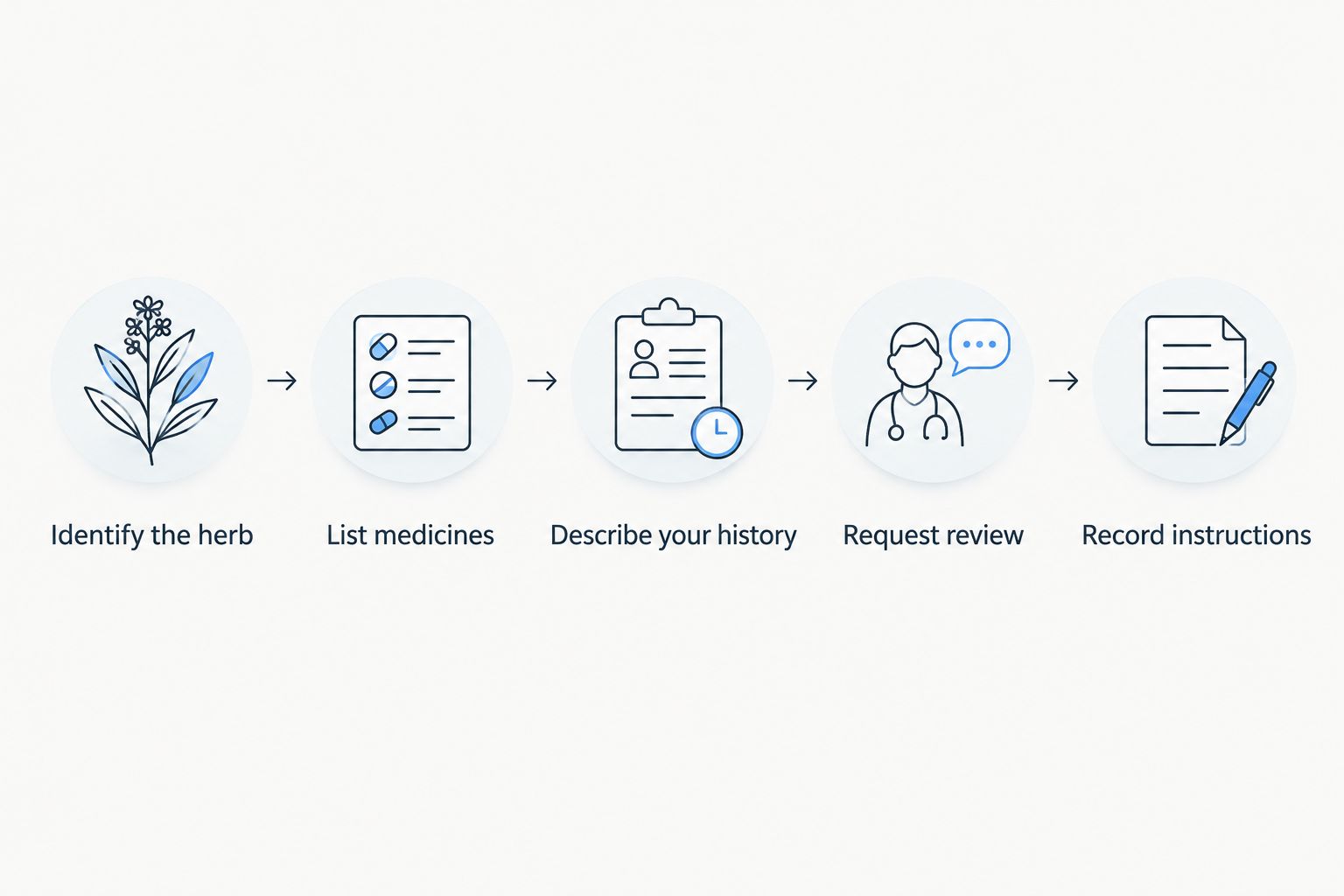
A useful question for your appointment is whether cat's claw should be avoided with your exact prescription—not whether herbs in general are healthy. If different clinicians manage your medicines, make sure the anticoagulant prescriber receives the supplement information too.
Why the risk assessment varies
The concern about cat's claw and blood thinners does not produce a single safe dose or timing rule. Your clinician assesses several factors together:
- Your medicine: Warfarin, direct oral anticoagulants, and antiplatelet medicines work differently and require different monitoring decisions.
- Other substances: Additional medicines or supplements that affect bleeding can change the assessment. Include occasional products, not just daily ones.
- Bleeding history: Previous significant bleeding or a known bleeding disorder is relevant to the decision.
- Kidney and liver function: These affect the use of several anticoagulants and belong in the medication review.
- Procedures: Surgery, dental treatment, and invasive testing require a coordinated medication plan.
- The preparation: A tea, tincture, capsule, or multi-herb blend is not automatically interchangeable with another preparation.
Organic certification and clean-label wording describe product attributes, not clearance to combine a supplement with prescription medicine. A concentrated extract also needs its own assessment; a strength statement does not establish interaction safety.
Is cat's claw tea safer than capsules or tinctures?
Do not treat cat's claw tea as a proven safer choice with blood thinners. Preparation changes what you consume, but there is no established home-brewing method or supplement dose that clears this combination for everyone.
Tea has an ingredient and preparation history your pharmacist can review. Capsules provide a labeled serving, while tinctures list a liquid serving and extraction details. Those practical differences do not resolve the bleeding concern.
| Preparation | Useful information to bring | Limit of that information |
|---|---|---|
| Tea | Botanical name, plant part, amount used, and brewing instructions | A mild taste or weak brew does not establish safety |
| Capsules | Ingredient panel, serving size, and extract details | A measured serving is not an approved dose with anticoagulants |
| Tincture or liquid extract | Ingredients, labeled serving, and extraction information | Using fewer drops does not create a validated safe combination |
| Multi-herb formula | Complete ingredient list and serving instructions | Reviewing cat's claw alone does not clear the other ingredients |
This is not a ranking of preparations. No preparation earns a recommendation for unsupervised use with blood thinners.
What if you already took cat's claw with a blood thinner?
Do not take another dose of cat's claw until a pharmacist or clinician advises you. Continue your prescribed blood thinner as directed unless your treating clinician tells you otherwise; stopping anticoagulation on your own can expose you to serious clotting risks.
Contact your pharmacist, anticoagulation clinic, or prescriber promptly. Give the medicine name, supplement label, amount taken, timing, and any symptoms. An accidental combination does not mean bleeding has occurred, but it deserves individualized advice.
Do not try to counteract the combination with another herb, a vitamin, or a skipped prescription dose. The appropriate response depends on the medicine involved and your condition, not a supplement-based balancing strategy.
Which symptoms need urgent medical attention?
Call 911 for severe or uncontrolled bleeding, fainting, sudden weakness, trouble speaking, or a sudden severe headache. Vomiting blood, coughing up blood, or black, tar-like stools also require urgent medical assessment. Do not wait for a supplement consultation when symptoms suggest significant bleeding.
Contact your clinician promptly for new unexplained bruising, repeated nosebleeds, bleeding gums, or unusually heavy menstrual bleeding. Tell the clinician that you take a blood thinner and describe every supplement you recently used.
A head injury while taking an anticoagulant also needs urgent medical advice, even when you cannot see bleeding. Bring your medication information if possible, but do not delay emergency care to collect a bottle or label.
Does a normal INR mean cat's claw is safe?
A normal or in-range INR does not clear cat's claw for use with blood thinners. INR testing helps manage warfarin; it is not a universal test for all anticoagulants, antiplatelet effects, or supplement interactions.
If you take warfarin, let the anticoagulation clinic decide whether a supplement change warrants additional testing. If you take apixaban or another direct oral anticoagulant, do not use a routine INR result as permission to add an herb.
The same principle applies in 2026 as at any medication review: a reassuring test result answers a specific question. It does not replace an assessment of a newly added supplement.
What should shoppers and health practitioners check?
Herbal Goodness herbal supplements are for wellness shoppers, not a substitute for prescribed anticoagulation. A product's wellness purpose does not establish that it is appropriate for a person taking a blood thinner.
Herbal Goodness offers teas, capsules, tinctures, and other botanical products. Before choosing any preparation, use its complete ingredient information in the medication review rather than selecting another plant as an assumed safe replacement for cat's claw.
For retailers and health practitioners, the useful service is accurate disclosure and referral. Keep ingredient information accessible, distinguish traditional-use descriptions from clinical evidence, and direct anticoagulant questions to the customer's pharmacist or prescriber. Do not describe a retail supplement as an antidote to a medicine or a way to balance clotting.
FAQ
Can I take cat's claw if I take warfarin?
Do not add cat's claw to warfarin without approval from your prescriber or anticoagulation clinic. Herbal safety references flag potential additional bleeding risk, and your clinic should decide whether any monitoring changes are needed.
Can I take cat's claw with Eliquis or Xarelto?
Do not combine cat's claw with Eliquis or Xarelto without a pharmacist or prescriber review. These anticoagulants already increase bleeding risk, and a routine INR result does not establish that the combination is safe.
Does low-dose aspirin count as a blood thinner for this warning?
Yes, aspirin belongs in this safety discussion because it inhibits platelet function. Include it in your medication list even when you buy it without a prescription.
Can I separate cat's claw and my blood thinner by a few hours?
Separating the doses does not establish safety. The concern involves potential effects on clotting, not simply whether the substances are swallowed together.
Is there a safe amount of cat's claw tea with blood thinners?
There is no established safe amount of cat's claw tea to recommend with blood thinners. Ask your pharmacist or prescriber to review the actual preparation before using it.
Should I stop my blood thinner if I already took cat's claw?
Do not stop or change your prescribed blood thinner on your own. Avoid further cat's claw until you receive advice, contact your medication team promptly, and seek urgent care for serious bleeding symptoms.
What sources support the warning about cat's claw and blood thinners?
NCCIH's Cat's Claw: Usefulness and Safety and Memorial Sloan Kettering Cancer Center's About Herbs: Cat's Claw identify potential bleeding-related interaction concerns. These safety references support caution but do not provide a precise personal risk estimate.
One last thing
A platelet count and an INR are different tests; neither is a blanket clearance for herbal supplements. Platelet number, platelet function, and coagulation are related but distinct parts of bleeding assessment. Do not use a normal platelet count to approve cat's claw or choose a product marketed for platelet support to offset a blood thinner.
For your next 2026 medication review, bring photographs of every supplement label—including products used only occasionally. The most useful next move is a complete medication conversation, not a different herb.