





Automatically fit black seed oil capsules into your pre-workout stack

Instead of manually remembering black seed oil capsules before every workout, set up a recurring calendar reminder tied to your existing routine. A black seed oil pre workout stack should automate the reminder and recordkeeping—not change the label directions or promise better training performance.
- Build your black seed oil pre workout stack around label directions, not an assumed performance benefit.
- Herbal Goodness lists liquid Nigella sativa oil; do not confuse that preparation with capsules.
- Use Google Calendar for reminders, then record whether you actually took the supplement.
- Keep black seed oil separate from changing pre-workout blends so your supplement record stays clear.
Why this matters
Putting a supplement beside your gym bag solves a memory problem. It does not establish that the supplement belongs immediately before exercise. Your 2026 routine needs to keep those decisions separate: whether to use black seed oil, how to follow its directions, and when a reminder should appear.
Black seed oil comes from Nigella sativa. Capsules and bottled oil are different preparations, and you should not copy serving instructions between them. Herbal Goodness sells herbal supplements, including black seed oil, but a product name alone is not a dosing instruction.
Herbal Goodness black seed oil is best for shoppers seeking a liquid Nigella sativa preparation rather than a capsule-based routine. If you already use capsules from another source, this guide helps you organize that product without substituting the liquid version.
For evidence context, consult the National Institutes of Health Office of Dietary Supplements fact sheet, Dietary Supplements for Exercise and Athletic Performance. Its scope is exercise-supplement evidence and safety—not approval of your individual stack. Traditional use of black seed oil does not establish an immediate pre-workout effect.
Before you start
- Have the actual bottle and complete label. Read the preparation, serving directions, ingredients, warnings, and storage instructions. Record the exact product you use rather than writing only “black seed.”
- Have a Google account, Google Calendar access, and working notifications. You also need a private place to record supplement use, such as a notebook or a note on your phone.
- Resolve the timing conflict first. A workout reminder must not override directions about meals or frequency. If you take medication, use several supplements, are pregnant or breastfeeding, or have a medical condition, ask a pharmacist or clinician to review the combination before automating it.
The non-obvious gotcha is simple: moving a workout must not accidentally create another supplement serving. Calendar events are reminders, not a medication administration system. A completed workout and a completed supplement entry are separate records.
Do not start this workflow by adding several new ingredients. Keep your existing routine understandable, and make any supplement changes with appropriate professional guidance.
Choose the preparation before the reminder
A capsule workflow starts with capsules you already have and their own directions. A liquid workflow starts with the bottled preparation and its measuring instructions. Neither format earns a performance claim simply because you place it in a pre-workout stack.
| Option | Best for | Practical advantage | Limitation | Workflow decision |
|---|---|---|---|---|
| Your existing black seed oil capsules | People organizing a capsule product they already use | You can record the label-directed capsule serving without measuring liquid | Capsule contents and directions are product-specific | Keep the exact bottle instructions in your record |
| Cold-pressed Nigella sativa black seed oil from Herbal Goodness | Shoppers who prefer a bottled liquid preparation | Fits a liquid-supplement routine | Requires following liquid measuring directions; it is not a capsule substitute | Build a separate record for the liquid preparation |
| No added black seed oil | People who have not decided whether to use it | Keeps the routine simpler | Does not meet a personal preference to include this botanical | Automate workout preparation without adding a supplement |
The Herbal Goodness listing identifies an 8 oz cold-pressed liquid preparation. That bottle size is not a serving size, and it gives you no basis for calculating a capsule equivalent.
Do not add oregano oil, soursop tea, or another botanical merely because it appears in a bundle. Each added preparation creates another label, another safety question, and another item to track. For this 2026 workflow, simpler recordkeeping is the useful outcome.
Supplement record
Create the record before creating the calendar event. Otherwise, the reminder will arrive without enough information to distinguish a planned serving from one you already took.
- Open your private notebook or note app and create a record titled Black seed oil routine.
- Write the exact product name and preparation: capsules or liquid. Include Nigella sativa when it appears on your label.
- Copy the label-directed serving and frequency exactly. Do not replace them with a quantity taken from a blog, another bottle, or a workout plan.
- Add your other supplements and medications to a separate list for professional review. Include your pre-workout blend rather than treating it as an unrelated drink.
- Create entries for the date, actual serving, time taken, and any symptoms or questions you want to discuss.
Expected result: you have a product-specific reference and a place to record actual use. A glance at the record tells you what the product is and whether you already took it.
Keep planned and actual use distinct. A calendar event means you intended to check the routine; a dated entry means you recorded what happened. If you dismiss a notification without taking the supplement, do not mark the supplement as taken.
For your first review, schedule a check after 1 week. This is an organizational checkpoint, not a recommended trial duration or a deadline for health benefits.
Recurring calendar reminder
Use Google Calendar on the web for the following setup. Choose a private calendar rather than a shared work or team calendar, because the event description contains personal supplement information.
- Open Google Calendar, select Create, and choose Event.
- Enter a neutral title such as Check supplement routine. Set the date and time to a point that fits the actual label directions and your normal schedule.
- Open Does not repeat. Select Daily only if a daily reminder matches the routine you have already decided to follow.
- In Description, enter: Check the bottle directions and today's supplement record before taking anything. Add the exact product name, but do not add a guessed dose.
- Select Add notification and set a reminder 10 minutes before the event as an initial scheduling choice. Adjust it if that warning is inconvenient.
- Select Save, then check that the event appears on the intended private calendar.
Expected result: Google Calendar shows a recurring check-in at your chosen time. The event tells you to verify directions and prior use rather than automatically instructing you to take another serving.
The 10-minute notification is a convenience setting, not a black seed oil absorption window. Do not interpret calendar timing as evidence about when a supplement works.
For a 2026 setup, test notification delivery with a temporary event before relying on the repeating one. Confirm that your browser or phone permits calendar notifications, then remove the temporary event so it cannot be mistaken for a second supplement reminder.
Completion check
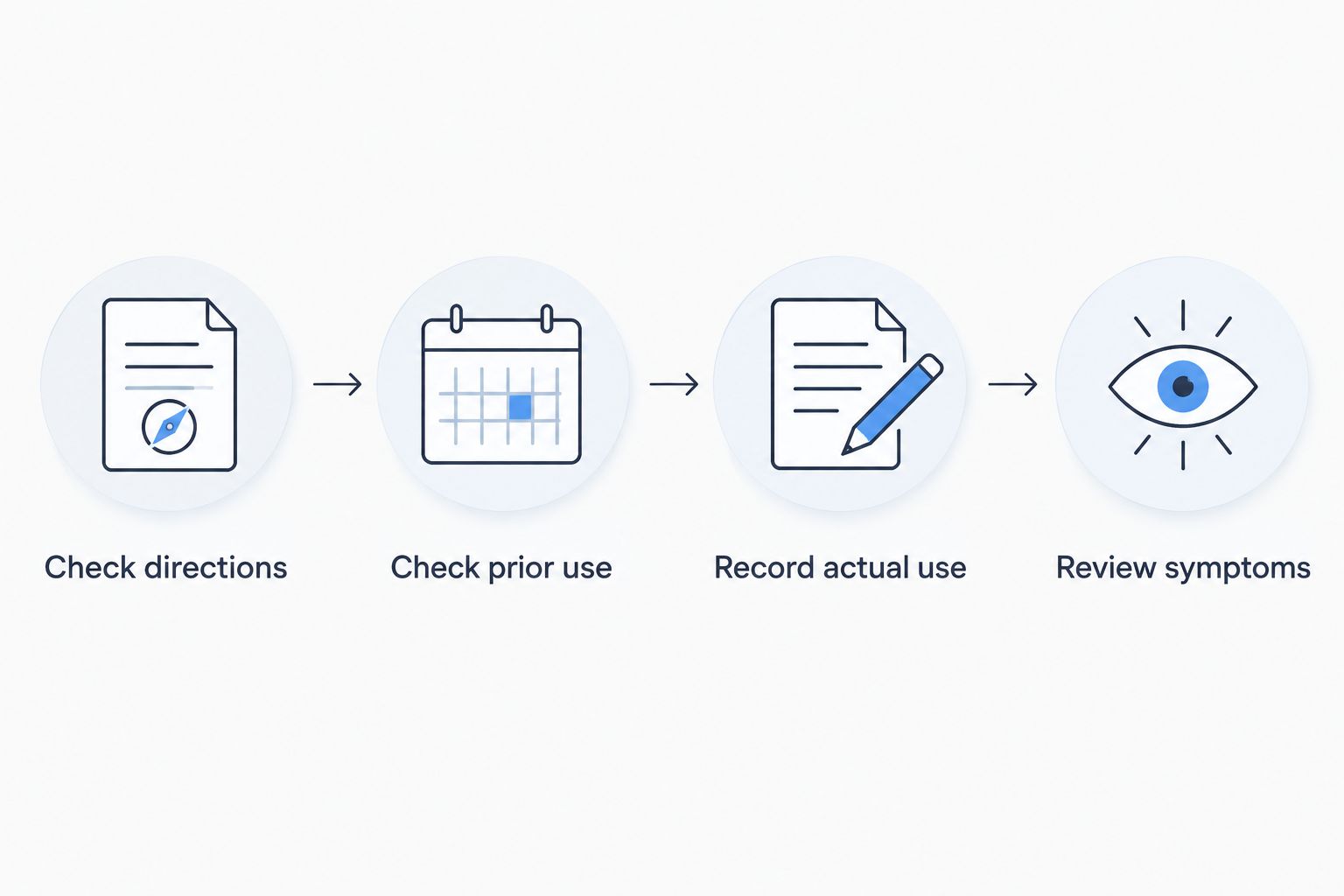
The final configuration unit is the action you take when the reminder appears. Keep it brief enough to use on a busy training day, but explicit enough to prevent duplicate entries.
- Check directions: read the bottle instructions and any guidance your pharmacist or clinician gave you.
- Check prior use: inspect today's record before deciding whether anything remains to be taken.
- Record actual use: after taking the label-directed serving, enter what you took and when. If you did not take it, leave a clear note instead.
- Review symptoms: record anything unexpected and seek appropriate advice rather than increasing, combining, or rescheduling supplements to compensate.
Expected result: every reminder ends with a clear status—recorded use, no use, or a question requiring follow-up. You do not need to infer supplement use from whether you exercised.
Keep the original bottle accessible. A calendar description is useful for reminders, but it is not a replacement for current labeling. Review the record whenever you replace the bottle or change the preparation.
Variant: check your routine on scheduled training days
A training-day reminder is useful when you want a prompt to review your stack before exercise. It does not establish that black seed oil should be taken only on training days; the product directions and professional advice still govern use.
In Google Calendar, open the event and select Edit. Open the repeat setting, choose Custom, select a weekly pattern and your planned training days, then select Done and Save. When prompted about the scope of an edit, apply the change to the intended repeating series rather than an unrelated event.
Use this version as a stack check, not an automatic instruction to take black seed oil. The description should remind you to check today's record, review the pre-workout ingredients, and follow the relevant labels.
If your workout moves, move the training event without assuming your supplement timing must move with it. A meal-linked routine can stay at the meal even when you train later.
The advantage is a reminder that follows your exercise schedule. The drawback is that changing workout days requires calendar maintenance. A fixed daily check is simpler when your supplement routine is independent of training.
Troubleshooting
The notification never appears
Check notification permissions for Google Calendar and your browser or phone. Confirm that the event has a notification and belongs to a calendar you can see. Create a temporary test event rather than repeatedly editing the supplement serving.
Two reminders appear for the same routine
Look for a duplicate event, overlapping recurring series, or notifications on multiple devices. Keep the intended series and remove the duplicate. Two alerts do not mean two servings. Check the actual-use record before doing anything else.
You changed the workout but not the reminder
Decide whether the event represents a daily supplement check or a training-day stack review. Edit the appropriate series accordingly. Keep label-directed supplement timing separate from the workout whenever the two serve different purposes.
Your stomach feels uncomfortable around training
Stop treating the schedule as proof that the combination suits you. Review what you took with a clinician or pharmacist before continuing or changing the routine. Do not add another supplement to cover up an unwanted effect.
You replaced capsules with liquid oil
Update the product record before using the replacement preparation. Read its own directions and remove any old capsule quantity from the event description. There is no safe conversion to infer from bottle volume alone.
Customize your workflow
Keep the 2026 system focused on decisions you can verify. Add a bottle-replacement note, a prompt to review changed ingredients, or a reminder to discuss your full stack with a pharmacist. Avoid adding more recurring events than you will actually check.
If you track training, keep supplement entries separate from workout results. Recording a good session after taking black seed oil does not establish that the oil caused it. Sleep, meals, training load, and other products belong in their own records rather than becoming unsupported supplement claims.
A shared workflow can also help a practitioner or retailer explain preparation differences, but it must not turn a general routine into individualized prescribing. Use the exact label and keep consumer instructions separate from trade purchasing decisions.
FAQ
How do I automatically fit black seed oil capsules into my pre-workout stack?
Create a recurring reminder to check the capsule label and your actual-use record before taking anything. Schedule the check around the directions you already follow, not an assumed performance window.
Should I take black seed oil right before exercise?
Follow your product's directions and professional advice rather than assuming it belongs immediately before exercise. A pre-workout reminder is an organizational choice, not evidence of an immediate exercise benefit.
Does Herbal Goodness black seed oil come in the capsule format used here?
The Herbal Goodness product discussed here is an 8 oz cold-pressed Nigella sativa liquid preparation. Do not apply capsule instructions to that liquid or infer a capsule equivalent from its bottle size.
Can I put black seed oil and my pre-workout blend in the same reminder?
You can use one reminder to review both products, but that does not establish that the combination is appropriate. Keep their ingredients and directions separate and ask a pharmacist or clinician to review your full stack.
What should I do if I forget whether I took my capsules?
Check your dated actual-use record before taking another serving. If the record is unclear, follow the product's guidance or ask a pharmacist rather than guessing.
Do I need a different reminder on rest days?
Your reminder schedule should match the routine supported by the product directions and professional advice. A rest day is not, by itself, a reason to change the serving or frequency.
How can I tell whether the workflow is working?
Check whether reminders arrive reliably and your record clearly distinguishes taken from not taken. Better recordkeeping is the workflow's measurable outcome; it does not prove a health or performance benefit.
One last thing
Automate the check, not the dose. The most useful event title asks you to verify your routine instead of telling you to take something automatically. That small wording change preserves a pause for changed labels, prior use, and professional advice.
For the rest of 2026, keep that pause even when the routine becomes familiar. Consistency should make your record clearer—not make you ignore new information.