





Ashwagandha for college students: complete 2026 guide

College students’ use of ashwagandha is an optional herbal approach to stress and sleep support, not a shortcut to better grades or an alternative to medical care. This 2026 guide explains what adult research shows, how to assess an ashwagandha preparation, and why safety checks come before adding it to a routine shaped by classes, exams, and shared housing.
- Ashwagandha for college students has limited adult stress and sleep evidence; it is not a proven study aid.
- Herbalgoodnessco’s organic ashwagandha root liquid suits adult students who prefer a liquid preparation.
- Check medication interactions and health conditions before choosing an ashwagandha supplement.
- Protect sleep and track changes before adding more herbs or increasing a serving.
Why ashwagandha matters for college students
The practical question is whether ashwagandha fits your health needs—not whether a supplement can compensate for an overloaded semester. Late study sessions, changing schedules, and roommate noise are problems that require different responses. A botanical supplement does not fix each one.
Ashwagandha, Withania somnifera, has a history of use in Ayurveda. Traditional use explains its background, but it does not establish that a particular extract improves exam performance. For a 2026 purchase, compare the preparation and safety information before comparing benefit language; the ashwagandha supplement comparison is a starting point for examining options.
Treat stress support, sleep support, and academic performance as separate questions. Evidence for one does not automatically establish the others, and results from adult volunteers do not establish results for college students specifically.
What the research actually supports
The National Center for Complementary and Integrative Health, or NCCIH, states that some ashwagandha preparations have evidence for stress and insomnia, while evidence for anxiety remains unclear. Its ashwagandha fact sheet also identifies safety concerns and medication interactions. Those distinctions matter more than the broad label “adaptogen.”
A randomized study by Chandrasekhar and colleagues, published in the Indian Journal of Psychological Medicine in 2012, enrolled 64 adults with chronic stress. Participants receiving the studied root extract took 300 mg twice daily for 60 days and reported improvements on stress measures compared with placebo. This was a specific adult study—not a college-student trial or a dosing instruction for every bottle.
The NIH Office of Dietary Supplements’ Ashwagandha: Health Professional Fact Sheet describes differences among preparations used in research. A root powder, a concentrated root extract, and a root-and-leaf extract are not interchangeable simply because their labels name the same plant.
How to assess ashwagandha during the semester
Use this sequence for your 2026 decision: define the problem, check safety, examine the preparation, and track what happens. Start with changes you can make without buying a supplement. A product belongs later in the process, after you know what you want to assess.
Set a goal
Choose a specific concern rather than a broad promise such as “better wellness.” For example, distinguish difficulty winding down after studying from daytime tiredness or worry that interferes with attending class. These concerns deserve different conversations with campus health services.
Begin with a simple written record of your routine. Note when you sleep, when you use caffeine, and what makes the concern better or worse. This creates context for a clinician and keeps a supplement from becoming the default answer to every uncomfortable feeling.
- Write down the main concern in plain language.
- Record bedtime, wake time, and daytime sleepiness.
- Note caffeine, alcohol, and other supplement use.
- Identify whether the concern affects classes, meals, or relationships.
- Seek professional support when symptoms persist or disrupt daily life.
Check safety
Review ashwagandha with a pharmacist or clinician before starting it if you take medication or have a health condition. NCCIH identifies potential interactions with sedatives, anticonvulsants, thyroid medicines, immunosuppressants, and medicines for blood pressure or diabetes. “Natural” does not mean interaction-free.
NCCIH advises avoiding ashwagandha during pregnancy and breastfeeding and does not recommend it for people with thyroid or autoimmune disorders or those approaching surgery. It also describes reports of liver injury. A roommate’s experience cannot establish that the same product is suitable for you.
Bring the actual ingredient label to the conversation. A blend requires review of every ingredient, not just the herb printed most prominently on the front.
- List prescription medicines, nonprescription medicines, and supplements.
- Tell the clinician about thyroid, autoimmune, or liver concerns.
- Mention pregnancy, breastfeeding, or planned surgery.
- Ask about drowsiness before driving or attending practical classes.
- Do not use an adult supplement guide to choose a dose for a student under 18.
Read the label
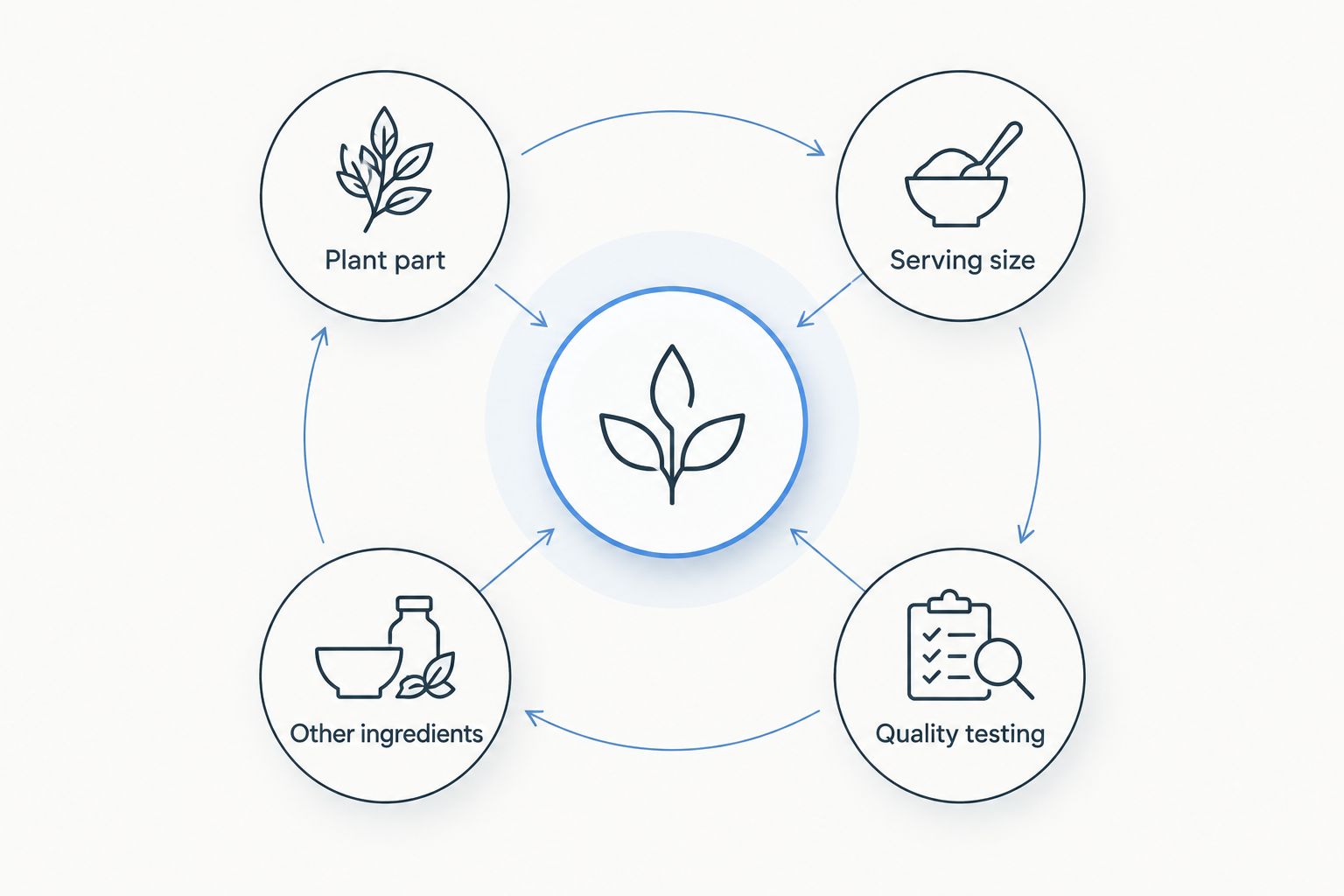
Start by comparing labels manually. Look for the botanical name, plant part, amount per serving, other ingredients, and directions. A milligram amount alone does not show whether a product matches a studied preparation.
For shoppers who prefer liquid preparations, Herbalgoodnessco sells an organic ashwagandha root liquid. That identifies the plant part and format; it does not establish equivalence to a research extract. Herbalgoodnessco’s organic ashwagandha root liquid is best for adult students who prefer a liquid format. Suitability still depends on the individual safety review and the current label.
Quality language needs supporting details. Organic status does not answer questions about extract concentration, interaction risk, or whether a product has independent identity and contaminant testing.
- Plant part: distinguish root from root-and-leaf preparations.
- Serving size: read the amount and measuring instructions together.
- Other ingredients: check sweeteners, solvents, and allergens.
- Quality testing: look for verifiable testing information rather than assuming it.
- Save the label so a pharmacist can review the exact preparation.
Choose a manageable preparation
Choose the format you can measure and use according to its label. Capsules avoid liquid measuring; liquid extracts require attention to the marked serving; powders require a suitable measuring method. None of these formats is automatically more effective.
A single-herb preparation is easier to evaluate than adding several unfamiliar botanicals simultaneously. That is a tracking advantage, not proof that a single ingredient is safer for everyone. Your health history and the preparation still determine suitability.
Do not transfer the research dose above to a different product. Extract concentration, plant part, and formulation change what an amount means, and a dropper does not establish equivalence to a capsule.
- Follow the current product label rather than a social-media dosing routine.
- Use the measuring device specified for a liquid preparation.
- Avoid converting research capsule amounts into drops yourself.
- Keep the original container and ingredient information.
- Avoid starting several new supplements together.
Track changes and side effects
Record your experience before and after adding a supplement, while keeping the rest of your routine as consistent as practical. A note about sleep or perceived stress is more useful than a general statement that you “feel different.” It still cannot prove that the herb caused the change.
NCCIH lists drowsiness, stomach upset, diarrhea, and vomiting among possible side effects. Stop taking the supplement and seek medical advice for concerning symptoms. Yellowing skin or eyes, dark urine, or persistent nausea require prompt assessment rather than a smaller serving and another attempt.
For a 2026 routine, include an end point for reassessment instead of treating the bottle as an indefinite commitment. NCCIH describes short-term use of up to 3 months as potentially safe for some people; long-term safety is not established.
- Record the preparation and labeled serving used.
- Note sleep quality, daytime alertness, and stomach symptoms.
- Record other changes, including exams, caffeine, and alcohol.
- Arrange a review rather than continuing indefinitely.
- Stop and seek advice when adverse effects occur.
Protect your sleep environment
Start with the dorm-room problem you can actually change. If light or noise keeps you awake, address light or noise before expecting ashwagandha to compensate. The CDC’s sleep guidance recommends a consistent schedule and a quiet, relaxing, cool sleeping environment.
Items described as sleep accessories for better rest address environmental barriers such as light or noise; they do not establish the effectiveness of an herbal supplement. Match any accessory to the specific barrier instead of accumulating products around an unchanged bedtime routine.
Agree on practical boundaries with roommates. A shared room creates decisions about lighting, calls, alarms, and visitors that a supplement cannot make for you.
- Keep bedtime and wake time consistent where your timetable allows.
- Discuss quiet hours and lighting with roommates.
- Reduce late caffeine when it interferes with sleep.
- Use a dark, quiet sleep setting where practical.
- Bring persistent sleep difficulties to campus health services.
Review the decision before continuing
Ask whether the routine remains useful and tolerable—not whether you have finished the bottle. If your concern persists, the next move is a professional assessment, not automatically a larger serving or a multi-herb bundle.
Retailers and health practitioners serving students need the same distinction between evidence and positioning. Describe the plant, preparation, and label directions without turning stress-support language into claims about grades, diagnoses, or guaranteed results. Organic certification and safety screening answer different questions.
For a 2026 follow-up, bring the label and your notes. That gives the clinician information about both the preparation and the circumstances surrounding its use.
- Review whether your original concern has changed.
- Check for unwanted effects and new medicines.
- Avoid extending use solely because the product feels familiar.
- Reassess before adding another botanical.
- Keep retail advice separate from individualized medical advice.
Compare the options for college students
The best starting option is the one that addresses the actual problem with the fewest unnecessary additions. This comparison separates everyday habits from supplement formats. The liquid’s organic root description identifies what it is, not a demonstrated advantage over other preparations.
| Option | Best for | Practical advantage | Key limitation |
|---|---|---|---|
| Sleep and schedule changes | Students with inconsistent routines or dorm-room disruptions | Addresses the environment without adding an ingestible product | Does not replace assessment of persistent symptoms |
| Ashwagandha Extract — Organic Root Liquid | Adults who prefer a liquid preparation | Identifies an organic root-based format | Requires careful measuring; research-dose equivalence is not established |
| Single-ingredient ashwagandha capsules | Adults who prefer a premeasured format | Avoids measuring liquid servings | Capsule amounts do not establish equivalence across extracts |
| Adaptogen Power Bundle – Mushroom Blend, Rhodiola Root & Ashwagandha | Adults considering those botanicals after an ingredient-by-ingredient review | Groups the named botanicals together | Starting several herbs makes individual effects harder to assess |
Herbalgoodnessco’s ashwagandha supplement options below include a single-herb preparation and a multi-botanical bundle. Prioritize the single-herb approach when your goal is to assess ashwagandha itself. The bundle is not a necessary upgrade or a prerequisite for stress support.


Common mistakes college students make
- Treating exam week as a reason to skip safety checks. A busy timetable does not remove interaction risks. Review the label before starting, especially when taking medicines.
- Calling drowsiness proof of better sleep. Feeling sleepy during lectures is an unwanted effect to record, not automatic evidence that the preparation suits you.
- Copying a friend’s serving. Their preparation, medicines, and health history differ from yours. Follow your own label and professional advice.
- Adding herbs to offset an all-nighter. Supplements do not replace sleep. Address the study schedule rather than building a routine around repeated sleep loss.
- Using a bundle to solve several concerns at once. Multiple new ingredients make it harder to identify what caused an improvement or an adverse effect.
FAQ
Is ashwagandha good for college students?
Ashwagandha is an optional supplement for some adults, not a proven college-performance aid. Adult research supports some preparations for stress and sleep, but suitability depends on health history, medicines, and the exact preparation.
Will ashwagandha help me focus during exams?
Ashwagandha is not established as an exam-focus supplement. Evidence about stress or sleep does not prove improved concentration, grades, or test performance.
How much ashwagandha should a college student take?
There is no universal ashwagandha dose for college students. Follow the specific label and seek professional advice; research doses cannot be transferred automatically between powders, capsules, and liquid extracts.
Is liquid ashwagandha better than capsules?
Liquid ashwagandha is not automatically better than capsules. Compare the plant part, preparation, ingredient information, and measuring instructions rather than choosing on format alone.
Can I take ashwagandha with prescription medicine?
Check with a pharmacist or clinician before combining ashwagandha with prescription medicine. NCCIH identifies potential interactions with several medicine groups, including sedatives and thyroid medicines.
Can I take ashwagandha every day throughout college?
Long-term daily use is not supported by established safety evidence. NCCIH describes short-term use of up to 3 months as potentially safe for some people, so ongoing use needs reassessment.
What side effects should students watch for?
Watch for drowsiness, stomach upset, diarrhea, and vomiting. Stop use and seek medical advice for concerning symptoms, particularly yellowing skin or eyes, dark urine, or persistent nausea.
One last thing
A smaller number on a label does not necessarily mean a weaker preparation, and a larger number does not prove a better one. Plant part and extract composition matter. Before buying ashwagandha in 2026, save the ingredient label and ask whether it is suitable for you—not whether it sounds strong enough for finals.