





Best Evening Primrose Oil Supplement for Women: Softgel 2026

The best evening primrose oil supplement for women in 2026 is a single-ingredient softgel that states its gamma-linolenic acid (GLA) content and provides evidence of independent testing. Choose a liquid if you avoid capsules; skip blends that hide how much evening primrose oil they contain. Evening primrose oil is a different plant oil from black seed oil, so do not treat the two as interchangeable.
- Best evening primrose oil supplement for women: choose a single-ingredient softgel with stated GLA content and independent testing.
- Choose bottled evening primrose oil if you avoid capsules and can measure each serving accurately.
- Skip blends that do not state their evening primrose oil amount; neither blends nor single oils have proven women's health benefits.
- Evening primrose oil does not replace medical care for breast pain, menopause symptoms or other health concerns.
Why this matters
Evening primrose oil comes from the seeds of Oenothera biennis. It contains linoleic acid and GLA, both omega-6 fatty acids. A label that says only how much oil is in a capsule leaves out a useful comparison point: how much GLA that serving provides.
The health claim matters as much as the label. The National Center for Complementary and Integrative Health (NCCIH), in its overview of evening primrose oil and health conditions, says there is not enough evidence to support its use for any health condition. Traditional use and a supplement label do not establish that the oil relieves menstrual symptoms, breast pain or menopause symptoms. Use this 2026 guide to compare what you are buying, not to select a treatment.
Best evening primrose oil supplements for women: the verdict
Best overall: a single-ingredient softgel with stated GLA content and independent testing. Best for people who avoid capsules: bottled evening primrose oil with a clearly measured serving. Best for people already choosing a multi-oil routine: a fully disclosed oil blend. These are formulation recommendations, not awards for specific products: no named evening primrose oil product is established by the supplied product information.
A blend ranks last because it adds another label question. You need to know the evening primrose oil amount separately from the blend total. If that breakdown is absent, choose a single-ingredient option instead.
What makes the best evening primrose oil supplement for women?
Use these criteria before comparing a front-label claim:
- Stated GLA content: Look for GLA per serving, not just a large evening primrose oil number. GLA content helps you compare servings without assuming that every oil has the same composition.
- Clear serving size: The label should identify the number of softgels or measured volume that makes one serving. Check servings per container separately from oil per serving.
- Ingredient transparency: For a single-ingredient choice, confirm that evening primrose oil is the oil listed. For a blend, identify each oil and its amount.
- Independent testing details: Look for a named testing program, a checkable certificate or a batch-specific report. A testing claim without supporting details gives you less to verify.
- Suitable format: A softgel simplifies counting; a liquid avoids swallowing a capsule but requires careful measurement and handling.
- Safety fit: Discuss supplements with a clinician if you are pregnant, take medication or plan to use an oil for a symptom that needs assessment. Do not use a label claim to settle a medical question.
Do not confuse certification with effectiveness. Testing can help assess whether a product matches its label; it does not prove that evening primrose oil treats a health condition. In 2026, that distinction remains more useful than a long list of promised benefits.
At a glance: which format fits your routine?
| Option | Best for | Standout feature | Key limitation |
|---|---|---|---|
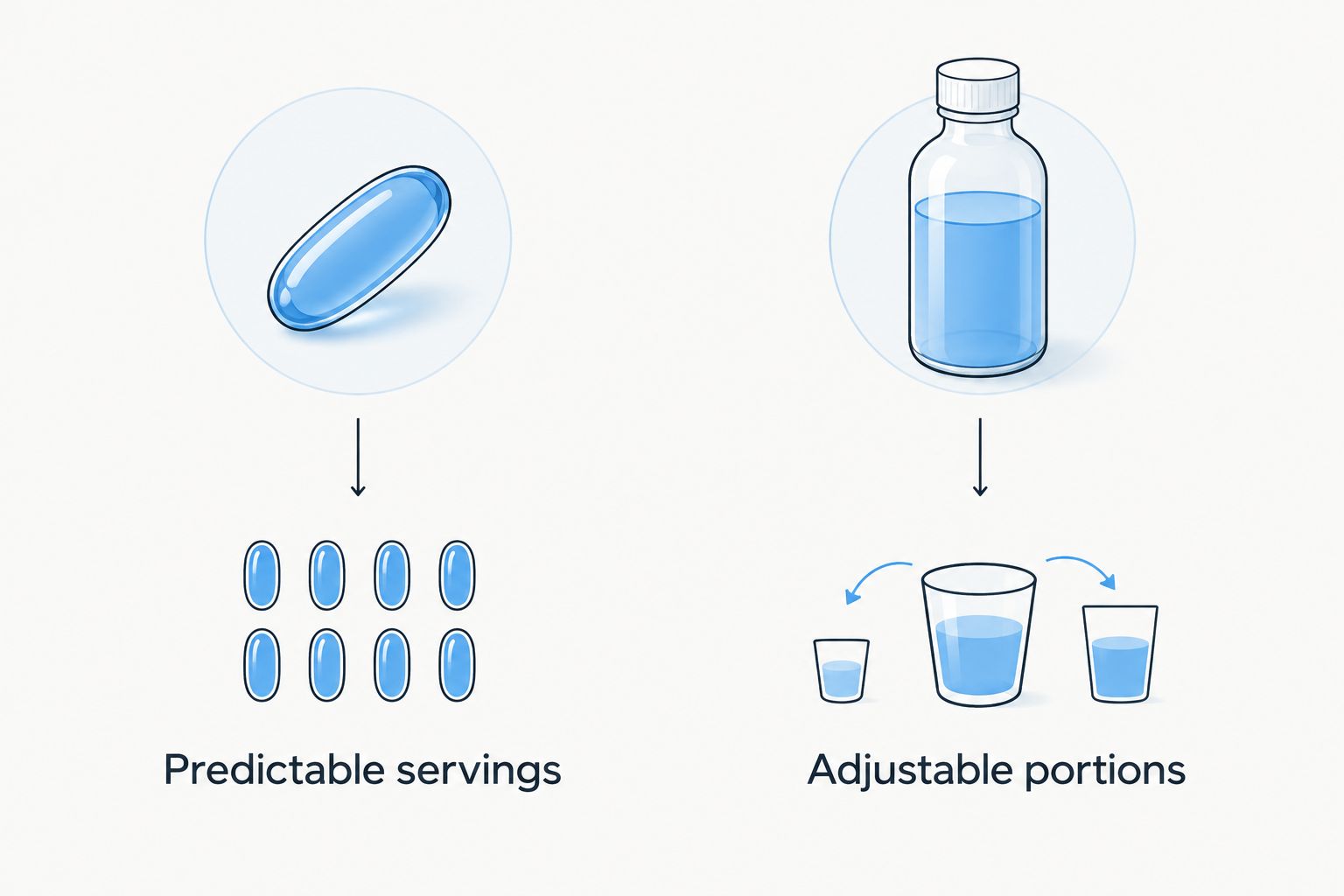
| Single-ingredient softgel with stated GLA | Predictable servings | Oil and GLA can be compared on the same label | Requires swallowing a capsule; a testing claim still needs verification |
| Bottled liquid with stated GLA | People avoiding capsules | Serving can be measured as a liquid | Measuring and handling take more care |
| Fully disclosed multi-oil blend | People who deliberately want more than one oil | Combines oils in one serving | Other ingredients complicate comparison and tolerance |
A format is not evidence of a health benefit. The table ranks label clarity and ease of use, not clinical outcomes. If two options look alike, compare their full Supplement Facts panels before treating their front-label oil amounts as equivalent.
A label may list 1,000 mg of oil without listing GLA. That does not tell you how much GLA the serving contains. For a purely mathematical illustration, 1,000 mg of oil at 10% GLA would contain 100 mg of GLA; a 500 mg serving at the same percentage would contain 50 mg. Those percentages are examples, not claims about any product or a recommended intake. A stated GLA amount removes the need to assume a percentage.
Read the label in the right order
Start with the serving size, then find the evening primrose oil amount, then the GLA amount. After that, read the full ingredient list and any testing information. This order stops a prominent oil amount from standing in for the details that let you compare products.
Check the unit beside every figure. A capsule count is not an oil amount, and an oil amount is not a GLA amount. 1 g equals 1,000 mg; converting units is straightforward, but converting oil weight into GLA requires the product's stated GLA content. If a seller provides that information separately from the bottle, make sure it identifies the same product and serving.
Ranked formats for 2026
1. Single-ingredient softgel: best for predictable servings
A single-ingredient evening primrose oil softgel is the default when its label states oil and GLA per serving and its testing information can be checked. Counting softgels is simpler than measuring a liquid, while a single oil is easier to assess than a blend. Read the inactive ingredients as well if capsule materials or other ingredients matter to you.
Single-ingredient softgel pros:
- Easy to identify the stated serving size.
- Keeps the evening primrose oil amount separate from other oils.
- Makes a stated GLA amount easier to compare across labels.
Single-ingredient softgel cons:
- Not suitable if you cannot or prefer not to swallow capsules.
- Some labels state the oil amount but leave GLA unstated.
- A testing logo or claim needs checking rather than assuming it covers every listed attribute.
Best for: Someone who wants one oil, a straightforward serving and a label that can be checked without decoding a blend. Verdict: Buy only when the oil amount, GLA content and testing details are clear; otherwise, hold.
The softgel wins on purchasing clarity, not on proven relief of women's health symptoms. If your reason for shopping is persistent breast pain, disruptive cycle symptoms or menopause symptoms, seek appropriate medical advice rather than using a supplement trial as a diagnosis.
2. Bottled liquid: best for people who avoid capsules
Bottled evening primrose oil provides a liquid format instead of a softgel. It is the stronger fit when swallowing capsules is the obstacle, provided the label explains the measured serving and states GLA for that serving. Follow the product's own storage and handling directions rather than assuming every bottled oil has the same requirements.
Bottled liquid pros:
- Avoids swallowing a softgel.
- Lets you use the measured serving shown on its label.
- Can make the oil itself easier to identify when it is the only oil listed.
Bottled liquid cons:
- Requires a suitable way to measure the stated serving.
- Spills and handling make it less convenient for some routines.
- A volume on the label alone does not establish its GLA content.
Best for: Someone who wants evening primrose oil but will not use capsules. Verdict: Buy only if the serving and GLA amount are stated clearly; otherwise, hold. Do not choose liquid because it sounds stronger: format does not establish a greater health effect.
When comparing liquid and softgel labels in 2026, compare GLA per stated serving, not the visual size of a bottle against a capsule count. If one label omits GLA, it offers less information for this decision, regardless of format.
3. Fully disclosed multi-oil blend: best for an intentional multi-oil routine
A blend combines evening primrose oil with at least one other oil. It belongs on your shortlist only when you actually want those ingredients and the label identifies how much evening primrose oil you get per serving. If the product lists only a combined oil total, you cannot use that total as the evening primrose oil amount.
Multi-oil blend pros:
- Puts the chosen oils in one serving.
- Allows comparison when each oil amount is disclosed.
- Can suit someone who has already reviewed every listed ingredient.
Multi-oil blend cons:
- An undisclosed breakdown prevents a clear evening primrose comparison.
- Extra ingredients make it harder to identify which oil you tolerate poorly.
- A blend does not establish better results than evening primrose oil alone.
Best for: Someone who has a specific reason to choose every oil on the label. Verdict: Hold unless the blend discloses its evening primrose oil and GLA amounts; skip it if the ingredient breakdown is hidden.
Do not treat black seed oil, borage oil or another named oil as evening primrose oil simply because it appears in the same blend. Each is a separate ingredient. Herbal Goodness carries cold-pressed black seed oil, but that listing is not evidence that its oil provides the composition or effects of evening primrose oil.
How these formats were ranked
The 2026 ranking gives priority to a readable serving size, stated GLA, identifiable ingredients and checkable testing. It then weighs whether you can use the format as labeled. A single-ingredient softgel ranks first because it gives the cleanest starting point for those comparisons; liquid moves ahead if capsules are unsuitable for you.
No rank means that a supplement is necessary or effective for a specific symptom. NCCIH's assessment of evening primrose oil does not support presenting these formats as treatments. Choose the clearest label for a supplement decision; choose clinical advice for a health decision.
Which evening primrose oil supplement should you choose?
Choose a single-ingredient softgel with stated GLA and checkable independent testing if you have no reason to avoid capsules. Choose a liquid with a measured serving and stated GLA if you do. Skip a blend that hides the amount of evening primrose oil, and do not let a women's health promise replace evidence.
Herbal Goodness sells other plant oils and herbal products, but a different botanical is not an evening primrose oil substitute. In particular, comparing black seed oil and evening primrose oil starts with recognizing that they come from different plants. Keep that distinction in view when browsing supplement guides in 2026.
FAQ
What is the best evening primrose oil supplement for women in 2026?
Choose a single-ingredient evening primrose oil softgel that states its GLA content and provides checkable independent testing details. Choose a clearly labeled liquid instead if you avoid capsules; no specific product is established as the best by this comparison.
Is evening primrose oil proven to help with PMS or menopause symptoms?
No; evening primrose oil is not established as an effective treatment for PMS or menopause symptoms. NCCIH says there is not enough evidence to support its use for any health condition, so discuss persistent symptoms with a clinician.
Is a liquid evening primrose oil better than softgels?
Liquid is better if you avoid capsules, while softgels make the stated serving easier to count. Neither format is established as more effective for women's health symptoms.
What does GLA mean on an evening primrose oil label?
GLA means gamma-linolenic acid, a fatty acid found in evening primrose oil. The stated GLA amount helps you compare servings without assuming that the total oil amount is all GLA.
How do I compare evening primrose oil serving sizes?
Compare the serving size, evening primrose oil amount and stated GLA amount in that order. A hypothetical 1,000 mg oil serving at 10% GLA contains 100 mg GLA, but do not assume an unstated percentage applies to a product.
Can I use evening primrose oil during pregnancy?
Ask your pregnancy care clinician before using evening primrose oil. Do not rely on a supplement label or traditional use as evidence that it is appropriate during pregnancy.
Is black seed oil the same as evening primrose oil?
No. Black seed oil and evening primrose oil come from different plants, so one listing cannot establish the composition or effects of the other.
One last thing
A large oil amount is not a GLA disclosure. If you have narrowed your 2026 choice to two otherwise suitable labels, pick the one that states what is in the serving and lets you verify its testing claim. If your goal is relief from a health condition, start with a clinician rather than a stronger-sounding label.
Related guides
Share this


FAQs
1. What are the main benefits of drinking bamboo leaf tea?
Drinking bamboo leaf tea supports hydration, relaxation, skin wellness, and antioxidant balance.
2. What is bamboo leaf extract used for?
It’s used for general body wellness, skin elasticity, hair and nail support, and overall vitality.
3. Can bamboo leaf help with skin care and body wellness?
Yes, bamboo leaf is rich in silica and antioxidants, which promote healthy skin, strong nails, and a youthful glow.
4. What forms of bamboo leaf are available?
You can find dried bamboo leaf, powder, extract, drops, oil, and bamboo leaf green tea.
5. Are there any side effects of bamboo leaf?
Bamboo leaf is generally safe when consumed in moderation. Always consult your healthcare provider before starting any new herbal supplement.