





Is evening primrose oil worth it in 2026?

Evening primrose oil is not worth adding routinely for broad hormone, skin or menopause claims in 2026: convincing evidence of benefit is lacking. It also adds possible side effects and medication concerns, so a natural source does not make it a risk-free purchase. If you still want to consider it, start with a specific goal and a clinician or pharmacist’s safety review—not a promise of hormone balance.
- Is evening primrose oil worth it? Usually not for broad wellness claims; evidence does not establish reliable benefits.
- Cochrane found oral evening primrose oil did not improve eczema compared with placebo.
- Compare gamma-linolenic acid content, not just total oil content, when reading labels.
- Herbal Goodness sells herbal supplements, but another plant oil is not an equivalent substitute for evening primrose oil.
Is evening primrose oil worth it in 2026?
The evidence does not justify a general recommendation. The National Center for Complementary and Integrative Health, or NCCIH, reports insufficient evidence to support evening primrose oil for any health condition. That includes popular reasons people consider it, such as premenstrual symptoms and menopause symptoms.
The practical question is whether research supports the particular outcome you want—not whether the plant contains a biologically active fatty acid.
| Reason you are considering it | What the evidence supports | Best next step |
|---|---|---|
| Eczema or persistent itchy skin | A Cochrane review found no benefit from oral evening primrose oil over placebo | Ask about established skin-care options rather than adding the oil |
| Premenstrual symptoms | NCCIH describes the evidence as insufficient | Discuss symptoms and their timing with your clinician |
| Menopause symptoms | Research does not establish a reliable overall benefit | Choose symptom-specific advice rather than a hormone-balance claim |
| Breast discomfort | Evidence does not establish a dependable benefit | Have new or persistent symptoms assessed |
| General daily wellness | There is no established broad benefit that makes supplementation necessary | Skip a supplement without a defined purpose |
Why this matters
A supplement label can describe an ingredient accurately without proving that taking it improves your symptoms. Evening primrose oil contains gamma-linolenic acid, commonly shortened to GLA; that ingredient fact is different from a demonstrated health outcome.
When you browse herbal supplements at Herbal Goodness, keep that distinction in view. A plant name, preparation and intended wellness use help you identify a product, but clinical evidence must support the benefit separately.
What does the strongest skin research show?
The Cochrane review Oral evening primrose oil and borage oil for eczema included 27 trials involving 1,596 participants. Of those, 19 trials evaluated evening primrose oil and the remaining trials evaluated borage oil. The review found that oral evening primrose oil did not improve eczema compared with placebo.
That finding matters because it tests a specific preparation against a specific outcome. It does not simply ask whether fatty acids have a role in skin biology.
For your 2026 buying decision, the distinction is straightforward: a plausible explanation for how GLA works is not evidence that evening primrose oil will improve eczema. Do not buy it on the assumption that an oral oil will resolve persistent itchy or inflamed skin.
The review also has a boundary: it evaluates oral supplements. It does not establish what every topical formula does, and it does not justify treating every skin concern as the same problem.
Does evening primrose oil balance hormones?
“Balances hormones” is too broad to be a useful buying claim. It does not identify which hormone, which symptom or which measurable result the supplement is supposed to change. NCCIH does not identify sufficient evidence supporting evening primrose oil for premenstrual or menopause symptoms.
Traditional use and personal testimonials do not answer those questions. Someone can report feeling better after starting a supplement without showing that the supplement caused the improvement.
Before choosing a product, name the actual concern: cycle-related discomfort, sleep disruption, hot flashes or something else. Different symptoms need different assessments; combining them under a hormone-balance label makes it harder to judge whether anything helped.
If symptoms disrupt your daily life, seek individualized advice. Evening primrose oil should not replace evaluation or established care.
Oral oil versus topical oil: which are you considering?
Evening primrose seed oil appears in oral supplements and skin-care preparations. These are different uses, and evidence for one route does not automatically support the other.
| Preparation | Best for | Practical advantage | Limitation |
|---|---|---|---|
| Oral evening primrose oil | A clinician-reviewed discussion about a specific supplement goal | Labels can identify oil and GLA amounts | Benefit remains unproven for commonly promoted uses; systemic safety matters |
| Topical evening primrose oil | Shoppers assessing an ingredient in a skin-care formula | You can assess the complete formula against your skin-care needs | Oral research does not establish topical benefits; irritation remains possible |
| No added evening primrose oil | People without a clear, evidence-supported reason to use it | Avoids unnecessary supplement exposure and an extra routine | Does not address an unresolved symptom by itself |
For general wellness, no added evening primrose oil is the better-supported default. If you are considering a topical product, evaluate the entire formula rather than assuming the seed oil alone determines the result.
For oral products, check whether the label identifies both the plant and the preparation. Do not swallow an oil intended only for external use.
Why the value of evening primrose oil varies
In 2026, the useful buying factors are the ones that change your decision—not a longer list of promotional benefits.
- Your goal: Eczema, premenstrual symptoms and menopause symptoms are separate questions. Evidence for one cannot establish another.
- The preparation: Oral capsules and topical formulas expose you to the ingredient differently. Research must match the route you intend to use.
- The label detail: Total seed oil and GLA are different quantities. A prominent oil amount does not tell you the GLA amount by itself.
- Your medicines and health history: A pharmacist or clinician needs the complete ingredient list to assess suitability and possible interactions.
- The evidence standard: A testimonial describes an experience; a controlled trial tests whether an outcome differs from a comparison group.
- Your alternative next step: Adding an uncertain supplement is different from getting an unexplained symptom assessed or following an established care plan.
These factors do not turn weak evidence into strong evidence. They help you avoid choosing an unsuitable preparation or mistaking an ingredient claim for a proven benefit.
How should you assess a bottle before buying?
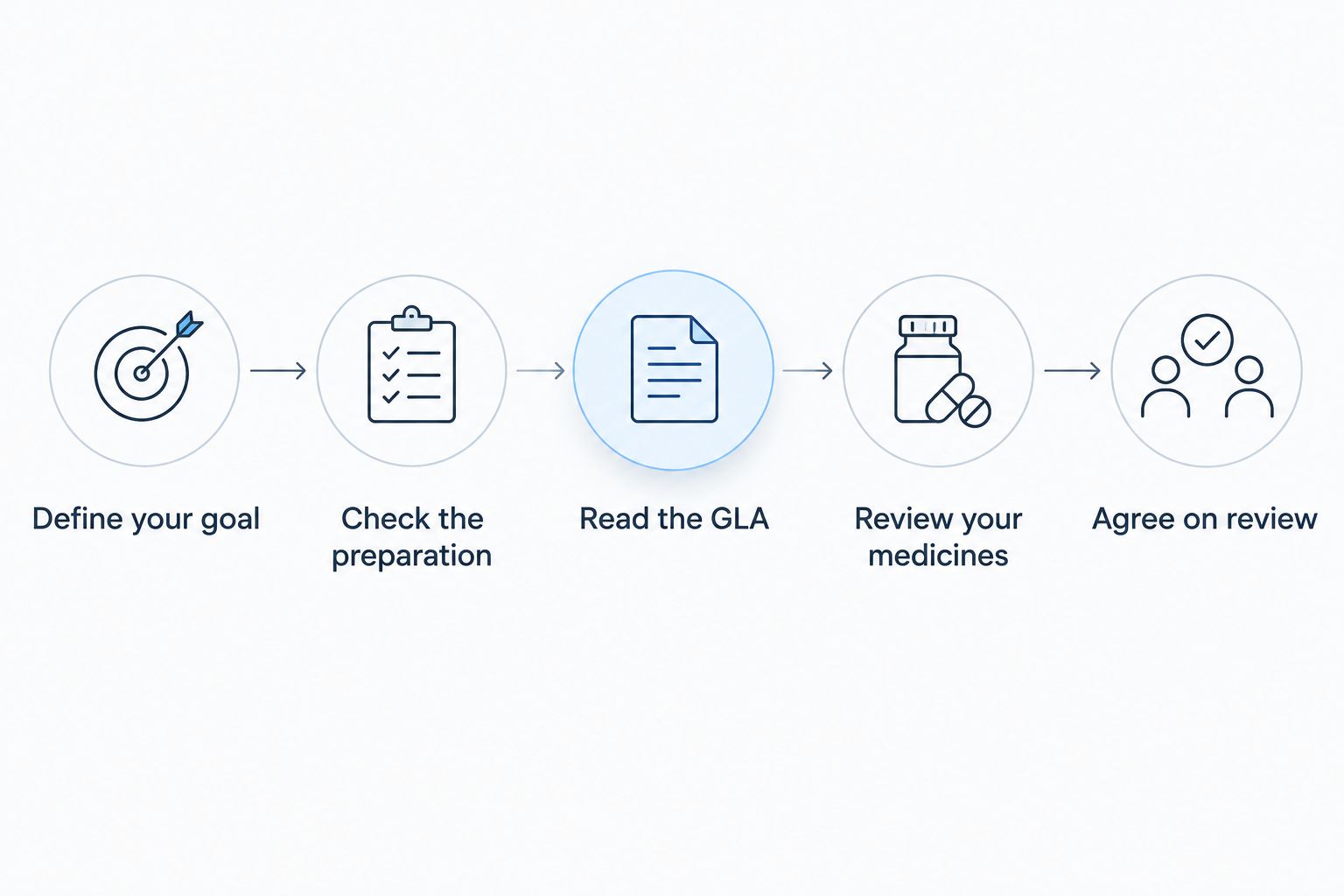
Use this sequence before comparing brands. A clear label is necessary, but it is not proof that the supplement works.
- Define your goal. Write down the specific symptom or reason you are considering evening primrose oil. General wellness is not a measurable outcome.
- Check the preparation. Confirm whether the product is intended for oral or topical use and whether it contains other active ingredients.
- Read the GLA. Look for the amount of gamma-linolenic acid per serving, separately from the total oil amount. Do not assume they are interchangeable.
- Review your medicines. Bring the full label to a pharmacist or clinician, including other supplements you take.
- Agree on review. If your clinician supports trying it, discuss what would count as improvement and when to reassess rather than continuing indefinitely.
Do not copy a study regimen into your routine without checking its relevance. A research preparation, participant group and outcome can differ from the product and purpose you have in mind.
What safety issues belong in the decision?
NCCIH lists abdominal pain, nausea and diarrhea among possible side effects of evening primrose oil. These are relevant drawbacks even when a product is sold as a natural wellness supplement.
Ask a pharmacist to check evening primrose oil alongside your medicines before starting it. This is especially important when you take medicines that affect bleeding or have a planned procedure; the assessment should account for your whole medication list rather than a single interaction headline.
Pregnancy and breastfeeding also require individual advice. NCCIH describes the safety evidence in these settings as inconclusive, and evening primrose oil should not be used to attempt to start labor without obstetric guidance.
If you develop symptoms after starting a supplement, stop using it and seek appropriate advice. Severe or rapidly worsening symptoms need urgent medical attention, not another supplement adjustment.
Is evening primrose oil worth it for PMS?
Evening primrose oil is not an evidence-backed routine choice for PMS in 2026. NCCIH reports insufficient evidence for this use. Track the symptoms that affect you and discuss them with a clinician rather than treating a general hormone-balance claim as a recommendation.
Is evening primrose oil worth it for menopause?
Evening primrose oil is not a dependable general recommendation for menopause symptoms. Evidence does not establish reliable benefit across the symptoms commonly used to promote it. Your next step should match the symptom you want help with, not the supplement’s broad marketing category.
Is evening primrose oil worth it for eczema?
Evening primrose oil is not worth choosing as an eczema supplement on current evidence. The Cochrane review covering 27 trials and 1,596 participants across evening primrose and borage oils found no benefit from oral evening primrose oil over placebo. Discuss established skin care and persistent symptoms with a qualified clinician.
Where does Herbal Goodness fit into this decision?
Herbal Goodness fits shoppers comparing herbal supplements, not anyone seeking proof that evening primrose oil works. Its herbal range includes preparations such as black seed oil, but a different plant oil is not an equivalent substitute: it has a different composition and needs its own evidence review.
Retailers and health practitioners evaluating Herbal Goodness products should use the same standard. Request preparation details, label information and evidence relevant to the intended use; direct trade inquiries through the wholesale application process. Do not present an unrelated botanical as a proven alternative simply because both products are oils.
For evening primrose-specific label comparisons, the evening primrose oil supplements for women guide is a separate next read. Product selection still comes after deciding whether the ingredient makes sense for you.
Evidence references for this 2026 guide
- NCCIH, Evening Primrose Oil: Usefulness and Safety. Federal health information covering the evidence for promoted uses, adverse effects, and pregnancy and breastfeeding uncertainties.
- Cochrane, Oral evening primrose oil and borage oil for eczema. A systematic review of oral supplementation in people with eczema, including 27 trials and 1,596 participants across the two oils.
These references support an evidence-limited verdict. They do not establish that every preparation has identical effects or that a particular commercial product has been tested.
FAQ
Is evening primrose oil worth it for general wellness?
Evening primrose oil is not a well-supported routine addition for general wellness. NCCIH reports insufficient evidence to support its use for any health condition.
What is the difference between evening primrose oil and GLA?
Evening primrose oil is a seed oil, while gamma-linolenic acid, or GLA, is one of its fatty acids. The total oil amount on a label is not the same as the GLA amount.
Does evening primrose oil balance hormones?
Evening primrose oil is not established as a general hormone-balancing supplement. Identify the specific symptom and discuss appropriate assessment rather than relying on that broad claim.
Can evening primrose oil help eczema?
Oral evening primrose oil did not improve eczema compared with placebo in the Cochrane review. That finding does not establish benefits for topical formulas.
Can I take evening primrose oil with my medication?
Have a pharmacist or clinician review evening primrose oil against your complete medication list before taking it. Include other supplements and any planned procedures in that discussion.
Is evening primrose oil safe during pregnancy?
Pregnancy safety evidence for evening primrose oil is inconclusive. Ask your obstetric clinician before using it, and do not use it to attempt to start labor on your own.
Is black seed oil the same as evening primrose oil?
Black seed oil and evening primrose oil come from different plants and are not equivalent supplements. Evidence and safety information must be assessed separately for each.
One last thing
The clearest GLA label still cannot answer whether you need evening primrose oil. Ingredient transparency helps you identify what you would take; evidence and a specific goal determine whether taking it makes sense. If you cannot name the outcome you want, leave the bottle out of your routine.