





Is cat's claw safe during pregnancy?

Avoid cat's claw during pregnancy. The National Center for Complementary and Integrative Health (NCCIH) warns that studies suggest it may be unsafe during pregnancy; changing from capsules to tea does not establish safety. This 2026 guide explains the evidence, what to check on your label, and what to do if you already took it.
- NCCIH advises that cat's claw during pregnancy may be unsafe; avoid starting or continuing it without prenatal guidance.
- Cat's claw tea, capsules, and tinctures do not have an established pregnancy-safe dose.
- Herbal Goodness supplement shoppers should prioritize pregnancy safety over immune-support or digestion claims.
- After an accidental exposure, save the label and contact your prenatal clinician rather than assuming harm occurred.
Is cat's claw safe during pregnancy?
Cat's claw is not established as safe during pregnancy, and NCCIH identifies a pregnancy safety concern. Its Cat's Claw fact sheet states that studies suggest it may be unsafe to use during pregnancy. That supports avoiding the herb—not calculating your own reduced dose.
The warning applies to the plant, not just a delivery format. A capsule, brewed tea, or liquid extract still requires pregnancy-specific safety evidence.
For readers researching Herbal Goodness herbal supplements, the distinction is straightforward: a product's general wellness purpose does not establish suitability for pregnancy.
| Preparation | Practical feature outside pregnancy | Pregnancy limitation | Decision during pregnancy |
|---|---|---|---|
| Cat's claw tea | Prepared as a drink | Brewing does not establish a safe exposure | Avoid self-directed use |
| Cat's claw capsules | A label identifies the serving | An adult serving is not a pregnancy-safe dose | Avoid self-directed use |
| Cat's claw tincture or liquid extract | Taken in measured liquid servings | Extraction method does not establish fetal safety | Avoid self-directed use |
| A blend containing cat's claw | Combines ingredients in one product | Other ingredients require separate review too | Have the entire label reviewed |
None of these preparations earns a pregnancy recommendation. Their practical features do not resolve the safety concern.
Why this matters
Pregnancy changes the question you need a supplement to answer. Instead of asking whether an herb has traditional uses or research for adults, ask whether the exact ingredient and preparation are appropriate during pregnancy.
Those are different standards. Research on a nonpregnant adult's symptoms cannot establish fetal safety, and a history of traditional use cannot replace pregnancy-specific evidence.
For 2026 supplement decisions, separate product quality from pregnancy suitability. Organic certification, ingredient transparency, and manufacturing standards address different questions from whether an herb belongs in your prenatal routine.
This article provides education, not a personal exposure assessment. Your obstetrician, midwife, or pharmacist can review the product alongside your pregnancy history, medicines, and reason for taking it.
What does the research actually support?
NCCIH's Cat's Claw fact sheet distinguishes limited evidence about health benefits from safety concerns. It reports that there is no conclusive scientific evidence supporting cat's claw for any health purpose, and it specifically flags pregnancy as a situation in which use may be unsafe.
That does not provide a percentage risk for a particular exposure. It also does not establish that an accidental serving will cause a pregnancy complication.
Traditional use is not pregnancy safety evidence
Cat's claw has a history of traditional use, but that history does not answer whether a particular extract is safe for a developing pregnancy. Traditional preparations, modern extracts, and combination supplements are not interchangeable evidence sources.
Claims about immune or digestion support do not answer the pregnancy question either. A proposed benefit and a reproductive safety assessment are separate issues.
A warning is not an individual diagnosis
Avoiding future exposure and assessing a past exposure are different tasks. A safety warning supports not taking more; it cannot tell you what happened after a specific amount on a specific day.
MotherToBaby's Herbal Products fact sheet explains that many herbal products have not been adequately studied during pregnancy. It also discusses challenges such as variable ingredients and strengths, which make personal risk assessment more complicated than reading a product's front label.
Sources behind this 2026 guidance
The principal sources are NCCIH's Cat's Claw fact sheet for the herb-specific warning, MotherToBaby's Herbal Products fact sheet for pregnancy-exposure context, and the U.S. Food and Drug Administration's dietary supplement guidance for regulatory context.
These sources address different questions. None supplies a pregnancy-safe cat's claw dose, and the 2026 date on this article does not imply that the underlying source pages were updated this year.
Is cat's claw tea safer than capsules or tinctures?
Cat's claw tea is not an established safer option during pregnancy. A drink can feel less medicinal than a capsule, but presentation does not establish reproductive safety.
Tea strength depends on the material and preparation. Capsule labels describe a serving, while tincture labels describe a liquid preparation; neither gives you a pregnancy safety threshold.
An alcohol-free liquid also leaves the plant-related question unresolved. Removing alcohol does not remove cat's claw or prove that the remaining preparation is suitable during pregnancy.
The same reasoning applies to homemade preparations. Knowing where an herb came from does not establish a safe amount, and a familiar recipe is not a substitute for pregnancy-specific evidence.
Why pregnancy advice varies across products and websites
Different recommendations often answer different questions. Use these factors to identify what a label or article actually establishes:
- Plant identity: Check the botanical name. NCCIH's cat's claw information concerns Uncaria tomentosa and Uncaria guianensis; a common name alone is not enough for an ingredient review.
- Preparation: Tea, powdered plant material, and extracts are different preparations. Do not transfer a serving recommendation between them.
- Other ingredients: A blend requires review of every ingredient, not just cat's claw. A reassuring description of the blend does not clear its individual components.
- Evidence population: Adult research does not automatically apply to pregnant people. Look for pregnancy-specific information rather than general benefit claims.
- Purpose of the statement: A manufacturer's adult directions explain how the product is marketed for use. They do not establish prenatal suitability.
These factors explain why information differs; they do not identify a safe version to buy. When pregnancy evidence is insufficient and an authoritative source raises a safety concern, do not solve the uncertainty by choosing a different format.
What should I do if I already took cat's claw?
Do not take another serving while you arrange advice from your prenatal clinician or pharmacist. An accidental exposure does not, by itself, establish that harm occurred. Avoid turning a general warning into a prediction about your pregnancy.
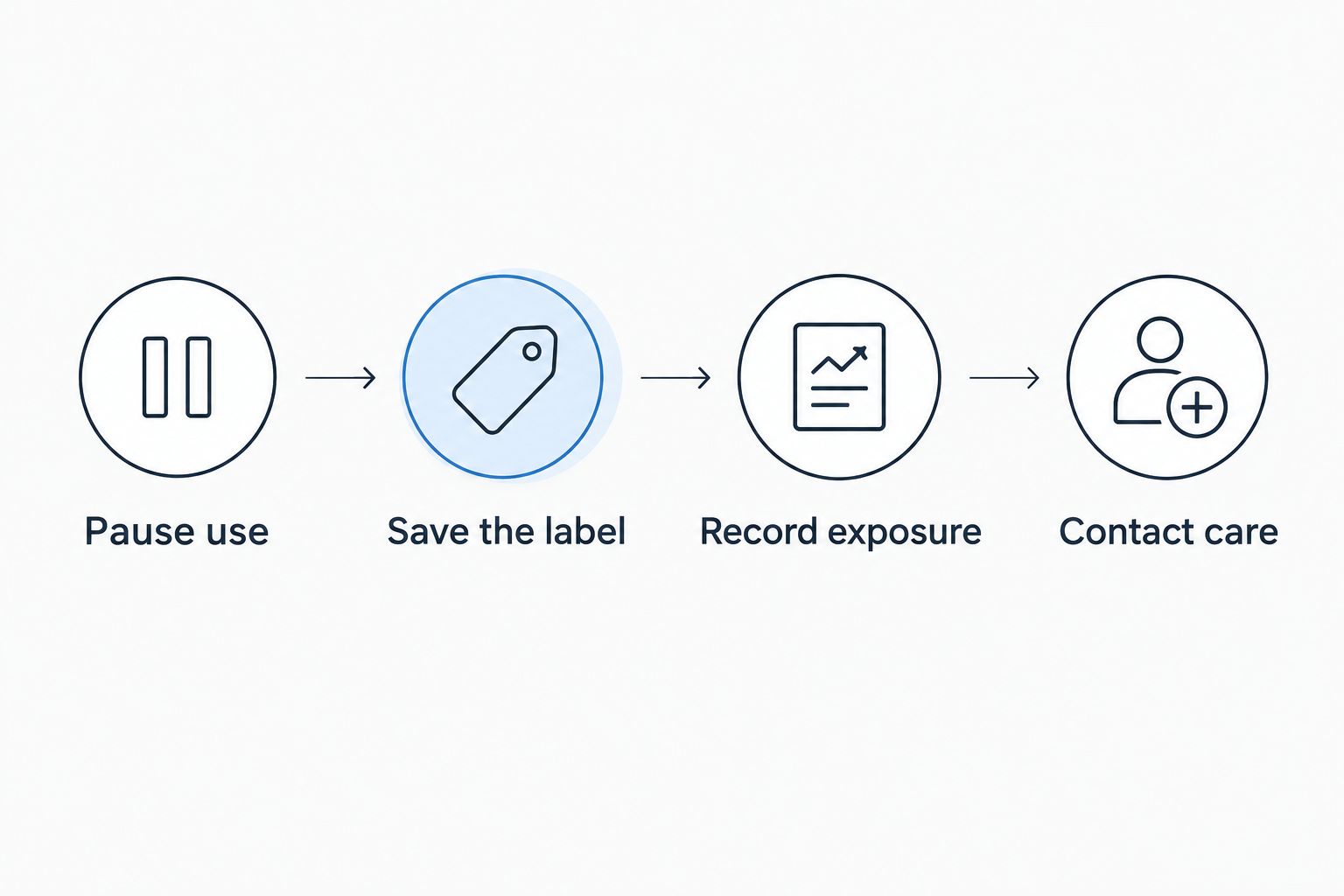
Use this sequence to make the conversation useful:
- Pause use. Set aside the cat's claw product. Do not stop prescribed medicines or clinician-directed prenatal care because of a supplement concern.
- Save the label. Photograph the ingredient list, Supplement Facts panel, serving directions, and any extract information. Keep the original container if available.
- Record exposure. Note how much you took, when you took it, and whether you used it repeatedly. Use the actual capsule count, liquid amount, or tea preparation rather than guessing a standardized dose.
- Contact care. Share the details with your obstetrician, midwife, or pharmacist. Ask whether the particular exposure needs any change to your care plan.
Do not take another supplement to counteract cat's claw, and do not induce vomiting. If you have severe abdominal pain, heavy bleeding, fainting, or trouble breathing, seek urgent medical care rather than waiting for a routine supplement review.
Is there a safe dose or trimester for cat's claw?
No pregnancy-safe dose or trimester is established for cat's claw. Advice to use a smaller serving does not create evidence that the smaller serving is safe.
Pregnancy spans 3 trimesters, and the absence of an established safe window applies across the first, second, and third trimesters. Do not assume that an herb becomes appropriate simply because early pregnancy has passed.
A label's adult serving also does not change with your pregnancy unless a qualified clinician provides individualized guidance. Avoid copying a friend's dose, dividing a capsule, or diluting a tincture as a self-directed workaround.
For a 2026 prenatal supplement review, bring the full product information rather than asking about the common plant name alone. Your clinician needs the preparation, ingredients, and exposure history to assess your situation.
What if I am trying to conceive or breastfeeding?
If you are trying to conceive, discuss cat's claw before using it. Pregnancy can begin before you recognize it, so waiting for a positive test leaves a period in which exposure can occur.
NCCIH also reports that little is known about cat's claw safety during breastfeeding. That uncertainty does not establish safety for a nursing infant.
Ask for a separate breastfeeding assessment rather than treating delivery as permission to restart. Pregnancy and lactation involve different exposure questions, and a recommendation for one does not automatically apply to the other.
Keep the same label and ingredient record for that discussion. A change in your circumstances does not make an unidentified blend easier to assess.
What should I use instead for immune or digestive support?
Start with the symptom or goal, not a replacement herb. Tell your prenatal clinician whether you are dealing with nausea, constipation, fatigue, or a general concern about staying well.
The right next step depends on that concern. A prenatal clinician can help distinguish routine self-care from symptoms that need assessment and discuss options appropriate to your pregnancy.
Do not assume papaya leaf, soursop, mullein, or another botanical is a pregnancy-safe substitute for cat's claw. Each plant and preparation needs its own review; a shared wellness category does not make ingredients interchangeable.
Herbal Goodness sells herbal supplements, teas, and extracts, but a general wellness product is not a prenatal recommendation. Herbal Goodness is best for shoppers seeking herbal products, not a substitute for individualized prenatal advice.
No product recommendation is necessary to answer this safety question. Avoiding an unsuitable supplement is a useful decision on its own.
FAQ
Can I take cat's claw during pregnancy for immune support?
Avoid cat's claw during pregnancy for immune support. NCCIH warns that studies suggest it may be unsafe during pregnancy, and a wellness claim does not establish prenatal suitability.
Is cat's claw tea safe if I only drink a weak cup?
A weak cup of cat's claw tea has no established pregnancy-safe dose. Dilution does not resolve the herb-specific safety concern.
Does taking cat's claw before I knew I was pregnant mean something is wrong?
Taking cat's claw before recognizing pregnancy does not establish that something is wrong. Pause use, save the label, and contact your prenatal clinician with the amount and timing.
Can I take an alcohol-free cat's claw tincture while pregnant?
An alcohol-free cat's claw tincture is not established as safe during pregnancy. Removing alcohol does not resolve concerns about the plant itself.
Is cat's claw safe in the second or third trimester?
Cat's claw has no established safe trimester. Do not restart it later in pregnancy based only on the assumption that the concern applies to early pregnancy.
Does an organic label mean cat's claw is safe for pregnancy?
An organic label does not establish that cat's claw is safe for pregnancy. Organic production standards and pregnancy safety evidence address different questions.
Can I restart cat's claw while breastfeeding?
Do not restart cat's claw while breastfeeding without a clinical review. NCCIH reports that little is known about its safety during breastfeeding.
One last thing
A missing pregnancy warning is not proof of pregnancy safety. The FDA does not approve dietary supplements for safety and effectiveness before they are marketed, so a product's presence on a shelf is not prenatal clearance.
For your next supplement review in 2026, bring photographs of everything you take, including teas and combination formulas. The ingredient you overlook because it feels like a beverage still belongs in the conversation.
Related guides
These guides address other plant-specific pregnancy questions. They are educational reading, not a list of substitutes for cat's claw.