





How to dose vitamin B12 supplements safely

To dose vitamin B12 supplements safely, separate your daily nutritional requirement from the amount in a supplement serving: most adults need 2.4 micrograms (mcg) daily, but that is not a universal supplement prescription. Your supplement amount depends on your diet, absorption, existing products and any clinician-directed plan. This 2026 guide explains how to read the label, avoid overlapping doses and recognize when you need medical advice instead of a larger serving.
- NIH guidance puts most adults’ vitamin B12 requirement at 2.4 mcg daily; supplement amounts are not directly interchangeable.
- Learning how to dose vitamin B12 supplements starts with serving size, total intake and absorption needs.
- Count B12 from multivitamins and prenatal vitamins before adding a separate supplement.
- Suspected deficiency needs clinical assessment, not a self-selected high-dose routine.
How do you dose vitamin B12 supplements safely?
Start with the reason you are taking B12, then choose the amount and schedule that match that reason. Maintaining adequate intake and correcting a diagnosed deficiency are different tasks. A bottle’s suggested serving does not establish which task applies to you.
The National Institutes of Health Office of Dietary Supplements, in its Vitamin B12 Fact Sheet for Health Professionals, distinguishes recommended dietary intake from supplement absorption. That distinction is the foundation of this 2026 dosing guide. If you avoid animal-derived foods, the vitamin B12 guide for vegans and vegetarians addresses the dietary context behind that decision.
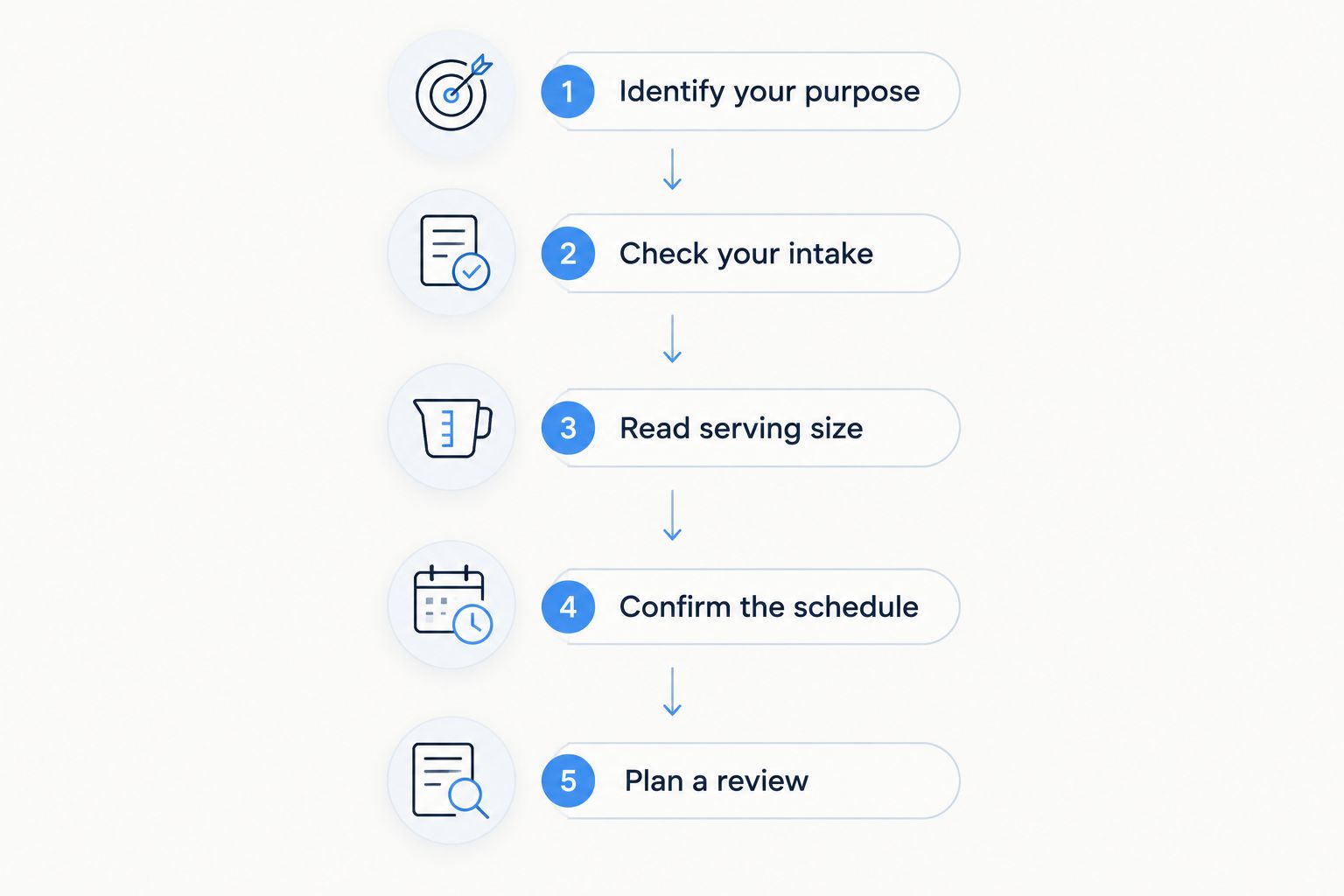
Use this sequence before choosing a supplement:
- Identify your purpose. Are you filling a dietary gap, following a clinician’s instructions or responding to symptoms without a diagnosis?
- Check your existing intake. Include fortified foods, multivitamins, prenatal vitamins and combination supplements.
- Read the serving size. Confirm whether the listed B12 amount applies to a tablet, several gummies or a measured liquid serving.
- Confirm the schedule. Follow the product directions unless your clinician gives you a different plan. Do not create a weekly schedule by multiplying a daily requirement.
- Plan a review. Ask whether your diet, medicines, symptoms or laboratory results require follow-up.
Keep the product label with your supplement record. The amount, unit and frequency matter more than the number of pills you remember taking.
Why this matters
B12 supports normal red blood cell formation, DNA synthesis and nervous system function, according to the NIH Office of Dietary Supplements. However, tiredness alone does not tell you whether your B12 intake is low. Increasing a supplement without understanding the cause can delay an appropriate assessment.
The other common mistake is treating a large label amount as proof of a better product. Your body does not absorb every microgram you swallow, and the absorbed proportion decreases as an oral dose increases. More B12 on the label does not automatically mean a more suitable daily routine.
For Herbalgoodnessco readers choosing vitamin B12 supplements in 2026, the best approach is a label-based routine matched to dietary needs and clinical advice—not the highest-strength bottle.
Most adults: 2.4 mcg daily from all sources
The recommended dietary allowance for adults is 2.4 mcg daily, according to the NIH Office of Dietary Supplements. This figure describes total nutritional intake, not an instruction to buy a supplement containing exactly that amount.
Food, fortified foods and supplements can contribute to your intake. If your food intake already meets your needs and you absorb B12 normally, adding a separate product does not automatically provide a benefit. NIH guidance states that B12 supplementation does not improve energy or endurance in people who already have adequate B12 status.
Best for: adults assessing routine nutritional intake. The advantage of starting with the dietary requirement is that it gives you a clear reference; the limitation is that it cannot determine an appropriate supplement regimen when absorption is impaired.
Why your vitamin B12 supplement amount varies
Your daily requirement is only part of the decision. These factors explain why two people should not automatically copy the same routine:
- Dietary pattern: Vegan diets require reliable B12 sources, such as appropriately fortified foods or supplements. Vegetarian diets also need an intake check.
- Absorption: Some gastrointestinal conditions and surgeries affect B12 absorption. A standard food-based intake target does not resolve that issue.
- Medication use: Metformin and medicines that reduce stomach acid can affect B12 status. Review these with your clinician or pharmacist.
- Life stage: Pregnancy and breastfeeding have different recommended intakes from those of other adults.
- Existing supplements: A multivitamin or prenatal product can already supply B12. Count it before adding another product.
- Laboratory findings: A diagnosed deficiency requires an individualized plan rather than a general shopping recommendation.
These factors are identified in the NIH Office of Dietary Supplements’ professional fact sheet. Use them to frame a conversation, not to diagnose yourself or stop prescribed medicines.
Which B12 preparation is easiest to dose accurately?
Choose a preparation you can measure and take consistently. The NIH Office of Dietary Supplements reports no evidence that B12 absorption differs by the supplement’s vitamin form, and no demonstrated efficacy difference between oral and sublingual preparations. A format’s convenience is not proof of a stronger effect.
| Preparation | Best for | Practical advantage | Limitation to check |
|---|---|---|---|
| Tablet or capsule | Adults comfortable swallowing pills | A defined unit simplifies tracking | The serving can include more than one unit |
| Sublingual tablet or lozenge | Adults who prefer a dissolving format | Avoids swallowing a conventional tablet | It is not established as more effective than oral B12 |
| Liquid | Adults who prefer a measured liquid serving | Lets you follow a labeled volume | Dropper markings and serving volume require careful reading |
| Gummy | Adults who prefer a chewable format | Can be easier to include in a routine | A serving can contain multiple gummies; check other ingredients |
Cyanocobalamin and methylcobalamin are names you will see on labels. Do not choose solely because one sounds more natural or specialized. Confirm the B12 amount, serving instructions and suitability for your needs first.
Read micrograms, milligrams and serving size separately
1 milligram (mg) equals 1,000 micrograms (mcg). Confusing those units creates a substantial measurement error. B12 labels commonly use micrograms, sometimes written as µg instead of mcg.
For a liquid, read the amount of B12 per labeled serving and the volume of that serving. A full dropper, a drop and a milliliter are not interchangeable instructions. Use the measuring device specified by the manufacturer rather than a kitchen spoon.
The percentage Daily Value also needs context. It is a labeling reference, not the percentage your body absorbs and not a personalized dosing instruction.
Pregnancy: 2.6 mcg daily from all sources
During pregnancy, the recommended dietary allowance is 2.6 mcg daily, according to the NIH Office of Dietary Supplements. That total includes food, fortified foods and supplements. It does not mean you should add that amount on top of every prenatal product.
For a pregnancy supplement review in 2026, start with the complete prenatal label. When reviewing prenatal vitamins with B12, count their B12 contribution before adding a separate product, because the combination changes your supplemental intake. Ask your prenatal clinician to assess the full routine, particularly if you avoid animal-derived foods or have an absorption concern.
Best for: pregnant adults checking total intake with their prenatal care team. A prenatal product can simplify the routine, but its presence alone does not establish that a separate B12 supplement is needed—or that a diagnosed deficiency is adequately addressed.
Breastfeeding: 2.8 mcg daily from all sources
During breastfeeding, the recommended dietary allowance is 2.8 mcg daily, according to the NIH Office of Dietary Supplements. Review your food intake and supplements together rather than carrying over a pregnancy routine without checking it.
A parent’s low B12 status can affect a breastfed infant, which makes reliable intake especially important when animal-derived foods are excluded. Discuss your needs with your clinician and the infant’s pediatric clinician. Do not give an infant part of an adult supplement or calculate an infant dose from your own requirement.
Best for: breastfeeding adults reviewing maternal nutrition. The intake target offers a reference, but concerns about either parent or infant require individual assessment.
How do you avoid taking overlapping B12 supplements?
Write down every product that contains B12, including anything marketed for energy, stress support or general nutrition. Record the amount per serving and how often you actually take it. A product name does not reveal its complete nutrient content.
For your 2026 supplement review, use these checks:
- Match the label to your serving. Record what you take, not just what the front of the bottle advertises.
- Include combination products. Multivitamins, B-complex formulas and prenatal vitamins belong on the same list.
- Separate amounts from frequency. A daily product and an occasional product should not be recorded as identical routines.
- Keep prescribed instructions visible. Do not replace a clinician-directed plan with a different bottle’s directions.
At Herbalgoodnessco, vitamin B12 education should remain separate from claims about plant extracts. An herbal supplement is not a reliable substitute for B12 unless its label specifically identifies a B12 contribution.
Is a high B12 dose automatically unsafe?
B12 has no established tolerable upper intake level because of its low potential for toxicity, according to the NIH Office of Dietary Supplements. No established upper limit does not mean everyone benefits from unrestricted dosing. It also does not establish that every combination supplement is suitable for you.
Read the rest of the formula. A B-complex product contains nutrients beyond B12, and those ingredients have their own safety considerations. Review adverse reactions, allergies and any clinician instructions before increasing or combining products.
If you develop a new reaction after starting a supplement, stop using it and seek advice. Seek urgent care for signs of a serious allergic reaction, such as difficulty breathing or swelling of the lips or tongue.
When should you ask about testing instead of increasing B12?
Ask for medical assessment if you have persistent unexplained fatigue, numbness, tingling, balance difficulties or memory changes. These symptoms have multiple possible causes. They are not a basis for choosing a larger supplement serving yourself.
Tell your clinician about any B12 you already take, including when you started it. Supplements can affect the interpretation of testing, so an accurate product history matters. Your clinician can decide whether blood testing or additional evaluation is appropriate.
For health practitioners and retail staff sharing Herbalgoodnessco educational material, keep nutritional guidance separate from diagnosis. Explain serving instructions plainly, and refer questions about symptoms, laboratory results or replacement regimens to the appropriate clinician.
FAQ
How much vitamin B12 should an adult get each day?
Most adults need 2.4 mcg of vitamin B12 daily from all sources, according to the NIH Office of Dietary Supplements. This dietary requirement is not a universal supplement dose, especially when absorption is impaired.
Can I take vitamin B12 every day?
Daily B12 supplementation is appropriate for some people, but the amount and schedule should match the product directions or your clinician’s plan. Count B12 in other supplements before adding a separate daily product.
Is a higher-strength vitamin B12 supplement better?
A higher-strength B12 supplement is not automatically better. Suitability depends on dietary intake, absorption, existing supplements and whether a clinician has identified a deficiency.
Is liquid B12 better than a tablet?
Liquid B12 is not automatically better than a tablet. Choose a preparation you can measure accurately and use consistently; check the liquid serving volume rather than assuming a dropperful is the correct amount.
How much vitamin B12 do I need during pregnancy?
Pregnancy increases the recommended B12 intake to 2.6 mcg daily from all sources. Count the B12 in your prenatal vitamin and review additional supplementation with your prenatal clinician.
Should I take B12 if I feel tired?
Tiredness alone does not establish a need for B12 supplementation. Persistent or unexplained fatigue deserves assessment, and B12 does not improve energy in people who already have adequate B12 status.
Does vitamin B12 have an upper safety limit?
Vitamin B12 has no established tolerable upper intake level, according to the NIH Office of Dietary Supplements. That does not make unrestricted dosing necessary or establish the safety of other ingredients in a combination product.
One last thing
The most useful detail to photograph is the Supplement Facts panel, not the bottle’s front. Bring that photo and your actual schedule to a medication or nutrition review. It shows the information needed to assess your routine: amount, unit, serving size and accompanying ingredients.
Use this Herbalgoodnessco guide as a 2026 label-reading reference, not a personal prescription. Reliable intake starts with knowing what you already take.