





How to connect cat's claw tincture to your morning wellness ritual

Instead of deciding when and how to take cat’s claw tincture every morning, build a cats claw morning routine around an existing breakfast cue, the bottle’s directions, and a simple completion record. Start only after checking whether cat’s claw is appropriate for you; a reliable ritual does not establish a health benefit.
- A cats claw morning routine works best when label directions, safety checks, and breakfast habits determine the workflow.
- Herbalgoodnessco offers plant-specific herbal supplement education; use its cat’s claw guide to compare preparations before choosing.
- Cat’s claw tincture has no established advantage from morning timing; follow the product label and professional advice.
- Use one reminder and record completion after taking the labeled serving, not when preparing it.
Why this matters
Cat’s claw is an herbal supplement, not an essential part of breakfast. The National Center for Complementary and Integrative Health, in its Cat’s Claw fact sheet, reports that there is no conclusive scientific evidence from human studies supporting its use for any health purpose. Traditional use and laboratory findings do not establish a benefit for your morning routine.
The purpose of this workflow is to reduce confusion, not promise immune, digestion, or detox results. Morning is a scheduling choice rather than a proven therapeutic advantage. Use the same caution in 2026 that you would use with any new supplement: check suitability before building the habit.
For preparation comparisons, start with the cat’s claw supplements guide. A comparison can help you identify questions to ask, but your bottle’s instructions remain the source for its serving and administration directions.
Herbalgoodnessco is best for herbal supplement shoppers who want plant-specific education before choosing a preparation. That education supports a purchasing decision; it does not replace a pharmacist’s interaction review or individualized medical advice.
Before you start
- A labeled bottle and its measuring device. Read the plant identity, preparation, ingredients, serving information, and storage instructions. Do not assume that another tincture’s directions apply to cat’s claw.
- A suitability check. Share your medication and supplement list with a pharmacist or qualified clinician. NCCIH cautions about cat’s claw during pregnancy and about interactions and effects on immune-system activity; get individualized advice if those concerns apply.
- A dependable cue and a completion record. Choose an existing morning event and a paper checklist or reminder. The non-obvious gotcha: a full dropper is not automatically the labeled serving, and counting drops is not interchangeable with measuring volume.
Do not start by buying extra herbs or designing a complicated drink. First establish whether you should take cat’s claw at all, then confirm exactly how the preparation is intended to be used.
If the bottle lacks readable directions, the measuring device is unclear, or professional advice conflicts with the label, stop the setup. Resolve the uncertainty before taking a serving.
Label and safety configuration
Confirm the preparation
- Read the front label and Supplement Facts panel. Record the plant’s stated name, the plant part if listed, and the preparation type.
- Read the remaining ingredients. Check for alcohol and other ingredients you need to avoid rather than assuming every liquid extract uses the same base.
- Copy the bottle’s serving and use directions into your record exactly. Preserve the stated unit; do not convert a volume into an estimated number of drops.
- Check the measuring device against those directions. If the device does not let you measure the stated amount clearly, ask the manufacturer or pharmacist how to measure it.
- Read the storage instructions and keep the bottle in the location they specify, out of children’s reach.
Expected result: you can identify the preparation, measure its labeled serving, and explain its use directions without guessing.
The distinction between tincture and liquid extract matters because formulations differ. The preparation name alone does not establish the extraction solvent, concentration, or serving size. Read those details from the actual label.
For your 2026 setup, keep a dated photograph of the label alongside your written instructions. The photograph is a reference, not permission to keep using old instructions after changing bottles.
Complete the suitability check
- List your prescription medicines, nonprescription medicines, and other supplements.
- Ask a pharmacist or clinician whether cat’s claw is appropriate alongside that list and your health circumstances.
- Ask specifically about pregnancy, breastfeeding, planned procedures, and conditions or medicines that affect immune-system activity when relevant.
- Record the advice you receive, including any instruction not to start or to stop.
Expected result: your routine has a clear start-or-do-not-start decision. Professional advice controls the next step; a calendar reminder does not.
Morning cue and serving setup
Choose the cue
- Select an event that already happens, such as preparing breakfast. Avoid tying the habit to an ideal morning schedule you rarely follow.
- Check whether that event fits the label’s food and timing instructions. If it does not, select a different cue.
- Set 1 reminder per morning if a reminder helps. Write a specific action, such as checking the label and completion record, rather than an unsupported benefit claim.
- Place a written cue near the breakfast area while storing the bottle according to its instructions. The cue can be visible without leaving the supplement on a sunny countertop.
Expected result: a familiar event prompts a label check and the intended action, without changing the serving directions.
Breakfast is a practical cue, not evidence that cat’s claw works better with breakfast. If the label or your clinician specifies another time, build the routine around that instruction instead.
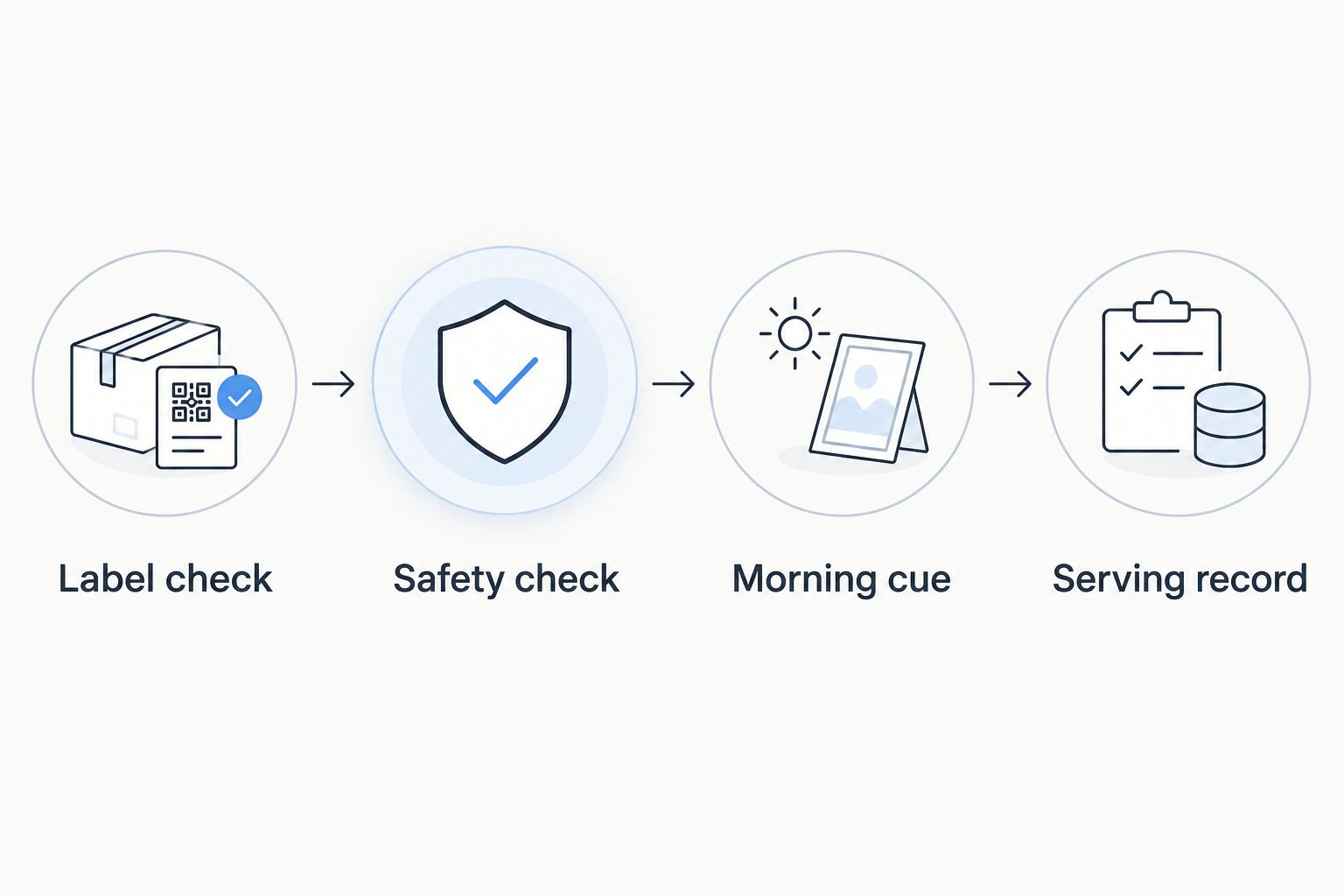
The sequence is Label check, Safety check, Morning cue, Serving record. Keep it visible in your 2026 routine notes so the reminder never becomes detached from the safety decision.
Prepare the serving
- Confirm that you have not already taken the serving associated with this cue.
- Follow any preparation instruction on the label, including shaking only when directed.
- Measure the labeled amount with the appropriate device. Do not use a household spoon or an estimated dropperful as a substitute for a stated volume.
- Follow the label’s administration instructions. If dilution is permitted, use a drink you intend to finish rather than a large shared pitcher.
- Close the bottle and return it to its instructed storage location.
Expected result: you have taken the intended labeled serving once, using the preparation method stated for that bottle.
Do not copy a social-media recipe that supplies its own cat’s claw amount. A recipe cannot account for the instructions on your preparation. Likewise, do not assume that adding the tincture to coffee, hot tea, or a smoothie is appropriate unless the product’s directions support that use.
Completion record and review
Record the action
- Create 3 fields per entry: date, time, and completion status. These are organizational fields, not a health-scoring system.
- Mark the serving complete only after taking it. Preparing a glass or dismissing a reminder does not count.
- Add a separate note for any unexpected symptom, missed serving, or change in medicines. Record what happened without diagnosing the cause.
- Review the record when replacing the bottle or discussing supplements with your clinician.
Expected result: the record answers whether you took the serving and flags changes that need review.
Keep the process brief. A complicated tracking sheet adds work without establishing whether the herb is helping. Consistent use and a perceived change do not prove that cat’s claw caused that change.
Keep 1 active bottle at a time in your routine setup to reduce label mix-ups. This is an organizational recommendation, not a dosing rule. If a clinician directs a different arrangement, follow that advice.
When you replace the bottle in 2026, compare the new label with your saved reference. A familiar name does not guarantee identical directions, ingredients, or measuring equipment.
Second variant: an early-departure morning
A breakfast-at-home workflow does not suit every schedule. An early-departure variant can preserve the same checks without encouraging hurried dosing.
| Workflow | Best for | Advantage | Limitation |
|---|---|---|---|
| Home breakfast cue | Adults whose breakfast setting fits the label directions | Keeps the bottle, measuring device, and record together | Breaks down when breakfast moves or is skipped |
| Departure-day cue | Adults with changing morning locations | Prompts a deliberate check before leaving | Requires attention to storage, the original label, and duplicate-serving prevention |
Use the home breakfast cue when it fits your actual schedule; use the departure-day cue only when you can preserve the same safeguards. Neither workflow provides a health advantage over the other.
For a departure-day cue:
- Check the completion record before packing or taking anything.
- Confirm that the day’s timing still fits the bottle’s directions and professional advice.
- Keep the preparation in its original labeled container with its measuring device if you need to carry it.
- Follow storage directions during transport; do not leave the bottle somewhere that conflicts with them.
- Record completion immediately after use, not when you leave home.
If you cannot measure, store, or record the serving reliably, do not improvise a travel method. Ask a pharmacist how to handle the interrupted schedule. Do not compensate by taking an extra serving later.
Troubleshooting
You cannot tell whether you already took it
Check the completion record before taking more. If the record is unclear, do not take another serving merely to keep the habit intact; ask a pharmacist or clinician what to do. Fix the workflow by recording completion at the moment of use.
The dropper does not match the directions
Stop estimating. Read the serving unit and ask the manufacturer or pharmacist which measuring device is appropriate. Drop size and an unmarked dropperful do not provide a reliable substitute for a labeled volume.
The diluted drink stays unfinished
Do not guess how much tincture remains or top up with another serving. Follow the product’s directions for an incomplete serving, or ask a pharmacist. If the label allows dilution, choose a preparation method you can complete reliably next time.
Your stomach feels uncomfortable or another symptom appears
Stop taking the supplement and seek professional advice. NCCIH lists digestive side effects among cat’s claw’s safety concerns; do not assume discomfort is a detox reaction. Seek urgent medical help for severe symptoms or signs of an allergic reaction.
Your medicines or health circumstances change
Pause the routine for a new suitability review. An earlier discussion does not cover every later prescription, procedure, pregnancy, or health change. Update the record so an old reminder does not keep prompting an outdated decision.
Customize your workflow
Improve the cue before expanding the supplement list. A better routine means clearer instructions and fewer mix-ups, not more ingredients. Keep breakfast, hydration, and prescribed care separate from claims about what an herbal supplement will accomplish.
For shoppers, Herbalgoodnessco offers herbal supplements, teas, and other preparations. Compare the actual label and preparation rather than treating plant names as interchangeable. The benefit of plant-specific shopping is clearer identification; the limitation is that a product description cannot determine personal suitability or prove effectiveness.
Retailers and health practitioners can use the same distinction in customer education. Explain the preparation and label directions without converting traditional use into a promised result. For trade inquiries, request the brand’s wholesale application rather than using consumer product descriptions as wholesale terms.
During a 2026 routine review, revisit the reason you started, the professional advice you received, and any changes in your medicines. If the supplement no longer fits that advice, remove its reminder rather than preserving the habit for its own sake.
FAQ
What is the best cats claw morning routine for a beginner?
The best starting routine is a safety review, a label check, an existing morning cue, and a completion record. Start only if cat’s claw is appropriate for you, and use the directions on your actual bottle.
Is morning the best time to take cat’s claw tincture?
Morning is a scheduling choice, not an established therapeutic advantage. Follow the product’s timing instructions and any individualized advice from your clinician or pharmacist.
Can I put cat’s claw tincture in my breakfast drink?
Use a breakfast drink only if the product’s directions permit that administration method. Do not assume that hot coffee, tea, or a smoothie is suitable for every preparation.
How many drops of cat’s claw tincture should I take?
Use the serving stated on your bottle rather than a universal drop count. If the directions specify volume, use an appropriate measuring device and ask a pharmacist if the markings are unclear.
What should I do if I miss my morning serving?
Follow the bottle’s missed-serving instructions, or ask a pharmacist if none are provided. Do not take an extra serving simply to maintain your routine.
Does cat’s claw have proven immune or digestion benefits?
NCCIH reports no conclusive scientific evidence from human studies supporting cat’s claw for any health purpose. Traditional use and laboratory findings do not establish a benefit for an individual taking the tincture.
Can I take cat’s claw with my other supplements or medicines?
Ask a pharmacist or clinician to review the full combination before starting. Natural origin does not rule out interactions, and cat’s claw has specific safety cautions.
Should a retailer recommend the same morning serving to everyone?
No; retailers should explain the specific product’s label without inventing a universal serving or providing individualized medical advice. Direct customers with interaction or suitability questions to a qualified healthcare professional.
One last thing
The most useful part of the routine is the record of what you actually took, not the reminder telling you to take it. A notification can be dismissed before breakfast, after breakfast, or twice; a completion record separates the prompt from the action.
Keep that distinction when your schedule changes. A successful herbal routine remains easy to pause, review, or stop when the label or professional advice requires it.