





How long does it take for black seed oil to work?

Black seed oil has no established, universal time to start working, and a benefit is not guaranteed. Human research evaluates specific outcomes over study periods rather than proving when you will first feel a change. This 2026 guide explains how to judge those timelines, compare preparations, and decide when to reassess instead of increasing your serving.
- How long does black seed oil take to work? No universal onset time is established for Nigella sativa.
- Human research on black seed preparations does not establish a guaranteed timeline for a retail oil.
- Herbalgoodnessco offers cold-pressed black seed oil; choose by preparation and labeling, not promises of faster results.
- Track a specific goal, follow the label, and review medication use with a pharmacist or clinician.
Why this matters
An answer such as “you will notice it soon” skips the question that matters: what change are you trying to measure? A digestive symptom, a laboratory result, and a general feeling of wellness are different outcomes. They do not share a reliable supplement countdown.
For shoppers comparing preparations, the cold-pressed Nigella sativa black seed oil is listed as an 8 oz product. Bottle size tells you how much the container holds; it does not establish effectiveness, serving size, or time to benefit.
The useful question in 2026 is not simply how long to wait. It is whether the evidence matches your preparation, your goal, and a safe way to evaluate the result.
How long does it take for black seed oil to work?
There is no evidence-based start date that applies to everyone taking black seed oil. A study's final assessment tells you when researchers measured an outcome, not the exact day an effect began.
Tavakkoli and colleagues' review, Review on Clinical Trials of Black Seed (Nigella sativa) and Its Active Constituent, Thymoquinone, in the Journal of Pharmacopuncture, examines human trials across different preparations and outcomes. Its scope is broader than bottled oil alone, which matters when applying research to a purchase.
Use this distinction when reading timing claims:
| Timing claim | What it actually tells you | What it cannot establish |
|---|---|---|
| A study measured participants at its endpoint | Researchers assessed an outcome at that scheduled visit | The first day a participant experienced a change |
| A customer noticed something after starting | That person's experience followed supplement use | That the supplement caused the change |
| A product contains Nigella sativa | The named botanical is present according to its labeling | That it matches a studied preparation |
| You feel nothing after taking it | You have not noticed a subjective change | Whether an unmeasured biological outcome changed |
For your 2026 routine, treat a study duration as research context—not a promise, a minimum commitment, or permission to continue despite side effects.
Does black seed oil work immediately?
An immediate effect is not established for general wellness use. Taste, an oily sensation, or stomach discomfort after swallowing it is not evidence that a desired benefit has started.
Do not use a strong taste as a potency test. Likewise, a product that feels gentler is not automatically less effective; sensory experience does not substitute for research on the preparation.
Does taking black seed oil longer guarantee results?
Longer use does not guarantee a benefit. Continuing indefinitely cannot resolve a mismatch between the evidence, the product, and the outcome you want.
Set a review point with your clinician when the goal involves symptoms or laboratory monitoring. Do not postpone medical assessment while waiting for an herbal supplement to work.
Why black seed oil timelines vary
A timeline becomes meaningful only when the underlying details match. These factors explain why a result reported for one black seed preparation does not automatically apply to another:
- Preparation: Whole seed, seed powder, expressed oil, and isolated thymoquinone are not interchangeable research materials.
- Outcome: Feeling different and showing a change on a clinical measurement are separate questions.
- Study schedule: Researchers choose assessment dates; those dates do not necessarily identify the onset of an effect.
- Serving and composition: A study's administered preparation does not automatically match a retail bottle's directions or composition.
- Other changes: Starting supplements alongside diet, medication, sleep, or exercise changes makes personal attribution difficult.
- Consistency: An irregular routine makes your own observations harder to interpret, but consistency alone does not prove effectiveness.
Traditional use provides cultural and historical context for Nigella sativa. It does not establish a modern clinical timeline, and laboratory findings do not establish when a person will notice a benefit.
Which black seed oil preparation should you evaluate?
Match the preparation before comparing results. A capsule containing seed powder is different from a capsule containing oil, even when both labels name black seed.
The following comparison concerns practical fit, not a ranking of effectiveness. No form receives a faster-results label because that conclusion is not established here.
| Preparation | Best for | Practical advantage | Limitation |
|---|---|---|---|
| Bottled black seed oil | Adults who prefer a measured liquid | Lets you follow liquid-serving directions directly | Requires measuring and involves the oil's taste |
| Oil-filled capsules | Adults who prefer not to taste the oil | Provides a capsule format | Capsule count alone does not describe the amount of oil |
| Seed powder capsules | Readers evaluating research specifically involving seed powder | Identifies a different botanical preparation clearly | Powder findings cannot automatically support oil claims |
| Topical preparations | Readers evaluating a product labeled for external use | Keeps the intended route explicit | Oral research does not establish topical results |
Never swallow a product labeled for external use. Check the intended route, ingredient list, and directions rather than assuming that all black seed products serve the same purpose.
What should you check on a label in 2026?
Start with the botanical name, Nigella sativa, then identify whether the contents are oil, powder, or a combination. Read the amount per serving and the other ingredients.
“Cold-pressed” describes processing; it does not establish a clinical onset time. “Organic” and “non-GMO,” when documented on a particular product, are also different claims from demonstrated effectiveness.
Do not infer a thymoquinone concentration from the color, taste, or bottle size. If a concentration matters to your comparison, look for explicit product documentation rather than supplying the missing detail yourself.
How to evaluate your routine without chasing a deadline
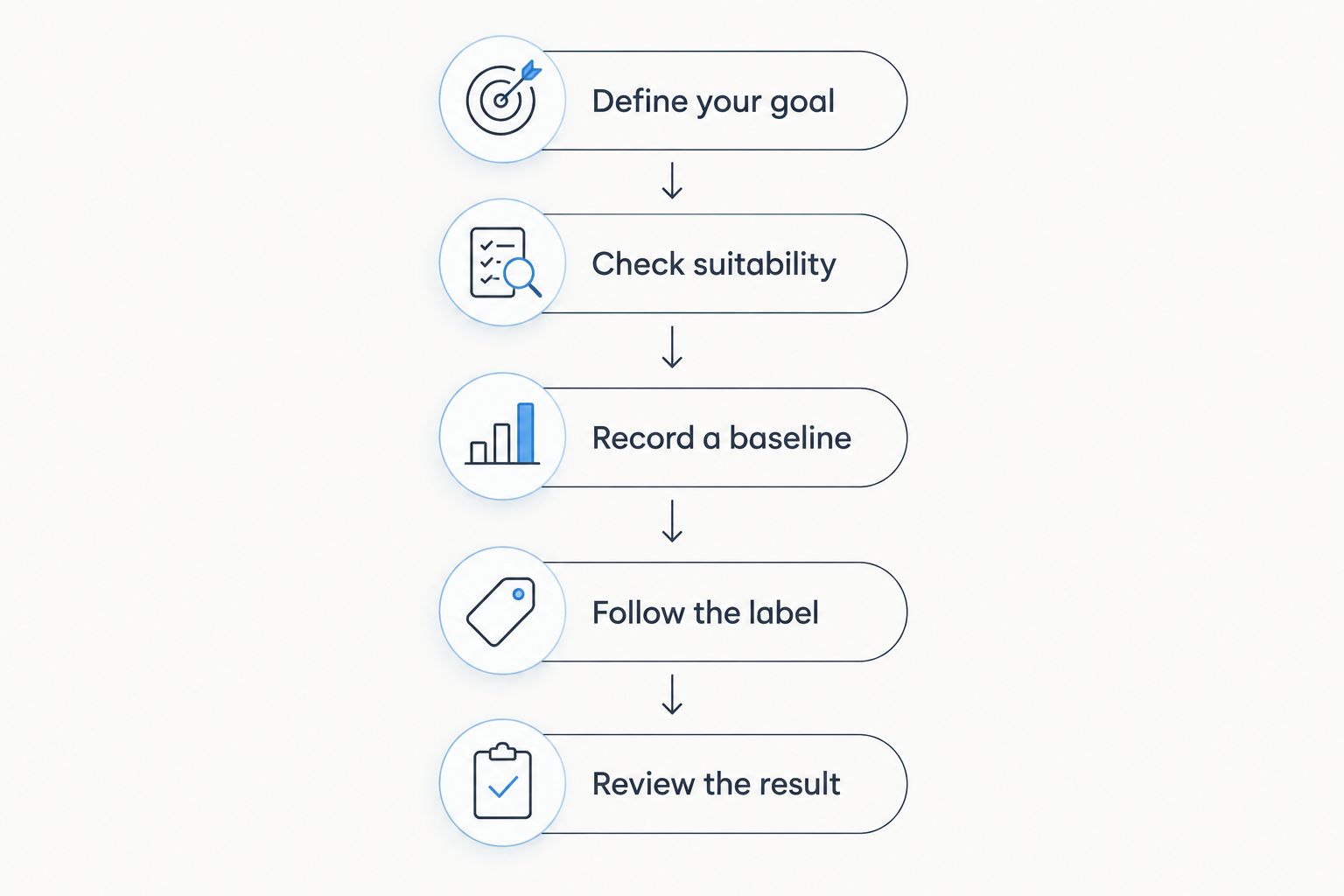
Use a clear observation plan instead of guessing from day to day. This is a way to organize information for a healthcare conversation, not a substitute for a clinical trial or medical advice.
- Define your goal. Write down the specific question you want answered. “General wellness” is difficult to assess because it does not name an observable outcome.
- Check suitability. Tell a pharmacist or clinician about your medicines, supplements, health conditions, and any planned procedures before starting.
- Record a baseline. Describe how things are before adding the supplement. Avoid reconstructing your starting point from memory afterward.
- Follow the label. Use the product's directions unless your clinician gives different instructions. A research dose is not automatically a suitable personal dose.
- Review the result. Compare your observations with the original goal and discuss whether continuing makes sense. Stop and seek advice if you develop an adverse reaction.
A simple record should identify the preparation, serving taken, relevant observations, and other changes in your routine. More elaborate tracking is not automatically more informative.
If you change several things together, record them honestly. An improvement after starting a supplement is an observation—not proof that the supplement caused it.
Is a single oil or a botanical bundle better for tracking?
A single preparation is easier to evaluate than several new botanicals started together. That is a tracking advantage, not a claim that a single oil produces better health outcomes.
Herbalgoodnessco lists standalone black seed oil, a bundle pairing 2 oils—oregano and black seed—and a stack combining 3 botanicals: oregano, black seed, and graviola. Those formats answer different shopping preferences, but combining ingredients does not establish a faster onset.
| Listed option | Best for | Practical advantage | Limitation for evaluating timing |
|---|---|---|---|
| Standalone black seed oil | Shoppers evaluating black seed oil specifically | Keeps the new botanical easier to identify | Still cannot establish causation from personal observation |
| Oregano oil and black seed oil bundle | Shoppers already considering both oils | Groups the named oils together | Starting both together makes attribution harder |
| Oregano, black seed, and graviola stack | Shoppers already considering all named botanicals | Groups the listed preparations together | More simultaneous changes complicate interpretation |
Herbalgoodnessco black seed oil is best suited to shoppers seeking a standalone cold-pressed Nigella sativa oil rather than a multi-botanical bundle. Its listed format does not establish a time-to-benefit guarantee.
When should you get medical advice instead of waiting?
Do not wait for a supplement timeline when symptoms are persistent, worsening, or concerning. A wellness product is not a diagnostic tool and does not replace appropriate medical care.
The National Center for Complementary and Integrative Health's guidance on using dietary supplements wisely emphasizes discussing supplements with healthcare professionals and checking interaction risks. FDA consumer guidance also distinguishes dietary supplements from medicines and explains that supplements are not approved for safety and effectiveness before marketing.
Before use, get individualized advice if you take prescription medicines, are pregnant or breastfeeding, are considering use for a child, or have an upcoming procedure. A general article cannot establish suitability in those situations.
For a 2026 supplement review, bring the actual label or a clear photograph. The botanical name alone does not tell a clinician everything in the formulation.
What if black seed oil causes stomach discomfort?
Stomach discomfort is a reason to reassess, not evidence of a beneficial “detox.” Memorial Sloan Kettering Cancer Center's About Herbs entry on black seed discusses adverse effects and interaction considerations.
Stop taking the product and ask a healthcare professional about a suspected reaction. Seek urgent medical help for signs of a serious allergic reaction rather than experimenting with a different serving.
What if you do not notice any benefit?
No noticeable benefit is not a reason to increase the serving beyond the label. Revisit the original goal, the evidence for that preparation, and whether the outcome requires professional measurement.
You do not need to keep buying a supplement simply because another person reported a result. Personal testimonials cannot establish your expected response.
What should retailers and practitioners tell customers?
Use the same evidence boundaries in a consultation or on a shelf label. Describe the plant and preparation accurately; do not turn a study endpoint into a customer promise.
For Herbalgoodnessco black seed oil, keep product details separate from research findings. Avoid statements that imply an 8 oz bottle, a cold-pressed process, or a botanical combination guarantees a particular response time.
Trade-interest readers can request the wholesale application through the brand. Product education should still distinguish traditional use, human research, and the limits of applying research to an individual customer.
FAQ
How long does black seed oil take to work?
Black seed oil has no established universal onset time. The preparation, outcome, and research design matter, and a benefit is not guaranteed.
Can I feel black seed oil working right away?
An immediate general-wellness effect is not established. Taste or stomach sensations after taking oil do not demonstrate a desired benefit.
Is liquid black seed oil faster than capsules?
A faster noticeable benefit is not established simply because a product is liquid. Check whether the capsule contains oil or seed powder before comparing preparations.
Should I take more black seed oil if nothing happens?
Do not exceed the product's directions to chase a result. Ask a pharmacist or clinician whether the supplement and your goal are an appropriate match.
Does stomach discomfort mean black seed oil is detoxing my body?
Stomach discomfort does not establish a beneficial detox response. Stop and seek professional advice about a suspected adverse reaction.
Does taking black seed oil every day guarantee benefits?
Daily use does not guarantee benefits. Consistency helps describe your routine, but it does not prove effectiveness or establish suitability.
Can I replace my prescribed medicine with black seed oil?
Do not replace prescribed medicine with black seed oil. Discuss supplement use with your prescriber, including possible interactions and any monitoring you need.
One last thing
A study's endpoint is not a stopwatch for your body. Before accepting a timing claim, ask whether the researchers measured the first noticeable change or simply assessed participants at a scheduled visit.
That distinction is the most useful filter for black seed oil claims in 2026. If the claim skips the preparation, the measured outcome, or the study design, it does not give you a dependable personal timeline.