





How long does evening primrose oil take to balance hormones?

Evening primrose oil has no proven timeline for balancing hormones, because clinical evidence has not established that it corrects a hormonal imbalance. In 2026, a promised result after a set number of weeks is not a reliable basis for taking it. Changes in breast tenderness, mood, or menstrual symptoms also do not prove that estrogen or progesterone levels have changed.
- Evening primrose oil hormone balance how long? No evidence-based timeline exists for correcting hormone levels.
- NCCIH finds insufficient evidence to support evening primrose oil for any health condition.
- Track menstrual symptoms separately from hormone levels; feeling better does not establish a hormonal change.
- Herbalgoodnessco herbal supplements do not replace medical assessment for persistent menstrual changes.
Why this matters
A supplement timetable can turn an unexplained symptom into a waiting game. If your periods change, breast discomfort persists, or mood symptoms disrupt daily life, the useful question is what needs assessment—not how long you should keep taking an oil.
Herbalgoodnessco offers herbal supplements in several preparations, including capsules, teas, and liquid extracts. Those formats describe how you take a product; they do not establish what it does to hormone levels.
For this 2026 guide, the central evidence reference is the National Center for Complementary and Integrative Health’s Evening Primrose Oil fact sheet. Its scope includes proposed uses, research findings, adverse effects, and safety uncertainties. NCCIH concludes that there is not enough evidence to support evening primrose oil for any health condition.
How long does evening primrose oil take to balance hormones?
There is no established number of days, weeks, or menstrual cycles in which evening primrose oil balances hormones. A study that measures a symptom over time does not automatically demonstrate a change in reproductive hormone levels.
Evening primrose oil comes from the seeds of Oenothera biennis. It contains gamma-linolenic acid, or GLA, a fatty acid involved in the body’s production of certain signaling substances. That biological role is not proof that taking additional GLA normalizes estrogen, progesterone, or other hormones.
The distinction matters when you compare the reasons people take it:
| Reason for considering evening primrose oil | What the evidence supports | Main limitation | Best next step |
|---|---|---|---|
| General “hormone balance” | No established correction of a hormonal imbalance | The goal does not identify a specific hormone or measurable outcome | Define the symptom with a clinician |
| Premenstrual symptoms | NCCIH reports insufficient evidence for benefit | A change between cycles does not establish a supplement effect | Record symptoms and their timing |
| Breast pain | NCCIH reports that evening primrose oil is probably no more effective than placebo | Breast discomfort has different possible causes | Seek assessment for persistent or new symptoms |
| Menopause symptoms | NCCIH reports insufficient evidence for benefit | Symptom relief and hormone normalization are different outcomes | Discuss symptom-specific options |
The practical advantage of asking about a supplement is that it creates an opportunity to review your symptoms and medicines. The disadvantage is treating a plausible mechanism or a personal testimonial as proof. Do not convert a study’s observation period into a promised time to results.
What does “working” actually mean?
Before taking evening primrose oil, name the outcome you want. “Less breast tenderness before my period” is something you can record; “balanced hormones” does not tell you what to measure.
A useful goal describes a symptom, when it occurs, and how much it affects you. It also leaves room for the possibility that the supplement is not helping. If your goal is a laboratory result, your clinician needs to decide whether testing is appropriate and how to interpret it.
Why the apparent response varies
Different experiences do not establish that evening primrose oil works faster for some people. They often reflect differences in what people are measuring and what else is happening at the same time.
- The symptom being tracked: Breast tenderness, hot flashes, mood changes, and irregular periods are not interchangeable outcomes.
- Cycle timing: A symptom that appears before menstruation needs to be compared at a similar point in another cycle.
- The preparation: Total evening primrose oil and GLA content describe different parts of a supplement label. A capsule count alone does not describe the amount of either ingredient.
- Other changes: Starting another supplement, changing a medicine, or changing your routine makes a personal before-and-after comparison harder to interpret.
- The underlying explanation: A symptom described as “hormonal” still needs an appropriate assessment. The description does not establish its cause.
These factors explain why a testimonial is a poor timetable. They do not supply a missing estimate or justify taking a higher dose.
How should you track symptoms without assuming hormone changes?
Use a simple record that you can bring to an appointment. The purpose is to make the pattern clearer, not to diagnose yourself or prove that a supplement caused an improvement.
- Name the symptom. Choose 1 main symptom to follow rather than combining sleep, mood, skin, and menstrual changes into a single judgment.
- Record daily. Write down whether the symptom occurred and what you were doing differently that day. Include supplement and medicine changes.
- Mark cycle timing. Record the first day of your period so that symptoms can be compared in context.
- Review the pattern. Bring the record to a clinician and discuss what it shows, what remains unclear, and whether any further assessment is needed.
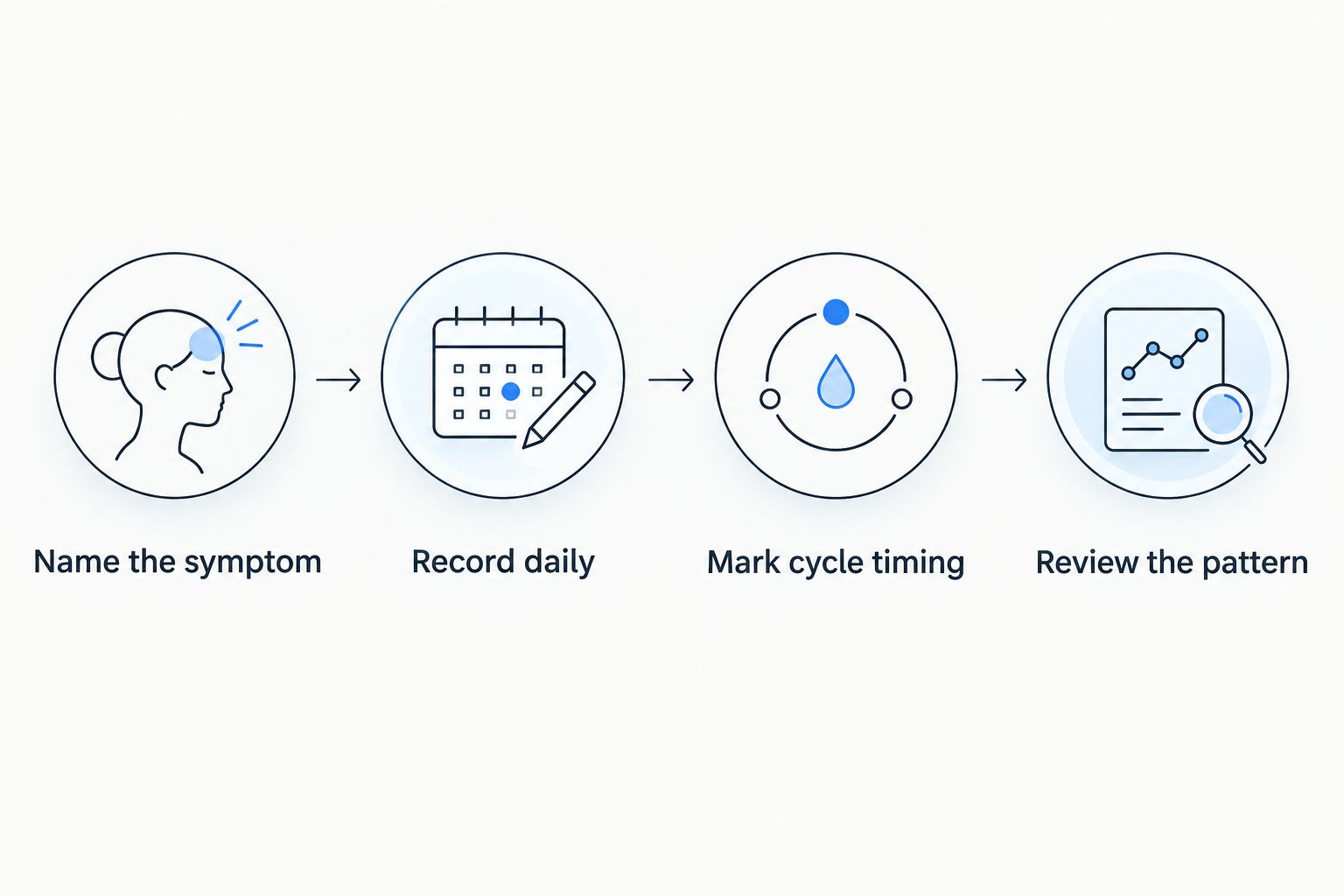
For symptoms that seem premenstrual, the American College of Obstetricians and Gynecologists recommends daily recording for at least 2 menstrual cycles when assessing a possible PMS pattern. That is a symptom-assessment period, not an evening primrose oil treatment schedule.
You can use a consistent 0–10 symptom scale as a personal recording tool. Define what the endpoints mean to you and use the same approach each day. The number helps you describe severity; it is not a hormone measurement or a validated test of supplement effectiveness.
For a 2026 symptom record, keep the dates, product label, and relevant medicine changes together. Do not delay care simply to finish the record if symptoms are severe, new, or worsening.
What should you check before taking evening primrose oil?
Start with the ingredient panel rather than the promise on the front of the bottle. Confirm that the product actually contains evening primrose oil, identify any additional ingredients, and read the directions and warnings. A blend introduces more ingredients to assess and makes it harder to identify which ingredient caused an unwanted effect.
Check the oil amount and GLA separately
The amount of evening primrose oil is not the same as the amount of GLA. If a label gives both, record both when you discuss the product with a pharmacist or clinician. Do not assume that equal capsule sizes mean equal ingredient amounts.
There is no established dose for correcting a hormonal imbalance. Taking more does not solve that evidence gap, and the dose used in a particular study is not automatically appropriate for your situation.
Review medicines and personal circumstances
NCCIH advises discussing herbal products with a healthcare professional because interactions with medicines are possible. Bring the actual label or a clear photograph rather than relying on the phrase “women’s wellness supplement.” That gives the professional an ingredient list to review.
Pregnancy and breastfeeding require particular care. NCCIH describes the safety evidence for evening primrose oil during pregnancy as inconclusive and recommends discussing its use with a healthcare professional. Do not use it to try to influence labor or pregnancy hormones on your own.
Watch for unwanted effects
NCCIH lists abdominal pain, nausea, and diarrhea among the most common side effects of evening primrose oil. An unwanted effect is not evidence that a supplement is “detoxing” your body or beginning to balance hormones.
If symptoms develop after you start a supplement, stop and ask a healthcare professional what to do next. Seek urgent help for signs of a serious allergic reaction, such as trouble breathing or swelling of the lips or tongue.
Can another herbal product balance hormones faster?
There is no established evening primrose oil timetable against which to compare a faster herbal alternative. A product described for mood, stress, vitality, or general wellness is not automatically an alternative for a suspected hormonal problem.
Herbalgoodnessco herbal supplements include a Hormone & Vitality Wellness Support product. Its wellness positioning does not establish that it corrects a hormone abnormality or shares evidence with evening primrose oil. Review the actual ingredients and intended use rather than treating products with similar wording as interchangeable.
Herbalgoodnessco is best for shoppers comparing herbal supplement formats, not for diagnosing a hormone imbalance. The useful buying decision comes after you have defined the goal and checked whether the proposed ingredient has evidence for that goal.
This distinction also matters for retailers and health practitioners discussing supplements with customers. Describe the plant and preparation accurately; do not turn general wellness language into a promise about estrogen, progesterone, fertility, or time to results.
Should you keep taking it if nothing changes?
No proven waiting period requires you to continue evening primrose oil for hormone balance. If you started it for an undefined goal, clarify that goal before committing to ongoing use.
Ask your clinician what outcome would justify continuing, what unwanted effects would prompt stopping, and when to reassess. This is more useful than repeatedly extending a personal deadline because a bottle or testimonial says results take time.
For decisions in 2026, keep symptom improvement and hormone correction separate. Even a clear improvement in how you feel does not identify the cause or establish that a laboratory abnormality has resolved.
When should you seek medical advice instead of waiting?
Arrange medical advice for persistent menstrual changes, ongoing breast pain, or symptoms that interfere with daily life. New breast lumps, nipple discharge, and unexplained bleeding deserve assessment rather than a supplement experiment.
If pregnancy is possible and your period is late, take a pregnancy test and follow appropriate medical advice. Severe pelvic pain, fainting, or heavy bleeding with weakness or dizziness calls for prompt care. Evening primrose oil is not a substitute for evaluating those symptoms.
You do not need to arrive with a diagnosis. Bring a plain description of what changed, when it began, your menstrual record if relevant, and a list of medicines and supplements. That information supports a more useful conversation than saying your hormones feel “off.”
FAQ
How long does evening primrose oil take to balance hormones?
There is no proven timeline for evening primrose oil to balance hormones. Clinical evidence has not established that it corrects a hormonal imbalance, so a promised result after a set number of weeks is unsupported.
Does evening primrose oil increase estrogen or progesterone?
Evening primrose oil is not an established way to raise or normalize estrogen or progesterone. Its GLA content does not demonstrate that taking it produces a clinically useful change in those hormones.
Does evening primrose oil help with PMS?
NCCIH reports insufficient evidence to support evening primrose oil for PMS. ACOG recommends recording symptoms daily for at least 2 menstrual cycles when assessing a possible PMS pattern; that is not a supplement treatment timetable.
Can evening primrose oil help breast tenderness?
NCCIH reports that evening primrose oil is probably no more effective than placebo for breast pain. Persistent pain, a new lump, or nipple discharge needs medical assessment rather than an assumed supplement waiting period.
What dose should I take for hormone balance?
There is no established evening primrose oil dose for correcting a hormonal imbalance. Review the ingredient label and your goal with a healthcare professional rather than increasing the dose to seek faster results.
Is evening primrose oil safe during pregnancy?
Safety evidence for evening primrose oil during pregnancy is inconclusive, according to NCCIH. Discuss it with your prenatal clinician and do not use it to influence labor or pregnancy hormones on your own.
How can I tell whether evening primrose oil is working?
Record a clearly defined symptom and review its pattern, but do not treat improvement as proof of hormone correction. A consistent 0–10 symptom scale can help describe your experience to a clinician.
One last thing
A better symptom day is useful information, not a hormone test. Before your next supplement purchase in 2026, write down the exact change you want and ask what evidence would demonstrate it. That single distinction keeps “how long?” from becoming an open-ended reason to continue something without a clear benefit.