





Herbal supplements for night shift workers: complete 2026 guide

Night shift workers’ herbal supplementation is the use of plant-based preparations alongside sleep, food and caffeine planning with the aim of supporting everyday wellbeing during overnight work. This 2026 guide explains how to assess herbal supplements for night shift workers without confusing stress support, stimulant effects or traditional use with evidence that a product corrects a disrupted sleep schedule.
- Herbal supplements for night shift workers belong behind protected sleep, planned meals and carefully timed caffeine.
- Herbal Goodness offers named botanical preparations; choose by ingredients and safety, not promises of overnight recovery.
- Ashwagandha has limited sleep and stress research, not established evidence for correcting night-shift schedules.
- Caffeine-free herbal tea is a beverage choice, not proof of a sleep benefit.
Start with the plant and preparation, not the advertised outcome. Herbal Goodness sells herbal teas, capsules and liquid extracts, but a familiar botanical name does not establish that every preparation has the same effects.
Herbal Goodness herbal supplements are best for shoppers comparing named plants and preparations, not for replacing a night-shift sleep plan.
Why herbal supplementation matters for night shift workers
Overnight work changes when you sleep, eat and seek alertness. That makes timing as important as the ingredient: something taken to stay awake near the end of work can conflict with the daytime sleep you need afterward.
CDC’s National Institute for Occupational Safety and Health, in its Training for Nurses on Shift Work and Long Work Hours, explains how night work conflicts with normal circadian patterns. Its guidance emphasizes sleep opportunity, fatigue management and caffeine timing rather than treating supplements as a solution to insufficient rest.
The useful distinction for your 2026 routine is support versus compensation. An optional beverage or carefully reviewed supplement belongs alongside a workable schedule; it does not compensate for repeatedly losing sleep.
You also need to separate three different questions. Do you want a warm drink after work, help evaluating an ingredient studied for stress, or a way to stay alert while working? Those goals require different decisions, and none justifies buying a broad “energy, sleep and detox” stack without reviewing its contents.
Build your night-shift routine before choosing an herb
Protect your main sleep period
Begin with a written sleep plan. Mark your intended sleep period, commute and household responsibilities before deciding where an herbal preparation belongs.
CDC guidance states that adults aged 18–60 need at least 7 hours of sleep per night. For an overnight worker, the practical task is to protect sufficient sleep across the day rather than judge rest by whether it happens after sunset. That recommendation concerns sleep duration, not time spent lying awake in bed.
Use a dark, quiet sleeping space and tell the people you live with when you need uninterrupted rest. If your rota changes, write a separate plan for each shift pattern instead of assuming the same supplement schedule will fit all of them.
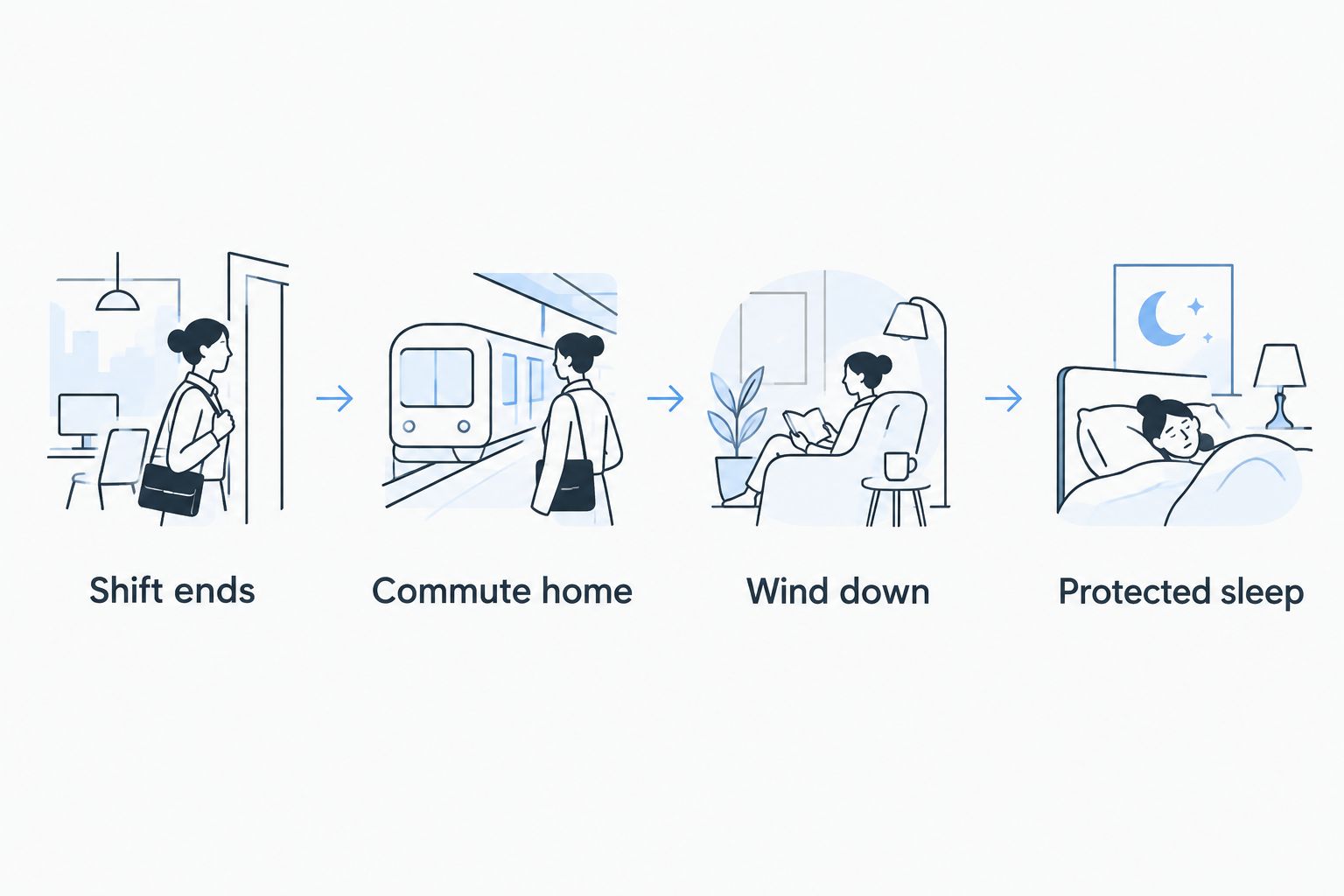
Keep the routine practical. A plan that depends on an elaborate preparation after an exhausting shift is harder to follow than one you can prepare beforehand.
- Shift ends: set a clear boundary between work and recovery.
- Commute home: arrange another way home if you are too sleepy to drive safely.
- Wind down: reduce interruptions and prepare your sleeping space.
- Protected sleep: agree on quiet hours with your household.
Separate alertness from wind-down
First, list your existing caffeine sources: coffee, tea, energy drinks and any stimulant-containing supplements. An “herbal” product is not automatically caffeine-free, and plant-derived caffeine still counts toward your routine.
NIOSH describes caffeine’s half-life as about 5–6 hours, with substantial variation between individuals. That explains why a drink near the end of your shift can still affect your intended sleep afterward. Do not treat that range as a guaranteed personal cutoff.
For a wind-down drink, start with a familiar caffeine-free beverage or plain water. If you want a botanical option, inspect the full ingredient list and follow the preparation instructions rather than assuming every herbal tea is suitable before bed.
Choose an ingredient for the period when you will use it—not because the package says “energy” or “calm.” Review your caffeine plan again whenever your shifts change in 2026.
- Write down the timing of every caffeinated drink.
- Check botanical beverages for caffeine-containing ingredients.
- Keep alertness products separate from your wind-down routine.
- Avoid trying an unfamiliar preparation before driving or safety-critical work.
Match the plant to a specific question
Use free, independent references before shopping. The NIH Office of Dietary Supplements fact sheet Ashwagandha: Is it helpful for stress, anxiety, or sleep? describes limited research suggesting benefits for some stress and sleep outcomes, while highlighting variation in preparations and unresolved safety questions.
That evidence does not establish ashwagandha as a solution to night-shift sleep disruption. A study of a particular extract also does not prove that a different liquid, capsule or combination produces the same result.
Herbal Goodness offers an ashwagandha root liquid extract. Treat it as a preparation to evaluate with a pharmacist or clinician, not as a proven night-shift aid. The product’s plant name alone cannot answer questions about the studied extract, dose or suitability for you.
Apply the same discipline to papaya leaf, soursop and mullein. Their presence in a wellness catalog does not establish a benefit for overnight alertness or daytime sleep. Traditional use explains historical interest in a plant; controlled human research addresses a different question.
- Define one goal before choosing an ingredient.
- Identify the plant and plant part on the label.
- Distinguish traditional use from human clinical evidence.
- Compare the research preparation with the product preparation.
- Reject claims that promise to replace sleep or medical care.
Review interactions before your first serving
Start with your medication list, not a shopping cart. Include prescriptions, nonprescription medicines and existing supplements, then ask a pharmacist to review the exact product label.
NCCIH’s Ashwagandha: Usefulness and Safety identifies important cautions, including pregnancy, thyroid and autoimmune conditions, interactions with several medicine classes, and reports of liver injury. It also notes possible drowsiness and gastrointestinal effects. Those cautions matter when your work involves vehicles, patients, machinery or other safety-sensitive tasks.
The screening principle applies beyond ashwagandha. “Organic” describes a production claim; it does not establish that a supplement is safe with your medication or appropriate during pregnancy.
For your 2026 review, bring photographs of the complete labels rather than a list of brand names. A reviewer needs the ingredients and serving instructions, particularly for multi-ingredient formulas.
Do not combine several new products simply because each carries a different wellness label. Different labels can conceal overlapping ingredients or risks.
- Show your pharmacist every active ingredient.
- Flag pregnancy, breastfeeding and planned surgery.
- Discuss liver, thyroid and autoimmune conditions where relevant.
- Ask specifically about sedation and work-safety implications.
- Do not discontinue prescribed medication to make room for an herb.
Choose a preparation you can use consistently
Try the manual approach first: compare labels side by side and write down plant, plant part, serving instructions and warnings. A tea requires brewing; a capsule requires swallowing; a liquid requires following its measuring instructions. Convenience is a format advantage, not evidence of a stronger benefit.
Herbal Goodness gives shoppers several botanical formats to compare. Its caffeine-free papaya leaf tea is a beverage option; its ashwagandha root liquid extract is a different plant and preparation. Neither should be selected solely because it fits in a work bag.
Check alcohol and other inactive ingredients on liquid labels when those details matter to you. Do not assume a liquid is alcohol-free or a capsule meets your dietary preferences without checking.
Ignore concentration shorthand as a shortcut to choosing a dose. Extract-ratio language does not, by itself, tell you whether a product matches a clinical study or is suitable for your routine.
- Compare the full label, not just the front panel.
- Choose a preparation that fits your break and home routine.
- Check inactive ingredients and dietary restrictions.
- Follow the product’s instructions rather than improvising servings.
- Keep the original packaging available for safety review.
Measure the routine instead of adding a stack
Begin with a simple written record of sleep timing, caffeine timing, meals and how alert you feel during work. You can do this without an app or supplement purchase.
If a clinician approves an optional supplement, avoid introducing several products together. Otherwise, you cannot clearly connect an unwanted effect—or a perceived improvement—to a particular change. Keep the rest of your routine as consistent as your rota allows.
NIOSH identifies short naps of 15–30 minutes as a fatigue-management option. Use workplace rules and allow time to recover alertness after waking; a nap is not permission to continue unsafe work when you remain sleepy.
For a 2026 routine review, persistent difficulty sleeping or excessive sleepiness deserves clinical assessment. Do not keep escalating products while the underlying schedule or a health concern remains unaddressed.
- Record intended sleep and actual sleep separately.
- Note caffeine timing alongside sleep difficulty.
- Record unwanted effects and stop experimenting when they occur.
- Reassess the routine when your rota changes.
- Seek care for persistent sleep problems or dangerous sleepiness.
Compare options by their actual purpose
The best option depends on the task: protecting sleep, choosing a beverage or reviewing a specific ingredient. The table separates those purposes rather than ranking unrelated herbs as interchangeable night-shift remedies.
For herbal supplements for night shift workers, the limitation column matters as much as the convenience column. No product format turns preliminary ingredient research into evidence for a particular shift-work outcome.
| Option | Best for | Practical advantage | Key limitation |
|---|---|---|---|
| Sleep, light and caffeine planning | Workers starting with the foundations | Addresses the schedule around work and recovery | Requires protection from household and workplace interruptions |
| Caffeine-free herbal tea | Shoppers wanting a noncaffeinated beverage | Fits a simple drinking routine | Caffeine-free does not mean clinically proven to improve sleep; ingredient suitability still matters |
| Ashwagandha root liquid extract | Shoppers whose clinician approves reviewing ashwagandha | Offers a liquid preparation of a named botanical | Exact-product night-shift benefits are not established by general ashwagandha research; safety screening is essential |
| Melatonin discussed with a clinician | Workers seeking advice about sleep timing | Allows a focused discussion about timing and suitability | Melatonin is a hormone, not an herb; incorrect timing and drowsiness require attention |
Apply the same standards in a retail or practitioner setting
Retailers and health practitioners should distinguish a product’s botanical identity from evidence for a customer’s specific need. Ask what the worker wants to address before discussing a preparation, and keep advice within your professional role.
For trade interest, request Herbal Goodness’s wholesale application. Wholesale purchasing does not change the evidence threshold: staff should not describe an herbal product as correcting circadian disruption, preventing fatigue-related mistakes or replacing clinical assessment.
Common mistakes night shift workers make
Taking a calming product before the commute
The drive home is still a safety-sensitive part of your day. Do not take an unfamiliar product associated with drowsiness before driving, and do not use another stimulant to justify driving while dangerously sleepy.
Choosing by clock time rather than intended sleep
“Morning” can mean the end of your workday, not the beginning. Organize your routine around work, wakefulness and intended sleep instead of copying a daytime worker’s supplement schedule.
Reading “energy” as evidence of restored sleep
An energy-related label does not demonstrate that a botanical reverses sleep loss. Review ingredients, caffeine content and evidence for the exact preparation instead of accepting the category name as an outcome.
Buying immune or detox bundles for fatigue
Papaya leaf, oregano oil and soursop are not interchangeable answers to tiredness. A bundle’s wellness positioning does not identify the cause of fatigue or establish suitability for overnight work.
Treating a better night as proof
Sleep changes with shift demands, caffeine, interruptions and other factors. A single improvement does not establish that a supplement caused it; compare the whole routine rather than immediately adding more ingredients.
FAQ
What are the best herbal supplements for night shift workers?
There is no single best herbal supplement for every night shift worker. Start with protected sleep and caffeine planning, then review a specific ingredient with a pharmacist or clinician if it matches a defined goal.
Is ashwagandha good for sleeping after a night shift?
Limited ashwagandha research suggests benefits for some sleep outcomes, but it does not establish effectiveness for daytime sleep after night work. Preparation differences, possible drowsiness and safety cautions require individual review.
Can I drink herbal tea after a night shift?
A caffeine-free herbal tea can fit an after-work beverage routine if its ingredients are appropriate for you. Check the label; herbal does not automatically mean caffeine-free or suitable with your medicines.
Is melatonin an herbal supplement?
Melatonin is a hormone, not an herbal supplement. Discuss timing and suitability with a clinician rather than treating it as interchangeable with herbal tea or plant extracts.
Can I take ashwagandha before driving home?
Do not experiment with ashwagandha before driving home because it can cause drowsiness. Ask a clinician or pharmacist about suitability and keep potentially sedating products away from safety-sensitive activities.
Do night shift workers need an immune or detox supplement?
Working nights does not automatically create a need for an immune or detox supplement. Choose products only for a clearly defined, appropriately reviewed purpose, not as compensation for lost sleep.
What should I ask before buying a botanical liquid extract?
Ask about the plant, plant part, complete ingredients, serving instructions and medication interactions. Confirm whether evidence concerns the same preparation rather than assuming all extracts of a plant are equivalent.
One last thing
Your supplement timing should follow your sleep plan, not the word “night” on your work schedule. Write your intended sleep time on your routine checklist before adding any botanical. That detail keeps an alertness choice from drifting into the period you are trying to protect for recovery.