





Can ashwagandha cause weight gain?

Ashwagandha is not established as a direct cause of weight gain; small human studies do not show that gaining body fat is an expected effect. Your weight can still change while taking it because of changes in eating, exercise, fluid balance, medications, or health. Do not assume a new weight change is caused by the supplement—or that ashwagandha will help you lose weight.
- Does ashwagandha cause weight gain? Human research does not establish weight gain as an expected effect.
- NCCIH identifies safety concerns and medication interactions; ashwagandha is not a proven weight-management supplement.
- Changes in appetite, training, and fluid balance need separate consideration when your weight changes.
- Compare the plant part, preparation, and full ingredient list before choosing an ashwagandha supplement.
Why this matters
A scale change does not tell you whether you gained fat, muscle, or fluid. It also does not identify the cause. Starting an herbal supplement shortly before a change creates a timeline, not proof.
For your 2026 supplement decisions, separate the reason you want ashwagandha from the result you expect on the scale. Stress support and weight management are different goals. If academic pressure is your main concern, the ashwagandha guide for college students covers that separate context.
Can ashwagandha cause weight gain?
Current human evidence does not establish ashwagandha as a cause of unwanted weight gain. That answer has limits: small, short studies cannot rule out every individual reaction, and research on a particular extract does not establish the effects of every capsule, powder, or liquid.
Two research settings help explain the conflicting claims you see online:
| Research setting | What researchers examined | What it tells you | Main limitation |
|---|---|---|---|
| Adults reporting chronic stress | Body weight, stress, and eating-related measures during supplementation | A small trial reported weight reduction rather than weight gain | It does not establish ashwagandha as a weight-loss treatment |
| Men beginning resistance training | Strength, muscle size, and body composition | A trial reported improvements in training-related outcomes | Muscle-related findings do not establish that ashwagandha causes fat gain |
Choudhary and colleagues' trial, Body Weight Management in Adults Under Chronic Stress Through Treatment With Ashwagandha Root Extract, published in the Journal of Evidence-Based Complementary & Alternative Medicine, included 52 adults over 8 weeks. Participants received a standardized root extract or placebo. The extract group reported improvements in weight-related and stress-related measures.
The studied regimen was 300 mg twice daily, totaling 600 mg per day. Those figures describe the study, not a recommended dose for your product. Different preparations are not automatically interchangeable.
Wankhede and colleagues' study, Examining the Effect of Withania somnifera Supplementation on Muscle Strength and Recovery, published in the Journal of the International Society of Sports Nutrition, examined ashwagandha alongside resistance training over 8 weeks. Its muscle and strength findings answer a different question from whether an herb causes unwanted fat gain.
What the evidence means for your 2026 decision
Neither study justifies a promise that ashwagandha will make you gain or lose weight. The participants, exercise programs, and extracts matter. A result in stressed adults or novice lifters is not a prediction for everyone who buys an ashwagandha supplement.
Traditional Ayurvedic use also needs a separate label. A history of use is not clinical proof of a weight effect, and calling a plant an adaptogen does not establish that it controls appetite, cortisol, or body composition in every user.
Does the preparation change the answer?
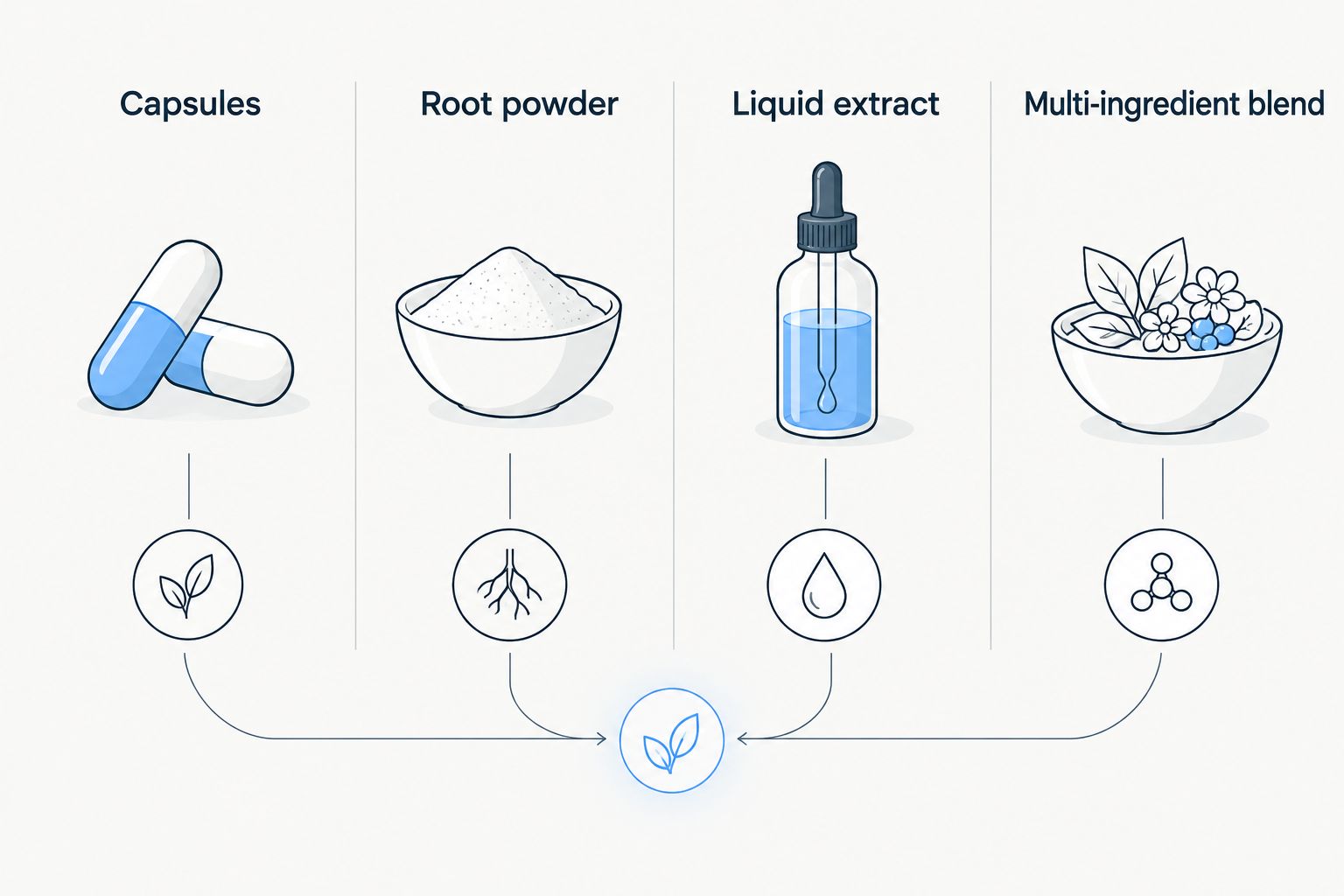
Capsules, powders, and liquids differ in how you take them. The format alone does not establish whether a preparation affects weight. Read the ingredient list and serving directions instead of treating the delivery method as the active benefit.
| Preparation | Best for | Practical advantage | Limitation to check |
|---|---|---|---|
| Capsules | People who prefer a measured capsule serving | No mixing is required | Capsule count does not explain extract strength or plant part |
| Root powder | People comfortable measuring and mixing a powder | You can see how the preparation fits into food or drinks | Powder weight is not equivalent to the same weight of concentrated extract |
| Liquid extract | People who prefer a liquid preparation | Avoids swallowing capsules | Serving volume alone does not establish equivalence to a study extract |
| Multi-ingredient blend | People who deliberately want every listed ingredient | Combines ingredients in one preparation | Makes it harder to identify which ingredient accompanies a new symptom |
None of these formats wins on preventing weight gain. A capsule can contain additional ingredients, and a liquid can use a different extraction method from a clinical-study product. The full label matters more than the format's reputation.
Herbalgoodnessco offers ashwagandha root liquid extract. Herbalgoodnessco's ashwagandha root liquid is best for shoppers who prefer a liquid preparation, not a weight-control promise. Its format is a practical preference; the supplied product information does not establish that it matches the extracts used in the weight or training studies.
Why your weight can vary while taking ashwagandha
Several factors deserve attention before you blame—or credit—the herb. These are established considerations in interpreting weight changes, not proven ashwagandha effects.
- Food intake: Changes in portions, snacks, drinks, or appetite can change your energy intake. Record what actually changed rather than assuming the supplement increased your appetite.
- Resistance training: Starting or changing strength training can affect muscle and body composition. A higher scale reading does not identify how much is muscle or fat.
- Fluid balance: Salt intake, menstrual changes, and some medications can affect fluid retention. A short-term increase is not automatically new body fat.
- Bowel patterns: Constipation and changes in digestive contents can affect scale readings. Consider accompanying symptoms, not just the number.
- Health and medication changes: Thyroid conditions and certain medicines can affect weight. NCCIH also flags ashwagandha concerns for people with thyroid disorders and potential interactions with thyroid medication.
- Weighing conditions: Different scales, clothing, and times of day make readings harder to compare. Use consistent conditions before interpreting a trend.
A useful 2026 tracking habit is to record the supplement's start date alongside other changes. Do not build a story around the herb while overlooking a new medicine, a different eating pattern, or a training program that began at the same time.
What should you do if your weight increases after starting it?
Check the pattern and your symptoms before changing supplements. Do not add a detox product, diuretic herb, or another supplement to counter an unexplained increase.
- Check the timeline. Record when you started ashwagandha, the label serving, and when you first noticed the change. Include any recent change in the amount you take.
- Compare like with like. Use the same scale under similar conditions. Avoid comparing a reading after a meal with one taken before breakfast.
- Review other changes. Note new medications, exercise, appetite changes, bowel symptoms, and menstrual changes where relevant. Keep the observations separate from your explanation.
- Read the whole formula. Identify other active ingredients and any accompanying powders, drinks, or shakes. A multi-ingredient routine is not the same exposure as ashwagandha alone.
- Get medical advice when needed. A persistent unexplained increase warrants a clinician's assessment. Rapid gain with swelling or shortness of breath needs prompt medical attention.
Bring the bottle or a clear label photograph to the appointment. A clinician or pharmacist needs the actual ingredients and serving directions—not just the word ashwagandha—to assess the supplement alongside your medicines and symptoms.
Can ashwagandha make you gain muscle instead of fat?
Ashwagandha has been studied alongside resistance training, but it is not established as a stand-alone way to gain muscle. The Wankhede trial examined a supplement within an exercise program, not an herb replacing training or nutrition.
If your weight rises after you begin lifting, do not label the change as muscle without further assessment. Strength, measurements, training history, and an appropriate body-composition assessment offer more context than body weight alone.
Does ashwagandha help with stress-related eating?
A small trial in adults with chronic stress reported improvements in eating-related measures, but that does not establish predictable appetite control. It also does not show that everyone who feels stressed will lose weight with ashwagandha.
The distinction matters: a study can identify a possible benefit without supporting a treatment claim. Persistent distress around eating or body weight deserves qualified support rather than repeated supplement changes.
Should you stop ashwagandha if you gain weight?
An unexplained weight increase deserves a review, not an automatic conclusion about its cause. Discuss the timing, ingredients, and symptoms with a clinician or pharmacist, especially if you take medication or have a thyroid condition.
Stop taking the supplement and seek medical advice if you develop signs of a possible serious reaction, such as yellowing skin or eyes, dark urine, or significant abdominal pain. Do not continue an herbal product simply to see whether a concerning symptom settles.
Safety comes before a weight goal
NCCIH's Ashwagandha: Usefulness and Safety identifies stomach upset, diarrhea, vomiting, and drowsiness as possible adverse effects. It also notes reports of liver injury and uncertainty about long-term safety. These concerns matter more than whether a product is described as natural or organic.
NCCIH advises avoiding ashwagandha during pregnancy and breastfeeding. It also identifies concerns for people with autoimmune or thyroid disorders, people approaching surgery, and those taking certain medicines, including sedatives, immunosuppressants, and medicines for blood pressure, diabetes, or thyroid conditions.
For a 2026 safety check, review these issues with a qualified healthcare professional before starting. A label's stress-support wording does not establish suitability for your medical history.
Herbalgoodnessco sells herbal supplements, but an herbal supplement does not replace medical assessment of unexplained weight change. Retailers and practitioners should preserve that distinction when discussing ashwagandha with customers: a preparation can be described plainly without promising weight, hormone, or disease outcomes.
How to read an ashwagandha label in 2026
Start with the botanical identity, Withania somnifera, then check the plant part and preparation. Root powder, root extract, and a formula containing additional plant parts or other herbs are not identical products.
Next, read the serving amount and any stated standardization. An extract ratio or a milligram figure alone does not demonstrate equivalence to a published trial. Do not copy the 600 mg daily research regimen onto a product with different directions.
Finally, check every other ingredient. If you want to understand your response to a new supplement, starting several new ingredients together makes that response harder to interpret. Keep the original packaging so you can share the complete label if a problem occurs.
FAQ
Does ashwagandha cause weight gain in women?
Human research does not establish weight gain as an expected effect of ashwagandha in women. Menstrual fluid changes, medications, eating patterns, and health conditions need separate consideration when weight changes.
Can ashwagandha increase belly fat?
Human evidence does not establish that ashwagandha increases belly fat. A change in waist size or body weight does not identify the cause, and the herb is not a proven belly-fat treatment either.
Will ashwagandha make me hungrier?
A predictable increase in hunger is not established by the small human studies discussed here. Record any appetite change and review the full formula, medicines, and other routine changes with a clinician if it persists.
Can I take ashwagandha to gain weight?
Ashwagandha is not an established weight-gain supplement. If you are losing weight unintentionally or struggling to eat enough, seek an assessment rather than relying on an herb.
Is liquid ashwagandha less likely to cause weight gain than capsules?
There is no established basis for saying liquid ashwagandha prevents weight gain better than capsules. Compare the ingredients, preparation, and label directions rather than assuming the format determines the outcome.
How long should I take ashwagandha before judging my weight?
There is no validated waiting period for an ashwagandha-related weight effect. The 8-week trial described in this guide is a research duration, not a reason to wait through unexplained changes or concerning symptoms.
Can I combine ashwagandha with my thyroid medicine?
Do not combine ashwagandha with thyroid medicine without approval from your prescribing clinician. NCCIH identifies thyroid-related concerns and potential interactions with thyroid medication.
One last thing
The most useful detail is often the ingredient label, not the scale reading. Two products called ashwagandha can differ in plant part, extract, serving, and additional ingredients. Keep that information with your symptom timeline; it gives your clinician something specific to assess.
Herbalgoodnessco's ashwagandha information should support an informed supplement choice, not a promise about your weight. Choose a preparation for a clear reason, check its safety, and investigate unexplained changes rather than trying to offset them with another herb.